1 / 1
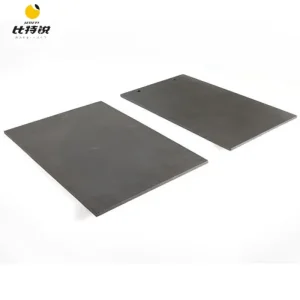
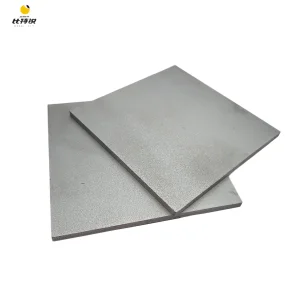
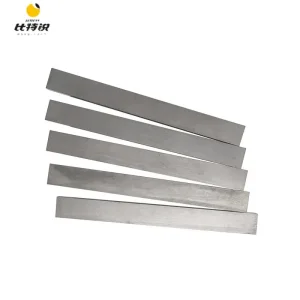
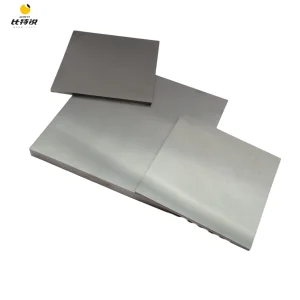
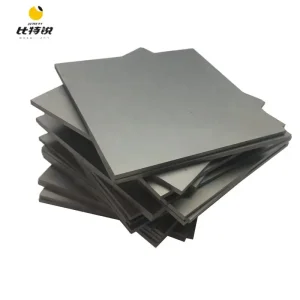
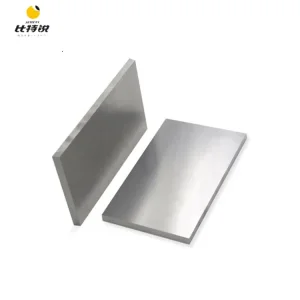
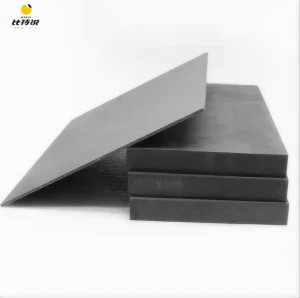
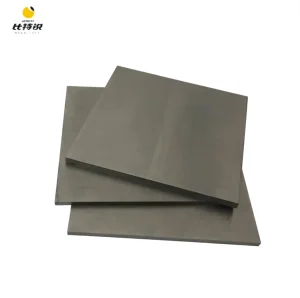
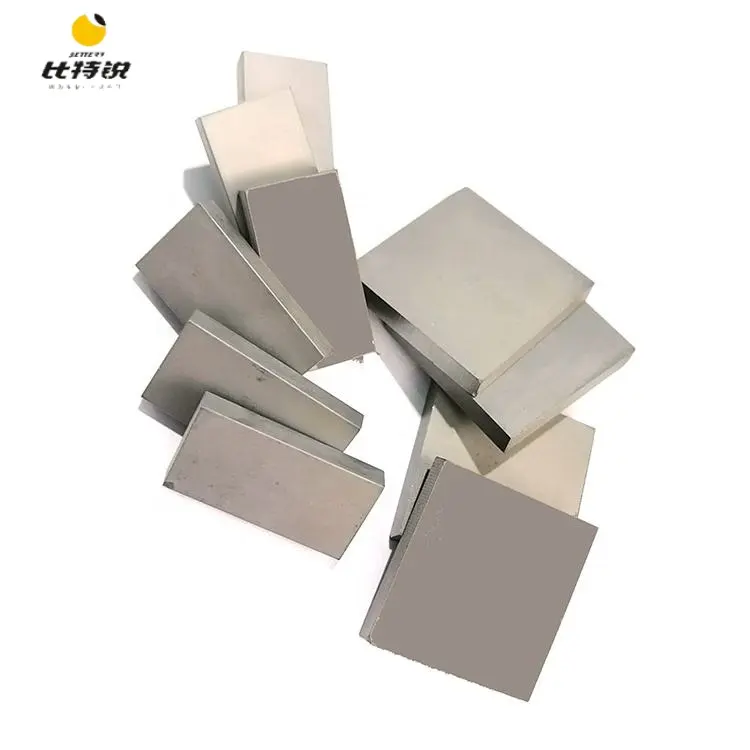
Buy Tungsten Carbide Plate HIP-Sintered Wear-Resistant Flat Blanks in YG6–YG20 Grades Supplier, Suppliers
Product Description
Main Specifications
| Parameter | Value |
|---|---|
| Material | WC-Co cemented carbide, 100% virgin powder; WC-Ni non-magnetic grades on request |
| Available grades | YG6, YG6X, YG8, YG8C, YG11, YG11C, YG15, YG15C, YG20, YL10.2 |
| Standard plate sizes | 100×100, 105×105, 150×150, 200×200, 300×160, 300×300 mm |
| Thickness range | 2 – 70 mm |
| Hardness | HRA 85.5 – 92.5 (grade dependent) |
| Density | 13.5 – 14.95 g/cm³ |
| Transverse rupture strength | 2,000 – 2,850 N/mm² |
| Blank tolerance | 0 ~ +1.0 mm (100 mm class) to 0 ~ +4.0 mm (300 mm class) |
| Ground / polished tolerance | ±0.02 mm / ±0.01 mm; flatness and parallelism to drawing |
| Surface finish | Sintered blank · semi-ground · mirror polished (Ra ≤ 0.2 µm) |
| Edge condition | As-sintered, chamfered or ground square |
| Non-magnetic option | Nickel-bonded YN series for magnet-forming and EDM applications |
Size and Tolerance Table
| Size L×W (mm) | Thickness (mm) | Blank tolerance — L / W | Blank tolerance — H | Polished tolerance |
|---|---|---|---|---|
| 100 × 100 | 2 – 50 | 0 ~ +1.5 mm | 0 ~ +1.0 mm | ±0.01 mm |
| 105 × 105 | 2 – 50 | 0 ~ +1.5 mm | 0 ~ +1.0 mm | ±0.01 mm |
| 150 × 150 | 2 – 50 | 0 ~ +2.0 mm | 0 ~ +1.5 mm | ±0.01 mm |
| 200 × 200 | 2 – 50 | 0 ~ +3.0 mm | 0 ~ +1.5 mm | ±0.01 mm |
| 300 × 160 | 7 – 25 | 0 ~ +4.0 mm | 0 ~ +2.0 mm | ±0.01 mm |
| 300 × 300 | 2 – 50 | 0 ~ +4.0 mm | 0 ~ +2.0 mm | ±0.01 mm |
Non-standard dimensions, round discs and irregular profiles are produced to drawing.
Grade Selection Chart
| Grade | Binder (wt %) | Density (g/cm³) | Hardness (HRA) | TRS (≥ N/mm²) | Best suited for |
|---|---|---|---|---|---|
| YG6 | 6 | 14.9 | 90.5 | 2,100 | Finishing tools, sealing rings, high-precision wear parts |
| YG6X | 6 | 14.95 | 92 | 2,000 | Fine grain; abrasive finishing and mirror-finish surfaces |
| YG8 | 8 | 14.8 | 89.5 | 2,200 | All-purpose cutting, pressing moulds, wear strips |
| YG8C | 8 | 14.7 | 88 | 2,300 | Coarse grain; impact wear parts, crusher components |
| YG11 / YG11C | 11 | 14.4 | 87.5 | 2,400+ | Milling inserts, heavy-impact cutting edges |
| YG15 / YG15C | 15 | 14.0 | 87 | 2,750 | Stamping dies, punch dies, nut-forming tooling |
| YG20 | 20 | 13.5 | 85.5 | 2,850 | Progressive dies and cold-heading, maximum toughness |
Surface Condition Options
| Condition | Tolerance | Surface roughness | Intended use |
|---|---|---|---|
| Sintered blank | +0.5 ~ +4.0 mm by size | As-sintered | Buyer finishes in-house; lowest plate cost |
| Semi-ground | ±0.05 – 0.1 mm | Ra ≤ 1.6 µm | Ready for wire-cut or EDM sectioning |
| Precision ground | ±0.02 mm | Ra ≤ 0.4 µm | Die assemblies, fixture mounting surfaces |
| Mirror polished | ±0.01 mm | Ra ≤ 0.2 µm | Direct assembly; precision stamping and forming |
Applications
Cutting tool blanks — inserts, blades and knives for machining cast iron, steel, stainless steel and non-ferrous alloys
Stamping, forming and progressive die segments for fastener and hardware production
Wire-EDM sectioning stock for punch inserts and EDM blocks
Wear parts — crusher jaws, wear strips, guide plates and scraper blades
Mould cavities, core inserts and powder-metallurgy tooling
Non-magnetic tooling for magnet and electronics manufacturing (YN grades)
Performance Advantages
HIP sintered — pore-free cross section, no hidden voids to become crack starters under impact
100% virgin raw material — consistent composition batch after batch
High wear resistance and bending strength — longer tool life between regrinds or replacements
Stable at elevated temperature — retains hardness where tool steel softens
Good machinability by grinding and EDM — sections cleanly without chipping when stress-relieved
Frequently Asked Questions (FAQ)
What raw materials are used in manufacturing these cemented carbide plates?
The plates are manufactured using 100% virgin WC-Co (tungsten carbide-cobalt) powder. For specialized applications requiring non-magnetic properties, such as magnet forming or electronics tooling, nickel-bonded WC-Ni (YN series) grades are also available.
How do I select the right grade for my application?
Grade selection depends on the required balance of hardness and toughness. Low-binder grades like YG6 and YG6X offer higher hardness (up to HRA 92) and wear resistance, making them ideal for finishing tools and wear components. Higher-binder grades like YG15, YG15C, and YG20 provide maximum transverse rupture strength and shock resistance for stamping dies, cold-heading, and progressive dies.
Can carbide plates be customized to non-standard dimensions?
Yes. While standard plate sizes range from 100×100 mm to 300×300 mm with thicknesses from 2 to 70 mm, non-standard dimensions, round discs, and irregular profiles can be custom manufactured according to customer drawings and specifications.
What surface finishes and tolerances are available?
Plates can be supplied in four surface conditions: sintered blanks (standard blank tolerance), semi-ground (±0.05–0.1 mm, Ra ≤ 1.6 µm), precision ground (±0.02 mm, Ra ≤ 0.4 µm), and mirror polished (±0.01 mm, Ra ≤ 0.2 µm). Flatness and parallelism can also be strictly controlled per drawing requirements.
What is the benefit of HIP (Hot Isostatic Pressing) sintering?
HIP sintering subjects the material to uniform high pressure and temperature simultaneously, creating a fully dense, pore-free cross section. This eliminates internal micro-voids that could act as crack initiation sites under heavy impact or cyclic mechanical stress.