

Engineered Carbide Plates & Blanks Portfolio
Explore precision-sintered flat blanks, ultra-dense wear plates, and EDM tooling blocks engineered with 100% virgin raw materials.

Buy Premium Bright Surface Tungsten Heavy Alloy Sheets & Pure Tungsten Plates for Industrial Applications Manufacturer, Factories
Configure & Inquire
China High-Quality Tungsten Carbide Strips - Durable Cemented Wolfram Bars Supplier, Suppliers
Configure & Inquire
Wholesale Premium Tungsten Carbide Sheet for Stamping Dies Durable P30 Alloy Model 200x200x10mm Manufacturers, Suppliers
Configure & Inquire
China OEM Customizable HIP Processed Square Tungsten Carbide Plate, Polished Flat Blank for Industrial Cutting Tools Manufacturer, Factories
Configure & Inquire
China Tungsten Carbide Plate | OEM Wear-Resistant Cemented Carbide Blank for Tooling & EDM Manufacturers, Supplier
Configure & Inquire
Wholesale Tungsten Carbide Plate 100×100×60 mm — Thick Block Stock for EDM, Die & Wear Parts Manufacturers, Suppliers
Configure & Inquire
Wholesale Customized Cemented Carbide Plate — Factory-Direct Tungsten Carbide Blanks in Any Size, Shape & Grade Factory, Factories
Configure & Inquire24+
Years Sintering Experience
5,000 m²
Precision Production Base
< 8h
Engineering Feasibility Cycle
100%
Virgin Refined Powder Purity
Next-Generation Tungsten Carbide Plate Developments
Strategic evolution in global tooling demands material performance far beyond conventional standards. The shift focuses on microstructural integrity, extended mean time between maintenance (MTBM), and chemical resistance.
Sub-Micron & Nano WC Formulations
Modern progressive stamping dies and semi-conductor lead frame tooling demand sub-micron (0.4–0.8 µm) tungsten carbide matrices. By strictly controlling grain growth inhibitors (VC, Cr3C2), our factory creates carbide plates achieving hardness ratings of HRA 92.5+ while avoiding micro-chipping under cyclic impact.
Overpressure Sinter-HIP Integration
Traditional vacuum sintering leaves microscopic voids (A04/B02 classes) that cause premature crack propagation under severe EDM processing. We employ high-pressure Sinter-HIP cycles (up to 100 bar at 1450°C), eliminating metallurgical microporosity down to zero, guaranteeing exceptional transverse rupture strength (TRS > 3200 MPa).
Corrosion & Non-Magnetic Adaptability
Downhole directional drilling (MWD/LWD) and automated magnetic sensor production demand carbide plates free from ferromagnetic interference. By replacing or alloying standard cobalt binders with targeted nickel-chromium matrices, our plates exhibit zero magnetic response while resisting abrasive acidic/alkaline slurries.
Global Procurement Architecture & Lifecycle Efficiency
Industrial procurement teams in North America, Western Europe, and Asia-Pacific are transitioning from initial purchase price models to Total Cost of Ownership (TCO) assessments in carbide stock purchasing.
Tooling Longevity vs. Downtime Costs
For stamping plants, press downtime to switch out worn die sections costs thousands of dollars per hour. High-cobalt impact plates (e.g., YG15 to YG20) provide optimal balance against edge chipping, providing 400% extended tool longevity compared to low-tier generic market blanks.
EDM Machinability & Stress Relief
Low-grade plates possess internal residual stress that distorts parts during wire electrical discharge machining (WEDM). Zhongfu employs precision stress-relief annealing to ensure cut tolerances remain within ±0.002 mm without unpredictable warping or microcracking.
Near-Net Shape Raw Blank Economics
Diamond wheel grinding is cost-prohibitive. By providing customized net-shape plates with engineered allowances (0.5 mm–1.0 mm), we drastically minimize our clients’ post-sinter machining time, electrical consumption, and grinding consumable expenses.
Regulatory Traceability & Ethics
Global supply chains demand Conflict-Free Smelter Initiative (CFSI) compliance. We source 100% verified virgin APT (Ammonium Paratungstate) concentrate from deep domestic tungsten mines, guaranteeing full chemical traceability and eliminating unverified recycled scrap variables.
Industry 4.0: Metallurgical Precision in Nanchang, Jiangxi
Located at the focal point of the world's primary tungsten deposits, Jiangxi Zhongfu integrates cutting-edge automation, digital furnace controls, and stringent process monitoring to ensure supply chain resilience.
Upstream Mineral Dominance
Direct supply line synergy with premier Jiangxi tungsten mining complexes ensures uncompromised raw material access even during volatile global pricing, preventing raw material allocation shortages and delivery bottlenecks for international partners.
Computerized Multi-Axis Pressing
Equipped with hydraulic and servo powder pressing units up to 500 tons, our factory maintains density variance below 0.02 g/cm³ across expansive plate blanks (up to 300 mm x 300 mm), mitigating uneven shrinkage rates throughout heat treatment.
Real-Time Microstructural Telemetry
Every sintered batch undergoes carbon balance monitoring (magnetic saturation and coercive force verification) and metallographic micro-imaging to guarantee complete avoidance of brittle eta (η) phases and detrimental uncombined free graphite.
Technical Matrix: Grade Formulations & Real-World Engineering
Select the optimal tungsten carbide plate grade based on operating stress, abrasive environment, and machining requirements.
| Alloy Grade | Cobalt / Binder (%) | Grain Size (µm) | Density (g/cm³) | Hardness (HRA) | TRS (N/mm²) | Target Industrial Application |
|---|---|---|---|---|---|---|
| YG6 (ISO K10-K20) | 6.0% Co | 1.2 – 1.6 | 14.85 – 15.00 | 90.5 – 91.5 | ≥ 2000 | High wear plates, non-ferrous metal slicing, ceramic tile molds. |
| YG8 (ISO K20-K30) | 8.0% Co | 1.4 – 2.0 | 14.60 – 14.80 | 89.5 – 90.5 | ≥ 2400 | Brazed wear shoes, wood profiling knives, light stamping die inserts. |
| YG15 (ISO K40) | 15.0% Co | 1.8 – 2.4 | 13.90 – 14.15 | 87.0 – 88.0 | ≥ 3000 | Progressive stamping dies for silicon steel, heavy blanking punches. |
| YG20 (High-Impact) | 20.0% Co | 2.0 – 3.0 | 13.40 – 13.65 | 85.0 – 86.5 | ≥ 3400 | Cold heading dies, fasteners forming plates, high-shock EDM blocks. |
| ZF-Ni10 (Non-Magnetic) | 10.0% Ni | 1.2 – 1.8 | 14.40 – 14.65 | 88.5 – 89.5 | ≥ 2200 | Magnetic powder compacting, MWD directional exploration, chemical seals. |
| P30 / YW2 Alloy | 8.5% (Co+TaC+TiC) | 1.6 – 2.2 | 12.80 – 13.10 | 90.0 – 91.0 | ≥ 2200 | Sheet metal stamping, scarfing knives, stainless steel forming. |
Frequently Asked Technical & Procurement Inquiries
In-depth metallurgic and commercial insights for engineering teams and supply chain leaders evaluating carbide plate sourcing.
How do you eliminate internal defects in large, thick carbide blocks?
Thick blocks (e.g., 100x100x60mm) are prone to thermal and density gradient cracks during dewaxing and liquid-phase sintering. We apply ultra-slow ramp vacuum dewaxing followed by high-pressure Sinter-HIP processing (up to 100 bar Ar gas) to ensure homogenous grain distribution and pore-free internal structures across the entire cross-section.
Can your carbide plates be machined directly with Wire EDM without cracking?
Yes. Low-grade plates undergo severe thermal shock during wire cutting due to residual binder stresses, which causes hairline cracking. Our plates undergo specialized stress-relief thermal annealing cycles after HIP sintering. Furthermore, using sub-micron or corrosion-resistant grades mitigates cobalt leaching caused by deionized dielectric water.
What parameters determine selecting YG6 vs YG15 vs YG20 for dies?
Cobalt percentage drives the trade-off between hardness and impact resistance. YG6 (6% Co) provides ultra-high hardness (HRA 90.5+) suitable for wear strips and paper/film slicing without impact. YG15 (15% Co) excels in motor core stamping dies. YG20 (20% Co) provides high fracture toughness (TRS > 3400 N/mm²) to withstand dynamic shock in cold heading and heavy sheet stamping.
What quality documentation and testing reports accompany export shipments?
Each production run includes a complete Certificate of Analysis (COA) containing metallographic test results: specific density (Archimedes method), Rockwell HRA hardness, coercive force (Hc), magnetic saturation (4πσ), and microstructural porosity ratings under 100x/500x magnification.
How does virgin WC powder compare to reprocessed/reclaimed powder?
Reclaimed powder (zinc-recycled or acid-leached scrap) introduces uncontrolled trace impurities (Fe, Cr, Ni, Ca) that lead to metallurgical inclusions, inconsistent hardness pockets, and premature microfracturing during high-speed stamping. Zhongfu exclusively uses 100% virgin crystal-refined APT-derived tungsten carbide powders.
What custom dimensions, tolerances, and surface finishes are achievable?
We supply unground/sintered blanks (tolerances +0.5/+1.0 mm) as well as diamond surface ground and mirror-polished plates up to 300 mm length/width. Achievable tolerances reach Ra 0.05 µm for mirror polish, parallelism within 0.005 mm, and flatness within 0.003 mm across tool surfaces.
Specialized Inserts, Wear Parts & Precision Components
Complementary tungsten carbide components manufactured to international industrial standards, including scarfing inserts, non-magnetic pins, and heavy-duty cutting tools.
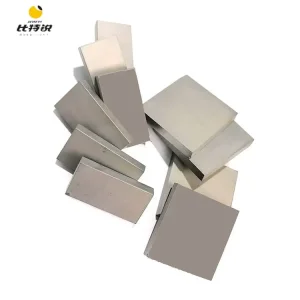
Buy Tungsten Carbide Plate HIP-Sintered Wear-Resistant Flat Blanks in YG6–YG20 Grades Supplier, Suppliers
Configure & Inquire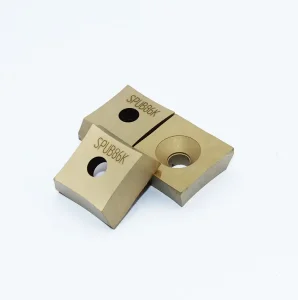
Wholesale Carbide scarfing inserts SPUB86B/86C/86D/86E/86F/86G/86H/86K/86M Manufacturers, Factories
Configure & Inquire
Buy 1*1*0.375“ CVD coating tungsten carbide tube scarfing insert Supplier, Factory
Configure & Inquire
Buy Wholesale tungsten non-magnetic cemented carbide wear parts Supplier, Suppliers
Configure & Inquire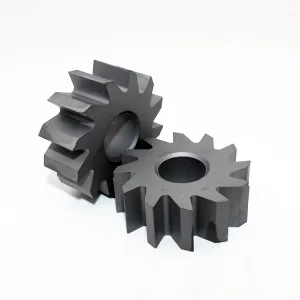
Buy Customize good quality precision metal parts spur gear tiller cultivator parts back gear Manufacturer, Manufacturers
Configure & Inquire
Wholesale Cemented carbide metal insert_cutting_tool SPUB86B/86C/86D/86E/86F/86G/86H/86K/86M Manufacturers, Factory
Configure & Inquire
China Wholesale customized high precision hard alloy tungsten carbide cutting tool wear parts Suppliers, Factory
Configure & Inquire