
High-Precision Indexable Inserts & Blanks (Catalog Tier I)
Explore standard and non-standard indexable inserts manufactured directly from virgin ammonium paratungstate (APT) powder blends with optimal cobalt distribution.






Sinter-HIP Densification & Binder-Phase Phase Control
A rigorous metallurgical overview of grain-boundary engineering, eta-phase (Co3W3C) prevention, and mechanical integrity in tungsten carbide (WC-Co) indexable inserts.
Sub-Micron vs. Coarse Grain
Tungsten carbide inserts derive their hardness and toughness balance from WC grain size distributions ranging from ultra-fine (0.2–0.5 µm) for precision titanium finish profiling, to coarse grains (3.0–5.0 µm) designed for high-impact interrupted railway bar peeling.
Pressure Sintering (10 MPa)
Utilizing high-vacuum overpressure sintering furnaces operating at 1,450°C under 60–100 bar pure Argon atmosphere, eliminating micro-porosities (ISO rating < A02/B02) and dramatically advancing transverse rupture strength (TRS > 3,800 N/mm²).
Eta-Phase Mitigation
Precise stoichiometry of carbon levels prevents brittle ternary η-phase (Co3W3C / Co6W6C) precipitation while suppressing free carbon inclusions. This delivers thermal crack resistance in heavy-load high-feed roughing operations.
Virgin Powder Purity Guarantee
Unlike lower-tier refabricators that integrate reclaimed scrap powder containing unregulated trace contaminants (such as Fe, Cr, and Si) which degrade hot-hardness, Jiangxi Zhongfu guarantees 100% pure virgin tungsten monocarbide and spherical extra-fine cobalt binders.
Sector-Specific Industrial Cutting Solutions
Overcoming material hardness thresholds, thermal deformation, work hardening, and intermittent mechanical shock in high-throughput manufacturing.
Aerospace & HRSA Alloys
For Inconel 718, Waspaloy, and Ti-6Al-4V turning. Features sharp positive rakes, low chemical affinity PVD-TiAlN/AlTiN nano-coatings, and razor micro-honed cutting edges that suppress notch wear and work-hardening zone formation.
Automotive & EV Machining
Tailored for high-speed machining of Compacted Graphite Iron (CGI) engine cylinder bores, brake rotors, and hypereutectic aluminum-silicon battery casings using high-thermal-conductivity grade substrates and ultra-smooth CVD Al2O3 stacks.
Heavy Rail & Slab Scarfing
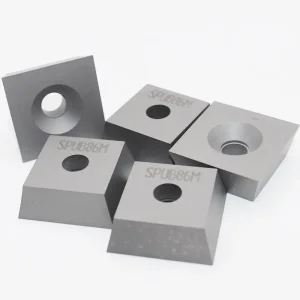
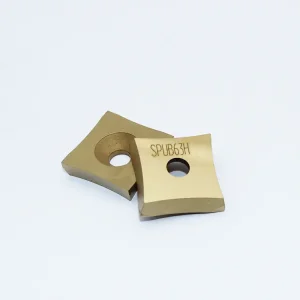
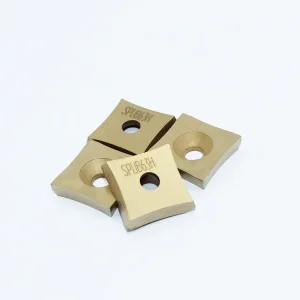
Heavy-duty turning inserts like SPUB86, SPUB63, and SNMX25 engineered to withstand extreme depths of cut (ap > 12mm) and heavy thermal shocks encountered during continuous billet conditioning and continuous rail re-profiling.
Jiangxi Supply Chain Resilience & Modern Production Lines
Harnessing regional tungsten reserves, vertical integration from ore to insert, and automated inspection to deliver unmatched lead-time predictability.
The Jiangxi Tungsten Cluster
Situated in Nanchang, Jiangxi, the world's most concentrated tungsten mining hub. Direct refinery integration shields our international OEM partners from geopolitical resource disruptions and sharp market price volatility.
CNC Multi-Axis Presses
Equipped with high-precision Dorst and Osterwalder multi-axial CNC presses providing uniform compaction densities across complex multi-tiered chipbreakers, mitigating distortion during liquid phase sintering.
Automated Visual Inspection
100% vision-guided 3D coordinate coordinate-measuring systems (CMM) and laser profile scanners verifying hone radii (K-factor, 15–50 µm), thickness, and nose radii consistency across multi-thousand-piece export batches.
Industrial Grade Selection Matrix & Cutting Parameters
Reference data for metallurgical composition, physical properties, ISO application classification, and recommended baseline cutting speeds.
| ISO Group | Grade Designation | Binder (Co/Ni %) | Density (g/cm³) | Hardness (HRA) | TRS (N/mm²) | Coating Architecture | Rec. Vc (m/min) | Target Workpiece |
|---|---|---|---|---|---|---|---|---|
| ISO P10–P25 | ZF-P20C | 7.5% Co | 14.65 | 91.8 | 2,650 | CVD Multi-Layer TiCN + Al2O3 + TiN | 180 – 320 | Carbon steel, alloy steel, high-feed turning |
| ISO P30–P40 | ZF-P35R | 9.5% Co | 14.30 | 89.6 | 3,100 | CVD Thick TiCN + Alpha-Al2O3 | 120 – 220 | Heavy interrupted cuts, roughing steel castings |
| ISO M15–M30 | ZF-M25U | 8.0% Co | 14.50 | 91.2 | 2,950 | PVD Nano-composite TiAlSiN | 140 – 240 | Austenitic & duplex stainless steel milling |
| ISO K05–K20 | ZF-K10H | 6.0% Co | 14.95 | 92.5 | 2,400 | PVD Super-lattice TiAlN or Uncoated | 200 – 400 | Grey cast iron, nodular iron, chill roll peeling |
| ISO S10–S25 | ZF-S15A | 10.0% Co (Ultrafine) | 14.40 | 92.0 | 3,400 | PVD High-Al AlTiN + CrN | 35 – 85 | Inconel 718, Hastelloy, Titanium alloys |
| ISO H05–H15 | ZF-H10X | 4.5% Co (Sub-micron) | 15.10 | 93.5 | 2,200 | PVD AlCrSiN Nano-Structure | 80 – 160 | Hardened steel (HRC 45–62), mold tooling |
| Special / Wear | ZF-NM12 (Non-Mag) | 10.0% Ni | 14.60 | 89.0 | 2,500 | Uncoated / Passivated Mirror Polish | N/A (Wear) | MWD downhole parts, magnetic punch dies |
Total Cost of Ownership (TCO) vs. Unit Price Optimization
How top global manufacturing enterprises maximize machining margins by balancing cycle times, edge reliability, and tool turnover rates.
The True Machining Cost Ratio
Cutting tools represent only 3% to 5% of total plant overhead, yet influence up to 40% of overall cycle efficiency. Purchasing low-grade inserts that trigger premature chipping elevates downtime costs far beyond initial purchasing savings.
Edge Life Repeatability
By enforcing narrow standard deviations in edge honings (within ±3 µm), Zhongfu inserts provide predictable tool wear curves. This enables automated lights-out CNC shifts to perform scheduled indexes with zero unexpected catastrophic failures.
OEM Customization Agility
We deliver tailored chipbreaker geometries, modified nose chamfers, and customized Wiper flats from customer DXF/STEP files with production prototypes dispatched in under 15 working days.
Nanostructured PVD & Medium-Temperature CVD Coatings
Overcoming the extreme friction interface and high-temperature thermal loads (>1,000°C) occurring at the tool-chip interface.
HiPIMS Magnetron Sputtering
High-Power Impulse Magnetron Sputtering (HiPIMS) produces ultra-dense, droplet-free nano-coatings with superior adhesion, low residual stress, and high crack deflection thresholds in intermittent cuts.
MT-CVD Layer Systems
Medium-Temperature Chemical Vapor Deposition (MT-CVD) synthesizes columnar TiCN alongside oriented α-Al2O3 films, establishing an impermeable thermal shield against catastrophic thermal plastic deformation.
Edge Honing & Polishing
State-of-the-art wet blast polishing and brush micro-finishing remove surface droplets and micro-burrs from rake faces, dramatically decreasing cutting forces and friction coefficient (μ < 0.25).
R&D Horizons: Next-Generation Cutting Tool Innovations
Pioneering advancements in additive manufacturing, sensor integration, and eco-friendly binder phases shaping the next decade of metal machining.
Additive Binder Jetting
Developing 3D binder jetting technologies for tungsten carbide geometries with optimized internal conformally-cooled channels, delivering cryogenic fluid directly to the micro-cutting zone.
Cobalt-Free Green Binders
Investigating environmentally friendly, non-carcinogenic iron-nickel-chromium (Fe-Ni-Cr) intermetallic binder networks to replace cobalt binders while maintaining superior hot-corrosion endurance.
Global Compliance, Conflict-Free Minerals & ESG Commitment
Ensuring complete ethical transparency, global trade conformity, and dedicated technical assistance across key manufacturing hubs.
RMI & OECD Compliance
Our raw material procurement strictly follows Responsible Minerals Initiative (RMI) protocols, guaranteeing that 100% of our tungsten monocarbide originates from verified conflict-free ethical sources.
Localized Engineering Support
With engineering teams answering inquiries within 8 hours, we supply full CAD/CAM recommendations, FEA tool deflection simulations, and on-site troubleshooting for large tier-1 production lines.
Frequently Asked Questions on Tungsten Carbide Inserts
In-depth engineering answers addressing tool wear physics, grade cross-references, edge hone geometries, and global procurement questions.
How does Sinter-HIP technology influence the transverse rupture strength (TRS) of carbide inserts compared to conventional vacuum sintering?
Conventional vacuum sintering relies entirely on capillary liquid-phase forces, which frequently leaves sub-surface micro-voids (0.1–0.5% porosity) that act as crack initiation sites under cyclic mechanical shocks. Sinter-HIP applies 60 to 100 bar of high-purity Argon gas at peak sintering temperatures (around 1,450°C). This forces the molten cobalt binder to flow into remaining voids, closing interior porosities to under ISO A02/B02 standards and boosting TRS by 15% to 25%, crucial for interrupted milling cuts.
What causes micro-chipping versus crater wear on turning inserts, and how can cutting grades be adjusted?
Micro-chipping along the cutting line indicates mechanical fatigue or excessive vibration, commonly resolved by transitioning to a higher cobalt substrate (e.g., from an ISO P15 to P30 grade) or adopting an edge preparation hone (such as a 25–40 µm radius or T-land chamfer). Crater wear on the rake face is driven by chemical diffusion at elevated cutting speeds (>200 m/min). This is best countered by employing an MT-CVD Al2O3 coated grade with elevated TiC/TaC/NbC cubic carbide additions.
When should an engineer specify PVD coating over CVD coating for indexable milling inserts?
PVD coatings (AlTiN, TiAlSiN) are favored for sharp-edge finishing, interrupted milling, small-diameter boring, and processing sticky materials like titanium, Inconel, and austenitic stainless steels. PVD processes operate at 450–550°C, preserving compressive residual surface stress and keeping razor hone radii (5–15 µm). CVD coatings deposit at 900–1050°C, producing thicker thermal barriers (8–20 µm) with tensile residual stresses, better suited for high-speed, continuous rough turning of steels and cast irons.
What dimensional tolerances can Jiangxi Zhongfu achieve on custom carbide blanks and precision ground inserts?
For standard pressed and sintered (as-sintered) blanks, we routinely maintain ISO U and M class tolerances (±0.05 mm to ±0.13 mm depending on size). For precision perimeter profile-ground and top/bottom ground inserts, our CNC peripheral grinding machines (Agathon and Wendt systems) consistently hit ISO G and E classes (thickness within ±0.025 mm, nose height within ±0.013 mm, and hone radii controlled within ±3 µm).
How does the factory prevent cobalt leaching and degradation in high-pressure water-soluble coolant environments?
Standard cobalt binders can undergo electrochemical leaching in acidic coolants or prolonged exposure to high-pressure metalworking emulsions, creating premature binder loss and crumbling of WC grains. To counter this, Zhongfu utilizes specialized chemical inhibitors and tailored nickel-chromium-cobalt (Ni-Cr-Co) alloy binder systems that resist acid degradation and preserve mechanical edge stability in continuous wet CNC setups.
What is the lead time for standard export orders versus custom tool drawings?
Standard catalog insert configurations (such as standard CNMG, WNMG, DNMG, and SPUB series) are dispatched from existing factory inventories within 3 to 7 business days. For customized non-standard geometries or custom toolholder blanks requiring EDM pre-forms, green shaping, and special powder formulations, our typical engineering and prototype production window is 15 to 20 working days, with expedited express sampling options available.
Heavy-Duty, Scarfing & Specialized Inserts (Catalog Tier II)
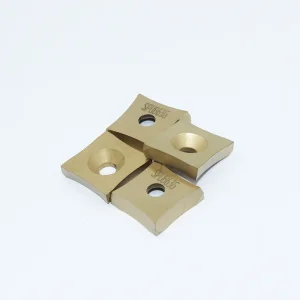
Explore high-impact SPUB63, SPUB86, round woodworking blades, and heavy-feed carbide solutions built for severe industrial environments.



Request Custom Grade Formulations & OEM Insert Quotations
Connect directly with our metallurgy and application engineering group. Send your 2D/3D part drawings or required ISO workpiece classifications for a comprehensive manufacturability review, grade matching, and competitive factory-direct pricing within 8 hours.