
Primary Precision Carbide Rods & Industrial Blanks Showcase
Directly manufactured from 100% virgin tungsten powder with high-pressure Sinter-HIP densification. Explore our core lineup of high-precision round rods, nano-grain tool blanks, wear bars, and heavy-duty inserts engineered for rigorous industrial duty.








Engineering Excellence: 24-Year Cemented Carbide Manufacturing Legacy
Jiangxi Zhongfu Cemented Carbide Co., Ltd. operates at the center of the world's primary tungsten resource cluster in Nanchang, Jiangxi. Controlling the entirety of the production cycle from raw ammonium paratungstate (APT) reduction and micronization to automated peg-ram extrusion, cold isostatic pressing (CIP), overpressure Sinter-HIP densification, and sub-micron h6 CNC centerless grinding, Zhongfu supplies engineering-grade carbide rods that meet strict dimensional and tribological constraints.
In high-speed CNC milling and micro-drilling, over 70% of premature cutting tool failures originate not from macroscopic friction wear, but from micro-voids, cobalt pooling, or abnormal grain growth (AGG) within the rod core. By combining patented wet-milling slurry stabilization with 10 MPa argon-atmosphere Sinter-HIP processing at 1,420°C, Zhongfu guarantees near-theoretical density (porosity class < A02, B00), eliminating catastrophic shank snap and micro-flaking along cutting flutes.
Modern Market Trends Reshaping Carbide Rod Manufacturing
The global demand for solid carbide round rods is transitioning rapidly away from generic multi-purpose grades toward highly specialized, application-tailored carbide formulations. Five structural macro drivers dictate modern manufacturing strategies:
1. Rise of Ultra-Precision Micro-Machining
Semiconductor test probe fabrication, printed circuit board (PCB) micro-drills (Ø0.05 mm – Ø0.3 mm), and medical 3C components require rods with grain sizes between 0.2 µm and 0.4 µm. Homogeneous cobalt dispersal is critical to prevent sub-micron runout and tool chatter during ultra-high RPM spindle operations (up to 200,000 RPM).
- Extruded micro-rods with mirror finish
- Grain boundary strengthening via VC/Cr3C2 inhibitors
2. Aerospace Composites & Superalloys
Machining carbon-fiber-reinforced polymers (CFRP), stacked titanium alloys (Ti-6Al-4V), and Inconel 718 requires extreme hot-hardness without sacrificing transverse rupture strength (TRS). Rod manufacturers must precisely formulate cobalt content between 6% and 10% to prevent rapid thermal softening under severe shear stresses.
- High hot-hardness > 92.5 HRA at room temp
- Thermal shock resistance during intermittent cutting
3. Internal Coolant Hole Complexity
High-feed deep-hole drilling (15×D to 30×D) has driven massive demand for solid carbide rods with helical internal coolant ducts (30° and 40° helix angles) as well as straight twin-hole configurations. Precision extrusion dies ensure frictionless flow of cutting fluid straight to the drill lip, extending tool life by 300%.
- Uniform pitch and concentricity along 330 mm lengths
- Smooth interior lumen preventing pressure drops
Global Enterprise Sourcing Priorities & TCO Analysis
When multinational cutting tool brands, tier-1 automotive suppliers, and aerospace toolmakers evaluate solid carbide rod manufacturers, direct per-kilogram acquisition cost accounts for less than 18% of the total economic calculation. Sourcing directors rely on these four foundational metrics:
1. Dimensional & Geometric Tolerancing
Rod roundness, cylindricity, and diameter tolerances (ISO h6 standard, optional h5) directly impact grinding wheel wear in CNC tool grinding centers (Rollomatic, Walter, ANCA). Inconsistent outer diameters force frequent wheel dressing, slowing cycle times.
2. Straightness & Core Runout
Total runout along standard 330 mm lengths must remain below 0.05 mm (or 0.02 mm for ultra-precision lines). Excessive rod camber induces centrifugal vibration during tool production and creates uneven flute geometry on finished end mills.
3. Batch-to-Batch Metallurgical Fidelity
A deviation of merely 0.3% in cobalt content or subtle changes in magnetic saturation (4πσ) can shift grinding behavior, causing micro-cracking during flute generation or altering the bonding adhesion of physical vapor deposition (PVD) coatings like AlTiN and TiAlSiN.
4. Total Cost of Ownership (TCO)
Premium virgin cemented carbide rods deliver 35% to 50% longer cutting life between regrinds. Fewer tool changes reduce machine downtime in automated manufacturing cells, proving vastly more cost-effective than cheaper, recycled-scrap alternatives.
Engineering Grade Matrix: WC-Co Structural Formulations
Selecting the correct cemented carbide rod grade requires balancing Rockwell hardness (HRA), transverse rupture strength (TRS), fracture toughness (K1C), and grain boundary chemistry. Below is Zhongfu's verified engineering grade specification for round rod blanks:
| Internal Grade | Binder (Co/Ni %) | Grain Size (µm) | Density (g/cm³) | Hardness (HRA / HV30) | TRS (MPa) | Primary Industrial Application |
|---|---|---|---|---|---|---|
| ZF-06UF (YG6X Class) | 6.0% Cobalt | 0.4 – 0.6 (Ultra-Fine) | 14.95 ± 0.10 | 93.2 HRA / 1750 HV | 3,800 | Hardened steel (≤ 55 HRC), grey cast iron, high-speed routing |
| ZF-08SM (YG8 Class) | 8.0% Cobalt | 0.6 – 0.8 (Sub-Micron) | 14.75 ± 0.10 | 92.4 HRA / 1620 HV | 4,100 | General purpose end mills, titanium alloy, aerospace drills |
| ZF-10NG (Nano Series) | 10.0% Cobalt | 0.2 – 0.4 (Nano-Grain) | 14.45 ± 0.10 | 92.8 HRA / 1680 HV | 4,400 | High-shear micro tools, graphite milling, abrasive composite routing |
| ZF-12H (Toughness Grade) | 12.0% Cobalt | 0.8 – 1.0 (Fine) | 14.25 ± 0.10 | 90.5 HRA / 1450 HV | 4,600 | Heavy roughing mills, intermittent cuts, shock-resistant punches |
| ZF-NM08 (Non-Magnetic) | 8.5% Nickel Binder | 0.8 – 1.2 (Sub-Micron) | 14.65 ± 0.12 | 89.8 HRA / 1380 HV | 3,200 | MWD downhole logging tools, water meter shafts, magnetic sensors |
| ZF-20I (Impact Grade) | 20.0% Cobalt | 1.2 – 1.8 (Medium) | 13.50 ± 0.15 | 85.5 HRA / 1120 HV | 3,500 | Cold heading punches, extreme shock dies, stamping tooling |
Extrusion vs. CIP Pressing
Continuous screw peg-ram extrusion creates high-density linear green rods with perfectly balanced core-to-surface distributions, essential for long round rods. For massive blocks or irregular preforms, Cold Isostatic Pressing (CIP at 200 MPa) delivers isotropic densification without directional internal stress.
Sinter-HIP Thermal Engineering
Standard vacuum sintering leaves residual micro-pores in the WC-Co skeleton. Zhongfu applies combined vacuum dewaxing followed by high-pressure Sinter-HIP at 1,400–1,450°C under 100 bar inert argon. The molten cobalt binder capillary-wets all carbide interfaces, closing sub-microscopic voids.
Sub-Micron h6 Precision Grinding
Rods are ground on multi-stage CNC centerless grinding systems using resin and vitrified diamond wheels. Laser micrometer in-process gauging checks outside diameter (OD), roundness (≤ 0.0015 mm), and runout across full rod lengths, delivering ready-to-flute blanks to cutting tool manufacturers.
Localized Technical Support, QA Protocol & Global Compliance
Seamless international trade requires rigorous compliance documentation, traceable metallurgy, and responsive engineering interfaces across varying time zones. Zhongfu integrates deep quality management systems designed for cross-border reliability:
Comprehensive Metallographic Testing
Every sintering heat is assigned a permanent lot number. Samples are diamond-polished and examined under 1,500× optical and scanning electron microscopy (SEM) to verify cobalt distribution, assess eta-phase (η-Co3W3C) absence, verify carbon balance, and record coercive force (Hc) and magnetic saturation (4πσ).
- ISO 4499 hardmetal microstructure compliance
- Digital inspection certificates supplied per batch
ESG & Conflict-Free Sourcing
All raw tungsten powders are sourced strictly through certified smelters compliant with the Responsible Minerals Initiative (RMI) and Dodd-Frank Section 1502. We provide full documentation confirming REACH and RoHS compliance, guaranteeing hazardous-substance-free carbide rods for European and North American buyers.
- Conflict-free mineral supply chain assurance
- Zero scrap adulteration — 100% virgin powder
Rapid Engineering Response (<8h)
Our dedicated technical sales division reviews OEM drawings, CAD models, and application requirements within 8 hours. Customers in the USA, Canada, Germany, Mexico, and Australia benefit from continuous order tracking, custom protective tube packaging, and air/sea freight dispatch from Shanghai and Shenzhen ports.
- Rapid DFM (Design for Manufacturability) advice
- Precision shock-absorbing packaging for zero transit damage
Technology Roadmap: Next-Generation Carbide Tooling Substrates
To address rising spindle speeds, difficult-to-cut superalloys, and green manufacturing imperatives, Zhongfu invests continuously into four disruptive powder metallurgy developments:
Functionally Graded Carbides (FGC)
Developing bi-structural carbide rods featuring an ultra-hard nano-grain outer skin (93.5 HRA) for maximum edge wear life, combined with a tough cobalt-rich core (12% Co) that absorbs bending harmonics and protects against spindle deflection shock.
Advanced PVD Interface Chemistry
Engineering rod surfaces to optimize chemical bonding with modern nanolayer coatings (AlCrN, TiAlSiN, diamond-like carbon DLC). Suppressing surface cobalt accumulation eliminates interfacial delamination under intense dry-machining conditions.
Complex Curvature Additive Hybrids
Combining Binder Jetting 3D printing with precision extrusion. We produce internal conformal cooling channels that adapt around cutting edges with geometry impossible to form via traditional helical extrusion tooling.
Circular Economy & Closed-Loop WC
Pioneering eco-friendly zinc-recovery processes that reclaim tungsten carbide scrap while re-extracting tungsten crystals at original virgin grain dimensions, minimizing carbon footprint without compromising mechanical performance.
Frequently Asked Technical & Procurement Questions (FAQ)
Expert answers from Zhongfu's engineering metallurgy team to clarify grade selection, tolerance limits, and operational criteria for industrial buyers.
What is the practical mechanical difference between h6 ground and unground sintered carbide rods?
Unground (sintered blank) rods possess an as-sintered surface oxide scale with diameter variations typically ranging from ±0.2 mm to ±0.5 mm, intended for tool manufacturers who execute in-house OD grinding. Precision h6 ground rods undergo diamond wheel centerless grinding to strict micron tolerances (e.g., Ø10 mm has a tolerance band of 0 to -0.009 mm) with surface roughness Ra ≤ 0.2 µm, ready for direct CNC flute grinding and tool shanking without preparatory machining.
How does grain size (nano vs. submicron vs. medium) dictate rod wear behavior in end mills?
Grain size governs the trade-off between hardness and edge strength. Submicron and nano grains (0.2–0.5 µm) provide higher hardness (92.5–93.5 HRA) and an extremely dense carbide matrix, allowing the grinding of razor-sharp cutting edges with minimal micro-chipping. This is critical for milling titanium, composites, and high-hardness die steels (>50 HRC). Coarser medium grains (1.0–1.5 µm) offer greater toughness and thermal shock resistance, ideal for heavy interrupted cuts or roughing applications where vibration is prevalent.
Why is non-magnetic carbide necessary, and what replaces the cobalt binder?
Cobalt is naturally ferromagnetic. In applications like downhole directional drilling tools (MWD/LWD), magnetic sensor shafts, semiconductor die manufacture, and electronic test fixtures, magnetic interference disrupts critical telemetry signals. Zhongfu formulates non-magnetic carbide using a nickel (Ni) or nickel-chromium (Ni-Cr) binder system, achieving magnetic permeability (µr) below 1.005 while maintaining exceptional resistance to acid and chemical corrosion.
Can Zhongfu fabricate custom dimensions and helical coolant configurations from OEM drawings?
Yes. Custom parts, non-standard diameters (from Ø0.5 mm up to Ø50 mm), single straight coolant holes, double straight parallel holes, and 30° / 40° dual helical coolant ducts are manufactured according to exact customer CAD files. Our engineering staff provides technical feedback and manufacturability optimization within 8 hours.
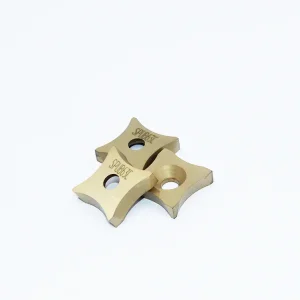
Specialty Tungsten Carbide Tooling & Heavy-Duty Inserts
Engineered for extreme wear, steel tube scarfing, external grooving, and non-magnetic shafts. Discover our full selection of heavy-duty carbide wear parts, CVD/TiN-coated scarfing inserts, and high-precision ground rods:







Initiate Your Precision Carbide Rod Sourcing Cycle
Submit your CAD drawings, grade requirements, or target workpiece hardness specifications. Zhongfu's metallurgists and tooling engineers deliver full DFM assessments, grade matching, and formal quotations within 8 hours.