
Featured Tungsten Carbide Molds, Dies & Wear Solutions
Factory-direct cemented tungsten carbide cold heading dies, wear-resistant tool inserts, precision scarifier cutters, and structural metal components engineered for high-impact manufacturing environments.




Evaluating Tungsten Carbide Mold Procurement: Total Cost of Ownership vs. Unit Price
In high-speed stamping, cold heading, and continuous powder compaction, mold life defines operational uptime. Tier-1 industrial buyers do not simply source carbide tools based on initial piece-price; they evaluate lifecycle throughput, fracture toughness limits, and dimensional repeatability across millions of press strokes.
Micro-Spalling & Fatigue Life
Uncontrolled internal porosity or suboptimal cobalt binder distribution creates stress-concentration microvoids. Under cyclical loading exceeding 1,200 MPa, conventional sintered tooling suffers premature adhesive wear and catastrophic micro-chipping along critical working radii. Sinter-HIP processing eliminates porosity below A02/B00 levels.
Wire EDM Recast Mitigation
Electrical Discharge Machining generates a damaged recast layer characterized by tensile residual stresses and cobalt depletion. Premium tungsten carbide mold manufacturing requires dedicated slow-feed multi-cut EDM finishing parameters paired with stress-relief annealing and diamond micro-polishing to restore fracture resistance.
Interchangeability & Tolerance
Multi-cavity high-speed tooling requires mold inserts ground to sub-micron accuracy (±0.001 mm) and mirror finishes down to Ra 0.05 µm. Batch-to-batch shrinkage variations in unrefined powder formulations cause assembly misalignment and uneven wear, drastically reducing overall equipment effectiveness (OEE).
Macro-Industry Solutions: Custom Carbide Molds Across Global Supply Chains
From extreme continuous plastic deformation to high-frequency blanking, our custom tungsten carbide mold configurations are tailored with specific cobalt content and tungsten carbide grain structures to withstand demanding production stresses.
Cold Heading & Forging Dies
Engineered for high-strength fastener forming, aerospace rivets, and automotive ball-stud production. Utilizing high-cobalt impact grades (15%–20% Co) with coarse WC grains to deliver exceptional fracture toughness (K1C > 22 MPa·m½) under repeated impact forces up to 2,000 MPa without longitudinal cracking.
Precision Wire Drawing Molds
Developed for stainless steel, copper, tire-cord wire, and welding wire drawing operations. Featuring optimized bell and reduction cone geometries with ultra-fine grain carbide cores (YG6X/YG8), delivering wear resistance, thermal dissipation, and anti-galling performance at draw speeds exceeding 30 m/s.
Powder Compaction Tooling
Critical for automotive PM components, ferrite magnets, and pharmaceutical pellet press tooling. We engineer matched punch-and-die sets with mirror-polished surfaces (Ra < 0.08 µm) and nickel-bonded non-magnetic carbide grades, eliminating powder friction, galling, and magnetic particle sticking.
Progressive Stamping Inserts
Tailored for high-speed motor lamination stamping (electrical silicon steel) and electronics lead-frame production. Fine-grain sub-micron carbide matrices ensure burr-free edge retention across 15 to 20 million strokes between regrinds, drastically lowering total tooling downtime.
Cemented Tungsten Carbide Metallurgy: Microstructural Control
A reliable tungsten carbide mold requires metallurgical balancing: tailoring the volumetric ratio of hard refractory tungsten monocarbide (WC) grains against a ductile metallic binder (Cobalt or Nickel). Through Sinter-HIP processing under 10 MPa of hot isostatic argon pressure, internal voids collapse entirely, achieving theoretical density.
| Carbide Grade | Binder Content (%) | Grain Size (µm) | Density (g/cm³) | Hardness (HRA) | TRS (MPa) | Optimal Mold Applications |
|---|---|---|---|---|---|---|
| YG6X | 6.0% Co | 0.8 (Sub-Micron) | 14.95 | 91.5 – 92.5 | 2,200 | Precision blanking dies, non-ferrous thin sheet punching, wire guide bushings |
| YG8 | 8.0% Co | 1.2 (Fine) | 14.80 | 89.5 – 90.5 | 2,600 | Wire drawing dies, light cold heading dies, wear-resistant trimming inserts |
| YG15 | 15.0% Co | 1.8 (Medium) | 14.05 | 86.5 – 87.5 | 3,100 | Medium cold heading molds, fastener upsetting punches, heavy drawing dies |
| YG20 | 20.0% Co | 2.2 (Medium-Coarse) | 13.55 | 85.0 – 86.0 | 3,400 | Heavy cold forging dies, severe impact stamping, bolt forming dies |
| YG20C | 20.0% Co | 3.0–4.0 (Coarse) | 13.50 | 83.5 – 84.5 | 3,600 | Extreme impact cold heading dies, cold extrusion punches, thick-plate stamping |
| NM-12 (Non-Mag) | 12.0% Ni/Cr | 1.4 (Medium) | 14.30 | 88.0 – 89.0 | 2,700 | Magnetic powder compaction dies, corrosion-resistant seal rings, sensor tooling |
The Precision Tooling Route: Powder to Sintered Mold Cavity
From metallurgical raw material control to sub-micron diamond grinding, our end-to-end production loop in Nanchang, Jiangxi, delivers uniform shrinkage, controlled cobalt distribution, and traceable dimensional repeatability.
Powder Formulation
Wet ball-milling of 100% virgin tungsten carbide and ultra-pure cobalt/nickel binders with grain-growth inhibitors (VC, Cr3C2) to stabilize carbide crystal morphology.
Near-Net Pressing
Automated multi-axis CNC hydraulic compaction and cold isostatic pressing (CIP) to produce homogeneous green compacts with uniform green density distribution.
Overpressure Sinter-HIP
Combined low-pressure vacuum dewaxing and high-temperature argon HIP sintering at 1,450°C and 100 bar, sealing micro-porosity and eliminating internal stress points.
Precision Grinding & EDM
Slow-speed multi-pass wire EDM and optical profile grinding (PG). Precision profile diamond wheel grinding achieves tolerances within ±0.001 mm.
Metrological Certification
100% verification using coordinate measuring machines (CMM), ultrasonic non-destructive flaw detection, optical profilometry, and metallographic grain inspection.
Technology Roadmap: Next-Generation Tungsten Carbide Tooling Systems
The industrial mold sector is transitioning from passive wear blocks toward smart, sensor-embedded, and hierarchically structured hard-metal components engineered for electrified automotive platforms, aerospace structures, and automated high-output manufacturing.
Hierarchical & Nano-Grain WC Formulations
Commercializing bimodal carbide structures that combine ultra-fine WC grains (0.2–0.4 µm) for abrasive wear resistance with ductile cobalt pools for high fracture toughness. This microstructural configuration increases tool operating life in EV battery cell casing stamping and micro-fastener heading by 40% to 65%.
Additive Manufacturing & Conformal Cooling
Integrating Binder Jetting (BJM) additive manufacturing for complex cemented carbide dies featuring internal conformal cooling channels. Accelerated thermal dissipation across heavy-duty cold forging cycles reduces thermal fatigue cracking, extending punch mold longevity in high-frequency production.
Smart Telemetry Tooling & Circular Metallurgy
Embedding thin-film piezo-resistive sensor arrays directly within stress-concentration zones to provide real-time mold wear, thermal spike, and micro-crack warnings. Simultaneously scaling closed-loop zinc recycling to reprocess 100% of scrap tungsten carbide molds into virgin-grade chemical precursors.
Global Industrial Landscape, Localized Engineering & Regulatory Compliance
Navigating global supply chain volatility demands a reliable manufacturing partner. Operating from Jiangxi, China—the primary origin of global tungsten reserves—Zhongfu provides global procurement teams with verifiable metallurgical origin, documented batch compliance, and reliable international logistics.
Conflict Minerals & Supply Chain Ethics
Fully compliant with the Responsible Minerals Initiative (RMI) and CFSI frameworks. We supply formal Conflict Minerals Reporting Templates (CMRT) verifying conflict-free sourcing of raw Ammonium Paratungstate (APT), accompanied by full chemical assay and raw material trace certificates.
RoHS, REACH & Heavy Metal Standards
All manufactured tungsten carbide grades, including nickel-bonded matrices, comply with EU RoHS Directives (2011/65/EU and 2015/863/EU) and REACH (EC 1907/2006). Every export shipment includes third-party verified spectrometer screening documentation.
Worldwide DDP Fulfillment & Support
Exporting to over 20 countries, including the USA, Germany, Japan, Canada, and Mexico. Engineering reviews are guaranteed within 8 hours. Molds are packed in hermetically sealed, VCI anti-corrosion barrier packaging with custom shock-absorbing timber framing for sea and air freight.
Industrial Indexable Inserts, Blanks & Non-Magnetic Carbide
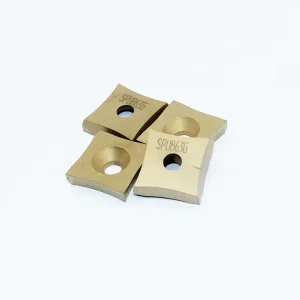
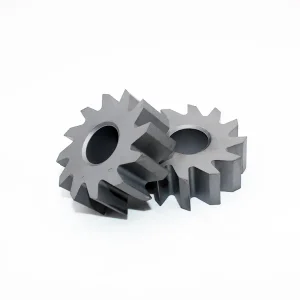
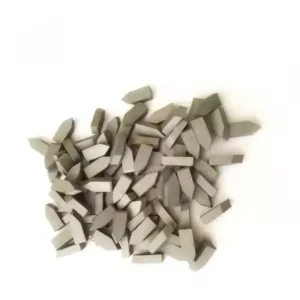
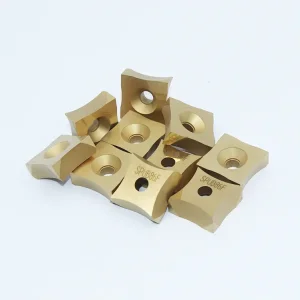
Explore our selection of heavy-duty scarfing inserts, EDM die stock plates, custom gear sets, and non-magnetic pins tailored for high-precision manufacturing operations.








Frequently Asked Engineering & Procurement Inquiries
Detailed answers regarding tool manufacturing standards, material grades, microstructural integrity, and international logistics.
How does Zhongfu prevent wire EDM cracking in tungsten carbide mold blocks?
Wire EDM introduces severe thermal gradients, creating a tensile recast layer and micro-fissuring. We address this by utilizing our specialized Sinter-HIP process to produce near-zero porosity blanks, optimizing customer EDM programming with lower discharge energies for finishing cuts, and applying secondary low-temperature stress-relief tempering (180°C–220°C) before final diamond lapping.
When is a Nickel-bonded non-magnetic carbide grade required over a Cobalt-bonded grade?
Cobalt is ferromagnetic. In magnetic powder compaction (e.g., NdFeB and SmCo permanent magnet manufacturing), cobalt-bonded molds magnetize and attract loose powder particles, causing severe abrasive scouring. Additionally, Nickel-bonded grades (NM-12) provide superior corrosion resistance in acidic or aqueous drawing environments where cobalt binder leaching would occur.
What is the maximum achievable hardness and dimensional tolerance for custom molds?
Depending on the binder content and grain size, our tungsten carbide tooling reaches up to 92.5 HRA (in sub-micron YG6X grades). On finished ground dies and punches, our CNC grinding and diamond polishing capabilities consistently achieve tolerances of ±0.001 mm (1 µm), with internal bore roundness within 0.0008 mm and surface roughness down to Ra 0.05 µm.
What documentation accompanies an international export shipment?
Every export consignment includes a comprehensive Quality Dossier: a Certificate of Conformity (CoC), a full Chemical Composition & Traceability Assay, an Ultrasonic Flaw Inspection Report, a 3D CMM Dimensional Inspection Protocol, and standard CMRT Conflict Mineral compliance documentation.