
Non-Magnetic Carbide Parts Manufacturer & Factory
Precision-engineered nickel-bonded tungsten carbide components optimized for extreme anti-wear, corrosion resistance, and total electromagnetic neutrality in high-field industrial operations.
Precision Non-Magnetic Carbide Solutions (Part I)
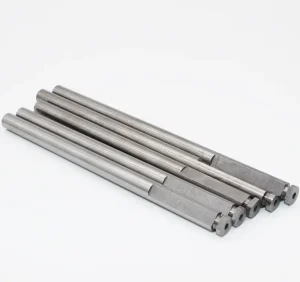
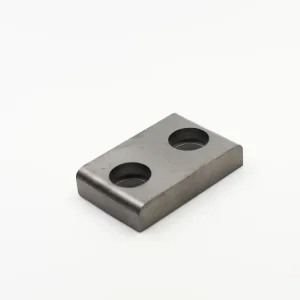
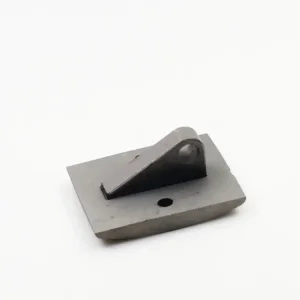
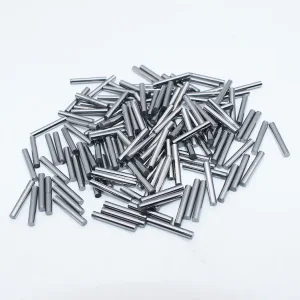
Ultra-wear resistant non-magnetic pins, wear sleeves, and custom cutting geometries manufactured for magnetic field neutrality.
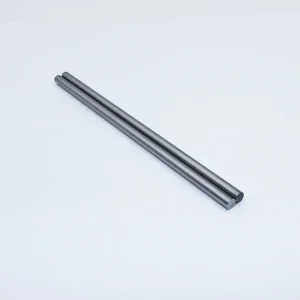
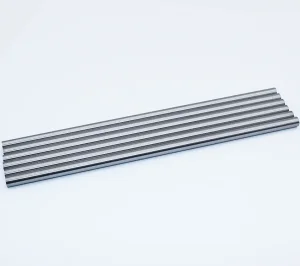
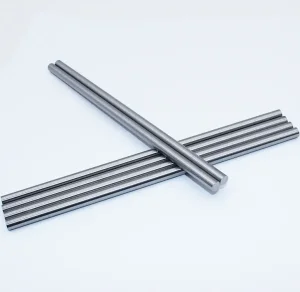
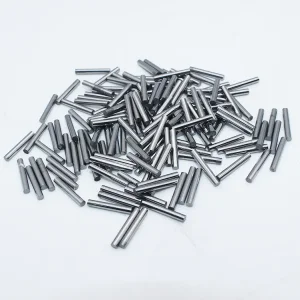
The Physics of Non-Magnetic Tungsten Carbide
Why conventional cobalt binders fail in sensitive electromagnetic environments, and how specialized nickel-chromium solid solution binders preserve dimensional stability and low relative magnetic permeability.
Magnetic Neutrality (μr < 1.005)
Standard cemented tungsten carbide utilizes cobalt (Co) as the matrix binder. Because cobalt is strongly ferromagnetic, standard tooling perturbs localized magnetic fluxes. By replacing standard cobalt matrices with precision Ni-Cr solid-solutions, our non-magnetic carbide achieves a relative magnetic permeability ($\mu_r$) approaching unity, entirely preventing parasitic induction.
Sinter-HIP Densification
Utilizing high-pressure Hot Isostatic Pressing (Sinter-HIP) during liquid-phase sintering at 1,450°C, we collapse micro-porosities down to ISO level A02/B00. This near-zero internal void volume guarantees that structural components subjected to pulsating mechanical loading or abrasive hydraulic slurries do not undergo early subsurface microcracking.
Chemical & Electrochemical Passivation
Nickel binder phases demonstrate electrochemical potentials superior to traditional cobalt in acid-rich, brackish, or saline working media. Our non-magnetic formulas establish a natural chromium-oxide passivation film, drastically curbing galvanic corrosion in marine meters, subsea sensor housings, and aggressive slurry pumps.
Global Industrial Footprint & Localized Application Scenarios
From North American downhole measurement tools to European semiconductor fabs, non-magnetic carbide solves critical interference challenges across major international markets.
MWD & LWD Downhole Telemetry
Region: North America & Middle East Oil Basins
In directional drilling, Measurement While Drilling (MWD) tools rely on precision fluxgate magnetometers to determine well trajectory relative to the Earth's geomagnetic field. Non-magnetic carbide wear sleeves, orifice plates, and mud-pulse shafts shield tools from intense sand wash erosion without corrupting directional magnetic signals.
Semiconductor & Electron Beam Lithography
Region: East Asia & Western Europe
High-speed wafer-handling grippers, vacuum lead-through pins, and pick-and-place nozzles operating within scanning electron microscope (SEM) or electron-beam lithography inspection chambers require extreme dimensional rigidity. Non-magnetic carbide prevents electrostatic charge buildup and eliminates deflection of focused sub-micron electron beams.
Precision Water Meters & Fluid Metering
Region: Global Municipal Infrastructure
Modern ultrasonic, inductive, and smart pulse water meters mandate rotor shafts that withstand billions of revolutions without wearing out or creating magnetic friction. Using non-magnetic solid carbide shafts guarantees zero particulate adhesion from iron-containing rust sediments common in urban potable water pipes.
Mechanical & Magnetic Performance Matrix
Comprehensive grade data for design engineers and metallurgists specifying parts under high abrasive, corrosive, and electromagnetic operational conditions.
| Alloy Grade | Binder Composition | Density (g/cm³) | Hardness (HRA) | Transverse Rupture Strength (TRS MPa) | Permeability (μr) | Key Operational Utility |
|---|---|---|---|---|---|---|
| ZF-NM06 | 6% Ni-Cr Complex | 14.95 ± 0.10 | 91.5 – 92.5 | 2,100 | < 1.002 | High-wear gauge pins, jewelry core pins, precision plug rods |
| ZF-NM10 | 10% Ni-Based Blend | 14.50 ± 0.10 | 89.0 – 90.5 | 2,500 | < 1.004 | MWD telemetry sleeves, erosion nozzles, flow measurement shafts |
| ZF-NM15 | 15% Ni-Cr Solid Solution | 14.05 ± 0.15 | 86.5 – 88.0 | 2,800 | < 1.005 | Magnetic powder compacting dies, heavy impact scrapers, seal rings |
| Standard YG8 (Ref) | 8% Cobalt (Co) | 14.70 ± 0.10 | 89.5 – 90.5 | 2,400 | 1.5 – 3.0 (Ferromagnetic) | Standard rock drill bits, non-sensitive metalworking tools |
Factory Resilience & Upstream Tungsten Integration
Located in Nanchang, Jiangxi—the epicenter of the world's raw tungsten mining and refining infrastructure—Zhongfu delivers unmatched continuity, cost containment, and capacity.
100% Virgin APT Feedstock
Direct access to virgin Ammonium Paratungstate (APT) ensures stable crystalline morphology. Zero recycled scrap powder means trace magnetic impurities (iron, cobalt residues) are strictly controlled at the parts-per-million (ppm) level.
In-House Tooling & EDM
From precision CNC wire-EDM to centerless grinding rigs capable of maintaining h6 outer-diameter tolerance on long shafts (±0.004 mm), all machining phases remain vertically integrated inside our 5,000 m² production site.
8-Hour DFM Technical Cycle
Direct communication with metallurgical engineers eliminates distributor markups and information delays. Customized 2D/3D CAD review, mold shrinkage calculations, and alloy recommendations are completed in 8 hours.
Global Logistics, Export Compliance & Quality Control
Every shipment undergoes rigorous metallurgical verification and international compliance packaging before export.
Metallographic & Permeability Testing
Every production batch includes factory mill test reports (MTR) covering: grain size analysis, cobalt residual assays via optical emission spectroscopy, magnetic balance verification, and ultrasonic flaw detection for internal integrity.
Custom Tariffs & Incoterms Handling
Extensive experience shipping DDP, CIF, and FOB to ports across the United States, Germany, Japan, and Canada. All customs harmonized codes (HS 8113.00, HS 8209.00) and dangerous goods/magnetic-free air freight declarations are pre-cleared.
Non-Destructive Shock Packaging
Given the notch sensitivity inherent to high-hardness tungsten carbide, all ground parts are protected with specialized anti-static plastic dipping, vacuum-sealed barrier foils, and impact-damping foam enclosures to prevent edge chipping in transit.
Technology Roadmap: Future Innovations in Non-Magnetic Tooling
Continuously pushing the boundaries of metallurgy to anticipate increasingly demanding operating environments.
Ultra-Fine Grain (0.4 – 0.8 μm) Ni-Cr Matrices
Refining powder crystallization allows higher nickel concentrations without sacrificing wear resistance. By limiting tungsten grain growth with precise vanadium/chromium carbide inhibitors, we deliver components that handle high abrasive slurry forces while guaranteeing zero magnetic signature.
High-Entropy Binder Systems (HEA) & Additive Geometry
Developing multi-element non-magnetic matrices (Fe-Ni-Cr-Mn) to raise the thermal ceiling beyond 800°C without phase transitions. In parallel, our binder-jet 3D printing research enables complex conformal internal cooling channels for non-magnetic drilling tools and aerospace sensing packages.
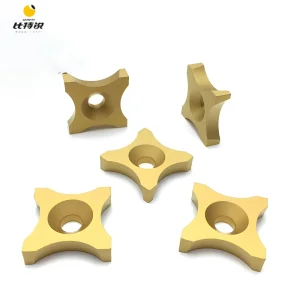
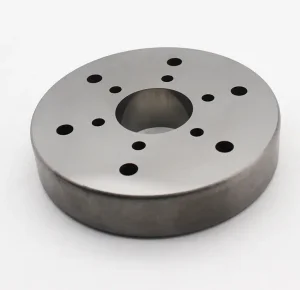
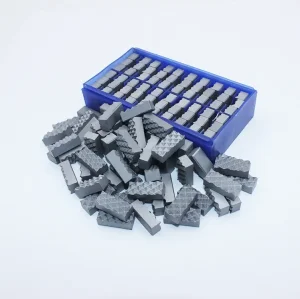
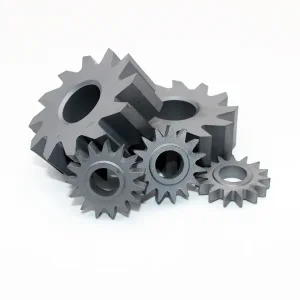
Precision Hard Alloy & Insert Components (Part II)
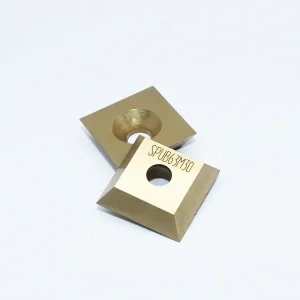
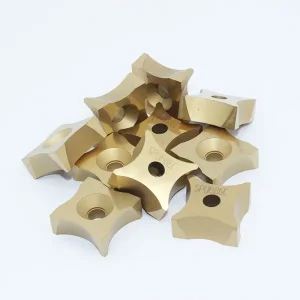
Explore standard tooling blanks, CNC scraping blades, lathe cutters, and heavy-wear replacement parts direct from our manufacturing floor.
Frequently Asked Technical Questions
Key information regarding material properties, non-magnetic performance, manufacturing tolerances, and ordering specifications.