
High-Performance Cemented Carbide Plates for Saudi Operations
Pre-sintered and precision-ground wear plates optimized for severe downhole attrition, heavy stamping tooling, and extreme heat dissipation in Gulf industrial hubs.




The Strategic Demand for Cemented Carbide in Saudi Arabia
As the Kingdom accelerates Vision 2030, industrial self-reliance, localized manufacturing, and extreme mineral extraction are driving record consumption of cemented tungsten carbide plates.
Upstream & Downstream Hydrocarbons
In the Eastern Province (Dammam, Khobar, Jubail), drilling through abrasive quartz-sand formations demands tungsten carbide wear plates that resist catastrophic high-velocity slurry erosion and abrasive wear in drilling motor bearings, blowout preventer (BOP) shears, and choke valve internals.
Ma'aden & Massive Mining Expansion
With Saudi Arabia unlocking $1.3 trillion in untapped mineral deposits (phosphate, bauxite, gold, and rare earth metals), crusher liners, screening chutes, and secondary sizing hammers require high-impact YG15 to YG20 carbide wear tiles capable of absorbing repeated shock loads.
Giga-Projects (NEOM, Red Sea, Qiddiya)
Mega-infrastructure tunnelling, trenching across basalt volcanic fields (Harrat), and foundation piling drive heavy demand for brazed and mechanical bolted carbide wear plates installed directly onto cutterheads, drag bits, and excavator bucket lips.
Engineering Grade Selection for Harsh Middle Eastern Operating Conditions
A comprehensive reference for mechanical engineers and plant managers selecting WC-Co and corrosion-resistant Ni-binder grades for high-heat, high-salinity, and H2S environments.
Standard catalog wear plates frequently fail prematurely in Gulf environments due to the combined action of sand erosion, severe mechanical impact, and sour-gas electrochemical attack. In drilling mud containing quartz grains, mechanical micro-scratching quickly removes weak binder phases. When H2S and brine moisture are present, conventional Cobalt binders undergo preferential galvanic leaching, leaving unsupported tungsten carbide skeletons that spall off under shear stress.
To counteract this degradation mechanism, our manufacturing process utilizes 100% virgin sub-micron ammonium paratungstate (APT) feedstock combined with proprietary micro-alloy additions of Chromium Carbide (Cr3C2) and Vanadium Carbide (VC). These act as dual-action grain growth inhibitors and corrosion passivators during the 100-bar Sinter-HIP densification cycle.
| Alloy Grade | Binder Content (wt%) | Grain Size (µm) | Density (g/cm³) | Hardness (HRA) | Transverse Rupture Strength (MPa) | Primary Saudi Application Suitability |
|---|---|---|---|---|---|---|
| ZG-YG6X | 6.0% Co | 0.8 (Fine) | 14.95 | 92.5 | 2,150 | Fine wire drawing, sheet metal trimming, non-ferrous high-speed slitters. |
| ZG-YG8 | 8.0% Co | 1.4 (Medium) | 14.75 | 89.8 | 2,600 | Rock drilling chisel inserts, trenching picks, scrap shear blade shims. |
| ZG-YG12X | 12.0% Co | 1.0 (Sub-micron) | 14.30 | 88.6 | 3,100 | Cold heading dies, compact stamping dies, high-pressure slurry valve chokes. |
| ZG-YG15 | 15.0% Co | 1.8 (Medium-Coarse) | 14.05 | 87.2 | 3,350 | Deep draw dies, extreme vibration shredder knives, heavy punch tooling. |
| ZG-YG20C | 20.0% Co | 2.5 (Coarse) | 13.55 | 85.4 | 3,600 | Heavy stamping, rotary hammer head cladding, mining jaw crusher armoring. |
| ZG-N09 (Corrosion-Proof) | 9.0% Ni-Cr | 1.2 (Uniform) | 14.50 | 89.0 | 2,450 | Sour gas (H2S) choke trims, offshore seawater desalination impellers, MWD housings. |
Engineered Wear Solutions Across Key Saudi Industrial Sectors
Purpose-built cemented carbide configurations delivering extended maintenance intervals across extreme working environments.
1. Oil & Gas Drilling Assembly Wear Protection
Downhole Measurement-While-Drilling (MWD) pulse generators and directional steerable collars experience abrasive fluids carrying 5% to 15% solid sand fractions. We supply non-magnetic nickel-bonded carbide wear strips and plates ground to ISO h6/js6 tolerances with parallel flat surfaces within 0.005mm, preventing sensor distortion and fluid washouts.
- Non-magnetic permeability: µr < 1.005 for directional instrumentation.
- Custom EDM wire-cut fluid port passages for turbulence minimization.
2. Petrochemical Slurry & Catalytic Cracker Valves
In Jubail Industrial City petrochemical refineries, heavy gas-oil and fluid catalytic cracking (FCC) units circulate high-temperature catalyst fines. Conventional satellite alloys erode within months. Our HIP-sintered silicon carbide and tungsten carbide sliding plates resist slurry cavitation up to 550°C with zero surface galling.
- Mirror optical polishing available down to Ra 0.05 µm.
- Extreme resistance to ammonium chloride and caustic sulfide stress cracking.
3. Steel Rebar, Billet Scarfing & Metal Stamping
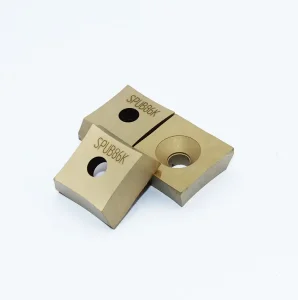
Continuous casting and rolling mills in Hadeed (SABIC) require scarfing plates and de-burring inserts capable of operating along continuous red-hot billet edges (900°C+). Our hot-wear scarfing series (SPUB, SNMX) maintain hot-hardness, preventing edge rounding and edge weld pickup.
- Specially blended cobalt-ruthenium binders for elevated thermal conductivity.
- Extended billet conditioning life up to 340 tons per cutting edge.
4. Cement Plants & Aggregate Beneficiation
Saudi cement production plants in Yanbu, Rabigh, and Hofuf process raw limestone, silica, and clinker. Roller press side-sealing plates, dynamic classifier vanes, and vertical mill chute liners lined with modular cemented carbide plates provide over 35,000 operational hours before maintenance replacement.
- Standard counter-sunk hole patterns for high-tensile Grade 10.9 bolting.
- Modular interlocking geometry eliminating exposed backing-plate gaps.
China Industry 4.0: Supply Chain Resilience & Feedstock Hegemony
Direct supply partnerships connecting Jiangxi's primary tungsten deposits with Saudi Arabia’s downstream capital projects.
Procuring tungsten carbide plates from intermediary trading entities or non-integrated machine shops introduces significant supply risks: unpredictable lead times, batch-to-batch porosity fluctuations, and uncontrolled feedstock scrap recycling. Our automated production complex located in Nanchang, Jiangxi sits directly at the epicenter of 60% of the world's primary tungsten reserves.
100-Bar Vacuum Sinter-HIP
Unlike conventional atmospheric vacuum sintering that leaves internal micropores (A04-B04 level), our German-engineered Sinter-HIP furnaces apply 10 MPa of ultra-pure Argon pressure at peak liquidus temperature (1,450°C). This collapses micro-voids, increasing Transverse Rupture Strength by 25-35%.
Sub-Micron CNC Profile Grinding
Equipped with multi-axis CNC surface grinding, double-disc face grinders, and electro-discharge wire cutting (EDM), we produce flat blanks with thickness tolerances within ±0.002 mm, parallelism ≤ 0.003 mm, and mirror surface finishes down to Ra 0.05 µm.
100% Virgin Powder Traceability
Strict adherence to zero scrap or reclaimed black powder. Every production lot includes spectral X-ray fluorescence (XRF) material verification, coercivity and magnetic saturation checks (Hc/4πσ), and metallographic grain inspection under 1,500x magnification.
Seamless Saudi Procurement: SABER, SASO & IKTVA Ecosystem Support
Ensuring compliance with Saudi regulatory frameworks, customs clearing via King Abdulaziz Port (Dammam) and Jeddah Islamic Port.
SABER & SASO Certification
Full documentation readiness for Saudi Arabian Standards Organization (SASO) conformity. We issue SABER e-Certificates of Conformity (PCoC and SCoC) for expedited customs clearance without shipment quarantines.
Aramco IKTVA Alignment
We collaborate with Saudi tier-1 engineering contractors to bolster In-Kingdom Total Value Add (IKTVA) metrics. We provide semi-finished, near-net pre-forms that permit local Saudi machine shops to perform high-value final EDM profiling and finish lapping within Saudi Arabia.
Direct Gulf Air & Sea Logistics
Fast-track air-cargo shipping to King Khalid International (RUH) and King Fahd International (DMM) within 4 to 6 business days for emergency rig shutdowns. Containerized ocean freight routed to Dammam and Jeddah via established maritime freight alliances.
Total Cost of Ownership (TCO): Carbide Plates vs. Standard Tool Steels
Why Tier-1 industrial buyers in Saudi Arabia are transitioning from conventional hardened tool steels (AISI D2, M2, Hardox 500) to Sinter-HIP tungsten carbide.
| Evaluation Factor | High-Chromium Tool Steel (D2 / 1.2379) | Quenched Wear Steel (Hardox 500) | Sinter-HIP Cemented Carbide Plate (ZG-YG12) |
|---|---|---|---|
| Rockwell Hardness | 58–62 HRC | ~50 HRC (~500 HBW) | 88.5–91.0 HRA (equiv. 74–77 HRC) |
| Young’s Modulus of Elasticity | 210 GPa | 205 GPa | 580–630 GPa (3x Rigid Stability) |
| Slurry Erosion Wear Rate | 1.0 (Baseline index) | 1.3 (Accelerated gouging) | 0.08 (12.5x Wear Life Increase) |
| Thermal Stability Limit | De-tempers above 220°C | Loses temper above 250°C | Stable up to 650°C (Hot-hardness) |
| Tooling Changeover Frequency | Every 45,000 punch strokes | Re-weld every 200 operational hours | Exceeds 550,000 punch cycles |
| Total Cost of Ownership (Annualized) | High (Constant line-stop labor costs) | Moderate (High consumable weld rod costs) | Lowest (Over 64% Net OPEX Savings) |
While the initial purchase cost of raw tungsten carbide plates is higher than tool steel, industrial field analytics demonstrate that downtime costs in high-speed manufacturing—such as beverage can end stamping in Riyadh or pipe hydrotesting in Jubail—exceed initial raw material expenditures within 72 hours of unplanned production shutdown. By specifying Sinter-HIP carbide plates, operators achieve sustained dimensional tolerances and eliminate recurring die rebuild costs.
Carbide Plate Sourcing in Saudi Arabia: Technical & Procurement FAQ
Real-world engineering questions answered directly by our chief metallurgical director.
Can you manufacture custom tungsten carbide plates according to specific CAD drawings and tolerances?
How do your carbide plates perform against abrasive Arabian desert sands?
Which carbide grade is best suited for sour gas (H2S) and corrosive seawater environments?
What is the typical shipping lead time for industrial delivery into Saudi Arabia?
Do shipments include raw material test reports and certification?
Can carbide plates be brazed or mechanically fastened to steel backing plates?
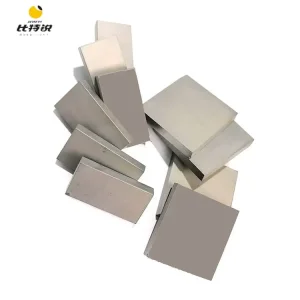
Tungsten Carbide Plates, EDM Blanks & Heavy Scarfing Inserts
Direct factory-floor stock available for immediate engineering review and fast-track Gulf export.





Accelerate Your Project with Factory-Direct Wear Engineering
Send your drawings, operating conditions, or material specifications to our metallurgists. We provide detailed feasibility feedback, grade recommendations, and competitive commercial quotes within 8 hours.