
High-Hardness Wear Plates & Advanced Stock for Sydney Tooling
Direct from engineering facilities: ultra-dense pressureless sintered ceramics, pure tungsten alloys, cemented wolfram strips, and stamping-grade alloys calibrated for severe wear applications.




Sydney's Industrial Fabric: The Strategic Need for Advanced Wear-Resistant Carbides
An in-depth metallurgical analysis of how Greater Western Sydney's advanced manufacturing hubs and Hunter-Illawarra industrial corridors utilize sintered tungsten carbide plates to mitigate downtime.
Sydney and the broader New South Wales (NSW) industrial macro-corridor represent Australia's most demanding territory for wear components, stamping dies, and precision cutting stock. From the intense heavy fabrication workshops in Western Sydney (spanning Paramatta, Wetherill Park, and Blacktown) to the mineral-processing bulk handling systems tied to Newcastle and Port Kembla, machinery faces severe abrasive wear, extreme compressive stress, and thermal cycling.
In high-throughput sheet metal stamping, CNC tooling fabrication, and aggregate processing, conventional D2/M2 tool steels exhibit limited operating lifespans. As production runs accelerate to satisfy domestic infrastructure programs and national supply chain reshoring, local engineers require cemented tungsten carbide (WC-Co) plates characterized by pore-free metallurgical microstructures, high fracture toughness (K1C), and Rockwell hardness values exceeding HRA 89.0 to 92.5. The localized economic equation is straightforward: unexpected die replacement or EDM tooling cavitation costs Sydney production lines thousands of dollars per idle hour.
Western Sydney Tool & Die Hub
High-precision metal stamping facilities require stress-relieved YG15 to YG20 grade carbide plates to prevent catastrophic micro-spalling during high-speed progressive blanking operations.
NSW Infrastructure & Tunneling
Civil infrastructure and bulk quarrying around New South Wales rely on impact-absorbing thick carbide wear blocks to line chutes, crushing jaws, and slurry transfer systems against severe gouging.
Maritime & Non-Magnetic Corridors
Specialized marine manufacturing and sensor calibration facilities in Port Jackson and Newcastle demand Nickel-bonded (Ni) non-magnetic carbide plates that resist saline galvanic corrosion.
Cemented Carbide Grade Selection Blueprint for Sydney Machinists
Optimal tool life requires balancing binder volumetric percentage (Cobalt or Nickel) against average Tungsten Carbide grain sizing (ranging from submicron 0.6µm to coarse 3.5µm).
| Carbide Grade | Binder (Co/Ni %) | Grain Size (µm) | Density (g/cm³) | Hardness (HRA) | TRS (MPa) | Recommended Sydney Applications |
|---|---|---|---|---|---|---|
| YG6X (Submicron) | 6.0% Co | 0.8 | 14.90 - 15.05 | 92.5 - 93.0 | 2200 | Fine slitters, paper/foil cutting, non-ferrous fine precision finishes. |
| YG8 (Standard) | 8.0% Co | 1.2 - 1.6 | 14.60 - 14.80 | 89.5 - 90.5 | 2600 | Wear guide plates, scraper blades, lathe tool brazed inserts for rail hubs. |
| YG15 (Medium Coarse) | 15.0% Co | 1.8 - 2.2 | 13.90 - 14.15 | 87.0 - 88.0 | 3100 | Heavy cold stamping dies, metal punching tools, progressive drawing plates. |
| YG20C (Coarse Grain) | 20.0% Co | 2.5 - 3.5 | 13.40 - 13.60 | 84.5 - 86.0 | 3400 | Severe impact blanking, cold heading dies, thick EDM blocks for heavy stamping. |
| WN-10 (Nickel Binder) | 10.0% Ni | 1.4 - 1.8 | 14.45 - 14.65 | 88.5 - 89.5 | 2400 | Non-magnetic environments, chemical seal rings, marine sensor housings. |
China Industry 4.0: Metallurgical Density & Supply Chain Resilience
Why Tier-1 Australian manufacturers partner directly with our Jiangxi manufacturing base: Overcoming localized material deficits through overpressure HIP technology and primary resource purity.
For Sydney procurement directors, sourcing cemented carbide flat blanks and custom plates presents a perennial dilemma: local stockists maintain limited catalog dimensions at substantial markups, while secondary distributors frequently supply mixed-scrap recycled material that fails during wire electrical discharge machining (EDM).
Jiangxi Zhongfu Cemented Carbide Co., Ltd. resolves this structural friction by anchoring production right at the source of China's world-leading tungsten reserves. Operating a state-of-the-art 5,000 m² manufacturing plant in Nanchang, we eliminate internal metallurgical defects by implementing modern Industry 4.0 processing pipelines:
100% Virgin Powder Metallurgy
Zero recycled scrap. We compound only premium purity Wolfram (W) ore and selected Cobalt/Nickel binders, guaranteeing homogenous grain distribution and preventing premature fracture under cycle stresses.
Overpressure Sinter-HIP Technology
Our computer-controlled Hot Isostatic Pressing furnaces apply 60 to 100 bar of argon pressure at 1450°C, collapsing microscopic voids to deliver near-theoretical density (ISO A00/B00 porosity).
Precision CNC Grinding & EDM Tolerance
Our finish-machining capabilities provide surface grinding down to Ra 0.2µm, flatness tolerances within 0.01mm, and custom pre-formed EDM cavities that reduce downstream wire-cutting runtimes.
Frictionless Logistics & Australian Compliance Framework
Seamless door-to-door delivery across Kingsford Smith Cargo Terminals and Port Botany, complete with comprehensive metallurgical tracing documents.
Procuring custom tungsten carbide from an overseas manufacturer requires uncompromising compliance with Australian industrial purchasing protocols. Zhongfu provides end-to-end transparency, ensuring your Sydney facility receives certified goods without customs delays or administrative overhead.
Complete Certification Delivered with Every Batch
Every shipment is accompanied by a full Mill Test Certificate (MTC), detailing chemical composition, true density (Archimedes method), Rockwell A hardness, and transverse rupture strength. On request, we furnish metallographic micrographs verifying grain boundary integrity and absolute non-porosity.
Direct Air & Sea Corridors to Sydney & NSW
Whether you require urgent replacement EDM plate blanks shipped via express air freight directly to Sydney Airport (SYD) within 3 to 5 business days, or containerized shipments cleared through Port Botany for heavy production schedules, our logistics team manages all export declarations, sea-freight packaging, and customs clearing documentation seamlessly.
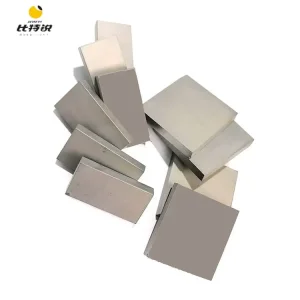
Engineered Tungsten Carbide Plates, EDM Blanks & Tooling Inserts for Sydney
Select from our complete range of HIP-sintered flat blanks, heavy EDM thick block stock, and specialized wear blades configured to Australian industry standards.







Frequently Asked Questions: Sourcing Sintered Carbide in Sydney, NSW
Practical guidance from our metallurgists covering drawing tolerances, EDM processing risks, and Australian logistics.
How do Zhongfu carbide plates perform under Wire EDM cutting?
Wire Electrical Discharge Machining (EDM) can cause severe thermal micro-cracking if the plate contains binder pools or porosity. Because our plates are 100% Sinter-HIP processed under high argon pressures, internal residual stress is normalized, allowing Sydney toolmakers to wire-cut intricate stamping die profiles with minimal risk of edge flaking or micro-delamination.
Can you provide custom ground blanks to Australian metric specifications?
Yes. Custom manufacturing to customer CAD/PDF drawings is our core specialty. We routinely supply Sydney fabricators with custom length, width, and thickness tolerances ground down to ±0.005mm, with chamfering, pre-formed mounting holes, and wire-start pilot holes according to your precise tooling specifications.
What is the standard delivery timeframe to Sydney and Western NSW?
Standard raw sintered blanks and catalog plate sizes are dispatched within 24 to 48 hours. Custom engineered or ground plates typically carry a 12 to 18-day manufacturing window. For rapid dispatch, express courier options (DHL/FedEx/Air Freight) deliver directly to your facility in Sydney within 3 to 5 business days after inspection release.
How do I select between YG8, YG15, and YG20 for sheet metal stamping?
The key factor is the thickness and tensile strength of the material you are punching. For thin sheet metals (<1.0mm) requiring extreme edge retention, YG8 or YG11 offers supreme abrasion resistance. For heavy stamping or high-impact progressive blanking of stainless steel (>2.0mm), YG15 or coarse-grained YG20 is required to provide the essential transverse rupture strength (TRS >3000 MPa) needed to absorb impact shock.
Accelerate Your Sydney Tooling Reliability Today
Partner directly with a 24-year ISO-certified carbide manufacturer. Submit your dimensional drawings or application requirements for an engineering review and factory-direct quote within 8 hours.