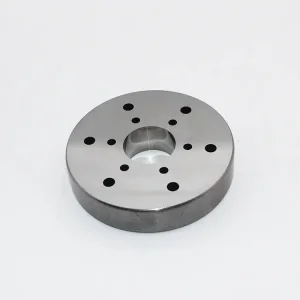
High-Precision Hard Metal Blanks & Tooling Solutions
Explore our hot-selling sintered carbides engineered for maximum fracture toughness and EDM machinability.







The Evolution of Non-Magnetic Hard Metals in Modern Industry
Decoupling ferromagnetic interference from structural wear resistance: A fundamental metallurgical necessity.
In high-precision electronics manufacturing, directional borehole logging, and medical instrumentation, conventional tungsten carbide poses a silent structural threat: binder ferromagnetism. Traditional WC-Co composites rely on cobalt, whose strong ferromagnetic profile distorts electromagnetic fields, compromises sensor telemetry, and accumulates stray magnetic debris that causes tooling seizures.
To eliminate this, leading global manufacturers like Jiangxi Zhongfu Cemented Carbide Co., Ltd. have replaced cobalt binders with complex Nickel-Chromium-Molybdenum (Ni-Cr-Mo) metallurgical binder matrices. These non-magnetic hard metals sustain exceptional micro-hardness and wear-ratio metrics while maintaining magnetic permeability close to unity (μr ≤ 1.001 to 1.005). Across the United States, Germany, Japan, and Southeast Asia, procurement paradigms are actively pivoting toward custom-engineered non-magnetic blanks to ensure dimensional integrity in electromagnetically sensitive working zones.
Metallurgical Formulations: Ni-Bonded vs. Conventional Alloys
Cross-comparative performance criteria engineered for procurement directors, EDM shops, and tooling specialists.
| Alloy Grade Class | Binder Type (%) | Density (g/cm³) | Hardness (HRA) | Magnetic Permeability (μr) | Corrosion & Acid Rating | Core Application Footprint |
|---|---|---|---|---|---|---|
| NM-10 (Ni-Binder) | 10% Ni-Cr Matrix | 14.45 – 14.70 | 89.0 – 90.5 | < 1.002 | Extreme (pH 2-12) | Semiconductor Chucks, Magnetic Powder Compacting Dies |
| NM-15 (Toughness Ni) | 15% Ni Solid Base | 13.90 – 14.20 | 86.5 – 88.0 | < 1.005 | Superior Acid Resistance | MWD Downhole Drill Collars, Hydro-Wear Sleeves |
| Standard YG6 (Co-Bond) | 6% Cobalt | 14.80 – 15.00 | 90.5 – 91.5 | Ferromagnetic (> 100) | Standard / Neutral | Non-Magnetic Sensitive Dies, Metal Milling & Turning |
| Standard YG15 (Co-Bond) | 15% Cobalt | 13.90 – 14.10 | 87.0 | High Ferromagnetism | Standard | Cold Heading, High-Impact Punch Dies |
Localized High-Value Industrial Applications
Field-proven performance where mechanical wear and electromagnetic interference cannot be compromised.
MWD & LWD Downhole Telemetry
During directional drilling, Measurement-While-Drilling (MWD) tools rely on sensitive magnetometers. Non-magnetic tungsten carbide wear bushings, sleeves, and pulse poppets eliminate magnetic field bias, ensuring accurate directional navigation while resisting harsh abrasive drilling mud.
NdFeB Permanent Magnet Compaction
Forming rare-earth magnets requires high-pressure powder compaction within high magnetic orientation fields. Standard tooling demagnetizes unevenly and shatters. Zhongfu's non-magnetic hard metal dies remain completely inert to the magnetic field, preventing particle adhesion and extending mold lifespan.
Advanced Semiconductor Fixtures
Wafer handling, precision sorting arms, and high-frequency wire-bonding tooling demand materials with zero magnetic hysteresis. Non-magnetic micro-pins and locating blocks safeguard delicate microelectronic nodes from static discharge, magnetic debris attraction, and signal disruption.
End-to-End Solutions for Global Procurement Leaders
How Zhongfu eliminates supply chain uncertainty through tight metallurgical control.
Raw Material Integrity: 100% Virgin Powder
Unlike secondary processors that blend recycled tungsten scrap, our facility formulates non-magnetic alloys exclusively from high-purity virgin Ammonium Paratungstate (APT). This guarantees absolute purity, uniform grain boundaries, zero trace cobalt contamination, and predictable sintering shrinkage ratios.
Sinter-HIP Technology: Zero Internal Porosity
Our over-pressure Hot Isostatic Pressing (Sinter-HIP) operates at up to 100 bar of inert argon during sintering. This collapses micro-voids, elevating density to near-theoretical maximums. Toolmakers achieve defect-free mirror EDM polishing, preventing edge-flaking and subsurface delamination.
Direct Engineering Answers for Purchasing Teams
Key procurement factors for non-magnetic carbides and custom hard metals.
Can Zhongfu manufacture non-magnetic hard metal parts directly from custom CAD drawings?
What metallurgical mechanism ensures non-magnetic hard metals remain non-magnetic after EDM and machining?
Which tungsten carbide grades and wear parts do you supply for global OEM export?
What are your lead times, export packing protocols, and quality certifications?
Precision Inserts, Specialized Tooling & Wear Parts
Explore our complete catalog of high-performance indexable inserts, custom wear components, and scarfing tools.