
High-Performance Tungsten Carbide Grades & Precision Wear Components
Engineered from 100% virgin wolframite concentrate via sub-micron carburization and overpressure Sinter-HIP cycles for zero-porosity operational endurance.








Commercial Dynamics in the Modern Cemented Carbide Sector
Strategic tungsten resource distribution, the shifting paradigm toward vertically integrated sintered preforms, and the critical role of primary refined powders.
The global cemented carbide marketplace represents an indispensable strategic pillar supporting international heavy industrialization, precision advanced manufacturing, geological core recovery, aerospace structural milling, and subterranean energy exploration. Often colloquially designated as "the teeth of modern manufacturing," tungsten carbide (WC-Co/Ni matrix) exhibits a profound tribological paradox: ultra-high compressive strength, hardness levels surpassing 92 HRA, and remarkable thermal persistence that enables mechanical operation under sheer and abrasive stresses exceeding 1,000°C.
In the contemporary commercial theatre, procurement executives and tooling engineers face substantial geopolitical, metallurgical, and economic volatility. Over 80% of upstream raw wolframite extraction and ammonium paratungstate (APT) conversion infrastructure remains geographically concentrated across central and southern China, notably within Jiangxi and Hunan provinces. For tier-1 industrial consumers across North America, the European Union, East Asia, and Australasia, establishing long-term procurement relationships with vertically integrated Chinese manufacturers—such as Jiangxi Zhongfu Cemented Carbide Co., Ltd.—is no longer solely a cost-efficiency decision, but a vital supply-chain de-risking strategy.
Standardized ISO & Proprietary Cemented Carbide Grade Matrix
Understanding the interplay between cobalt/nickel volumetric binder fraction, tungsten carbide grain sizing, transverse rupture strength (TRS), and working life.
Selecting the optimal cemented carbide grade necessitates balancing two fundamentally diametrical mechanical phenomena: Wear Resistance (Abrasive Hardness) versus Fracture Toughness (Shock Impact Tolerance). When cobalt binder content is minimized and tungsten carbide grain morphology is refined to submicron (0.5–0.8 µm) or ultra-fine regimes, hardness peaks, establishing unmatched endurance against micro-ploughing and high-velocity abrasive slurry wear. Conversely, increasing binder content up to 15%–20% creates a continuous ductile matrix that arrest crack propagation in high-shock stamping, cold heading, and percussive rock crushing.
| Alloy Grade | Equivalent Standard | Binder Fraction | Density (g/cm³) | Hardness (HRA) | TRS (MPa) | Primary Industrial Field |
|---|---|---|---|---|---|---|
| YG6 | ISO K10 / K20 | 6.0% Cobalt | 14.90 – 15.05 | 90.5 – 91.5 | ≥ 1,900 | Chilled cast iron, non-ferrous finishing, light drawing dies, wear guide rings. |
| YG8 | ISO K20 / K30 | 8.0% Cobalt | 14.60 – 14.80 | 89.5 – 90.5 | ≥ 2,200 | Percussive drill bits, water well boring tips, heavy lathe weld-on tooling. |
| YG11C | Mining Heavy Impact | 11.0% Cobalt | 14.30 – 14.50 | 86.5 – 87.8 | ≥ 2,600 | Railway track ballast tamping picks, heavy road planing, roller cone inserts. |
| YG15 | ISO K40 / Stamping | 15.0% Cobalt | 13.90 – 14.15 | 87.0 – 88.2 | ≥ 2,800 | Progressive stamping dies, cold extrusion punches, wire drawing mandrels. |
| YG20 | Heavy Heading Die | 20.0% Cobalt | 13.40 – 13.65 | 85.0 – 86.5 | ≥ 3,100 | High-impact fastener cold header dies, heavy shearing blades, thick EDM blocks. |
| ZF-NM8 | Non-Magnetic / Corrosive | 8.5% Nickel-Cr | 14.45 – 14.70 | 88.5 – 90.0 | ≥ 2,100 | MWD/LWD oilfield directional tools, magnetic powder molding, marine valves. |
| ZF-UF06 | Submicron Solid Rod | 10.0% Ultra-Co | 14.40 – 14.55 | 91.8 – 92.6 | ≥ 3,800 | 0.25 µm micro-drills, aerospace endmills, titanium alloy high-speed CNC cutters. |
Emerging Metallurgical Trends Transforming the Carbide Landscape
Critical shifts toward nano-crystalline structures, environmentally sustainable binder substitution, and automated 10 MPa overpressure sinter-HIP systems.
1. Sinter-HIP Consolidation
Traditional vacuum sintering often leaves microporosities (A02-B02 classes) that act as crack-initiation epicenters under cyclic fatigue. Zhongfu deploys state-of-the-art Overpressure Hot Isostatic Sintering (Sinter-HIP) at 60–100 bar argon gas pressure during the liquid phase sintering cycle. This drives internal micropores to collapse via diffusion-assisted plastic deformation, achieving 99.99% theoretical bulk density and dramatically elevating transverse rupture strength.
2. Nano-Grain Engineering
By preventing carbide grain coalescence during thermal dwell times using specialized grain growth inhibitors—including Vanadium Carbide (VC), Chromium Carbide (Cr3C2), and Tantalum-Niobium Carbide (TaNbC)—we successfully arrest grain sizes within the 0.2 to 0.4 µm boundary. The Hall-Petch strengthening mechanism unlocks hardness over 92.5 HRA without sacrificing essential fracture toughness, tailored specifically for micromachining semiconductor substrates.
3. Nickel-Chromium Binders
With stringent requirements emerging in downhole offshore petrochemical and deep magnetic molding, standard ferromagnetic cobalt binders suffer severe galvanic dissolution and magnetic field interference. Zhongfu’s non-magnetic grades deploy a fine-tuned nickel-chromium-molybdenum alloy binder matrix. These alloys maintain magnetic permeability (µ) approaching 1.002 while exhibiting exceptional resistance to aggressive acidic and chlorinated media.
Engineering Solutions Across Global Industrial Verticals
Field-proven performance case studies covering continuous steel mill scarification, railway track maintenance, oilfield directional drilling, and automotive stamping.
Steel Mill Pipe Scarfing
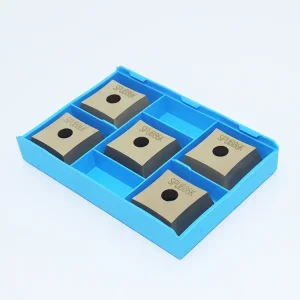
Continuous ERW tube welding produces severe longitudinal flash along inner and outer weld seams. Zhongfu scarfing inserts (SPUB63, SPUB86, SNMX series) with thick CVD TiCN-Al2O3 multi-layer coatings resist red-hardness softening under relentless dry metal contact up to 950°C, maintaining clean burr removal across thousands of continuous pipe meters.
Railway Track Maintenance
Modern high-speed railway tamping tines strike basalt ballast under extreme vibrational impact. Our specialized cemented carbide tips for railway track tamping picks feature specialized coarse-grain tungsten carbide (WC grain 3.5–5.0 µm) brazed onto high-tensile alloy shanks, extending pick service intervals from 40 hours to over 300 tamping hours.
Downhole MWD / LWD Logging
Drilling navigation instruments operate in hostile high-pressure, high-temperature downhole conditions surrounded by abrasive drilling mud. Zhongfu’s nickel-bonded non-magnetic parts deliver absolute zero interference with geomagnetic positioning sensors alongside unyielding erosion resistance against high-velocity bentonite slurries.
Solid Endmill Blanks
High-speed five-axis machining of titanium aero-structures demands solid round carbide rods ground to ISO h6 diametrical tolerance. Our nano-grain tungsten carbide rods with helical interior coolant holes deliver high thermal shock dissipation, eliminating edge-chipping during dry trochoidal milling operations.
End-to-End Powder Metallurgy & Grinding Flow
A rigorous five-stage production framework ensuring 100% trace-element purity and microstructural equilibrium across every custom drawing.
Virgin Wet Ball Milling
100% virgin tungsten carbide and ultra-pure cobalt/nickel powders undergo 48 hours of wet attritor milling with ethanol to achieve homogeneous dispersion without iron contamination.
Spray Drying Tower
Slurry is atomized in closed-cycle nitrogen spray drying towers to form free-flowing spherical granules, ensuring uniform die-cavity filling and minimal shrinkage variance during sintering.
Automated CNC Pressing
High-precision multi-action CNC hydraulic and mechanical presses produce green compacts with near-net-shape geometries, controlled density gradients, and optimized brazing bevels.
Integrated Sinter-HIP
Thermal debinding is followed by liquid phase consolidation under 10 MPa argon overpressure at 1,420°C–1,480°C, eliminating internal voids and establishing metallurgical cohesion.
Sub-Micron Grinding
Centerless grinding, five-axis profile diamond grinding, and metallographic microscope inspections ensure h6 tolerances, mirror surface finishes, and absolute grade consistency.
Next-Generation Cemented Carbide Technological Trajectory
From binderless ultra-hard composites to functionally graded sintered layers and high-entropy alloy binder exploration.
Functionally Graded Sintering
By modulating carbon and nitrogen activity during early sintering stages, a cobalt-enriched, high-toughness surface boundary layer can be generated above an ultra-hard, wear-resistant interior core. This continuous metallurgical gradient completely resolves the historic engineering trade-off between shock chipping and abrasive flank wear in heavy-interruption CNC turning.
High-Entropy Binder Systems
To withstand extreme operating temperatures exceeding 1,100°C without plastic deformation, next-generation grades utilize FeCoNiCrAl multi-principal element binders. These high-entropy alloys form an oxidized barrier film during high-speed machining, effectively suppressing both adhesive wear and cratering dissolution.
Precision Additive Manufacturing
Laser powder bed fusion and binder jetting technologies are unlocking geometrically complex internal cooling galleries for solid drills and molds that were previously impossible to machine through conventional EDM or axial pressing. Post-sintering Sinter-HIP cycles re-densify additive components to reach traditional forging strengths.
Specialized Wear Inserts, Gripper Jaws & Cutting Tools
Precision-ground blanks, brazed lathe cutting tips, centerless ground solid carbide rods, and profile inserts ready for global volume distribution.






Frequently Asked Questions for Wholesale Carbide Buyers
Detailed technical, metallurgical, and commercial answers for tooling directors, sourcing specialists, and design engineers.
Can Zhongfu manufacture tungsten carbide wear parts and inserts directly from customer 2D/3D drawings?
What are the metallurgical differences between submicron and coarse-grained tungsten carbide grades?
Why is Sinter-HIP technology superior to conventional vacuum sintering?
What defines non-magnetic tungsten carbide, and when should it be specified over standard cobalt grades?
How does Zhongfu guarantee lot-to-lot consistency for high-volume overseas OEM contracts?
What are the lead times and minimum order quantities (MOQ) for wholesale and custom tooling blanks?
Collaborate Directly with Zhongfu’s Metallurgical Engineering Team
Eliminate intermediary supply friction. Submit your CAD specifications, operating load profiles, and target wear life parameters to receive an authoritative DFM review and factory-direct wholesale pricing within 8 hours.