Precision Engineered Tungsten Carbide Solutions
Explore our top-tier precision-sintered components manufactured from 100% virgin tungsten monocarbide powders. Built for severe abrasion, extreme compressive stress, and aggressive cutting environments.






Global Tungsten Carbide Machining: Industry Landscape & Evolution
The commercial and engineering landscape for machining tungsten carbide has transitioned from standard tooling production into a high-technology domain dominated by nanoscale metallurgy, cryogenic dry-grinding, and ultra-high-pressure sintering technologies.
Sub-Micron Grain Architecture
Traditional coarse-grain tungsten carbide (WC) alloys often sacrifice hardness to achieve mechanical toughness. Modern powder formulations utilize ultrafine and nano grain sizes (<0.4 µm) with vanadium carbide (VC) and chromium carbide (Cr3C2) grain growth inhibitors, delivering hardness values above 92.5 HRA without micro-fracturing along grain boundaries.
HIP (Hot Isostatic Pressing) Standard
Atmospheric sintering is obsolete for mission-critical tooling. Sinter-HIP processing applies over 10 MPa of inert argon gas pressure at sintering temperatures up to 1450°C. This completely closes internal micro-voids, elevating transverse rupture strength (TRS) to upwards of 4,000 MPa and eliminating wire-EDM pitting risks.
Advanced CVD/PVD Multilayer Coating
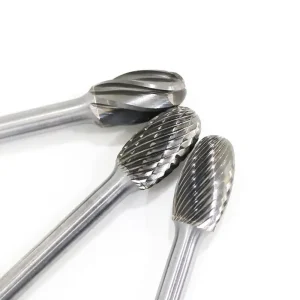
Machined carbide inserts and rotary burs require surface protection under intense thermal shear. High-power impulse magnetron sputtering (HiPIMS) and chemical vapor deposition (CVD) deposit ultra-dense coatings such as AlTiN, AlCrN, and diamond (PCD-like) that withstand interfacial cutting temperatures surpassing 1100°C.
Supply Chain Resilience, Raw Material Dominance & Factory 4.0
China controls over 80% of global upstream tungsten reserves and processing capacity. Zhongfu Carbide harnesses this direct geological advantage in Nanchang, Jiangxi, delivering unprecedented supply chain stability, uncompromised raw material purity, and end-to-end trace control.
Virgin APT Sourcing
Direct access to virgin ammonium paratungstate (APT). Zero recycled scrap powders, preventing trace impurity brittleness and guaranteeing uniform grain crystallographic growth.
Micron Precision (mm)
Integrated 5-axis CNC grinding centers, high-precision centerless grinding machines, and mirror-surface EDM infrastructure achieve true h6 dimensional tolerance on carbide rods.
Digitalized Facility
Fully automated powder blending, high-tonnage hydraulic dry pressing, and centralized SCADA-controlled Sinter-HIP furnaces operational 24/7 with zero thermal drift.
Direct DFM Response
Engineering-led global client support. Receive full Design for Manufacturability (DFM) analyses, CAD/CAM cross-referencing, and metallographic feasibility reviews rapidly.
Global Enterprise Demand: Targeted Industrial Applications
From heavy oil drilling in the Gulf of Mexico to progressive stamping dies in Stuttgart and automotive steel pipe scarfing in East Asia, machining tungsten carbide is the backbone of high-wear industrial engineering.
1. Pipeline Scarfing & ERW Tube Mills
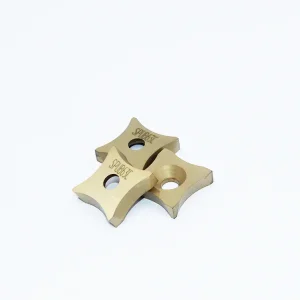
Steel pipe manufacturing relies heavily on internal and external bead removal. Specialized indexable carbide scarfing inserts like the SPUB-63C and SPUB86 (P40 grade) withstand thermal shocks, high shear friction, and intermittent impacts at tube welding speeds exceeding 60 m/min without edge spalling.
2. Electronics & Progressive Stamping Dies
Micro-electronic lead frame stamping requires tooling materials with exceptional edge retention and compressive yield strength. Our YG15 to YG20 thick carbide plates undergo cryogenic aging to eliminate residual stresses, preventing micro-chipping during high-speed wire-EDM cutting operations.
3. Subsea & MWD/LWD Drilling Tools
Magnetic telemetry tools in directional oil drilling cannot tolerate ferromagnetic cobalt binders. Zhongfu supplies nickel-bonded non-magnetic tungsten carbide wear sleeves, mud flow restrictors, and valve trims that offer total corrosion protection against sour gas (H2S) and zero magnetic interference.
4. High-Pressure Grinding Rolls (HPGR)
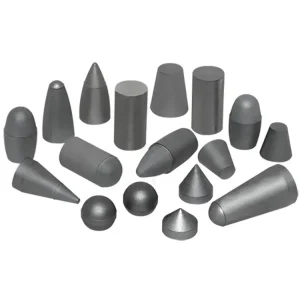
In cement and hard-rock mineral extraction, roll crushers experience devastating abrasive wear. Zhongfu manufactures heavy-duty tungsten carbide studs and inserts with optimized convex profiles that embed into crushing roll faces, multiplying component service life by over 400% compared to hardfaced alloys.
5. Aerospace & Composite Routing
Carbon fiber reinforced polymers (CFRP) and titanium alloys chew through conventional high-speed steel in seconds. Solid carbide round rods with h6 precision ground OD and internal coolant channels allow end-mill manufacturers to create ultra-rigid milling cutters operating at elevated cutting speeds.
6. Mining & Foundation Rotary Burrs
Heavy rotary files, wood scarifier cutters, and weld-on carbide brazed tips must absorb catastrophic mechanical impacts without fracturing. Formulations featuring a bimodal grain structure provide maximum toughness at the braze interface with intense abrasion resistance at the cutting periphery.
Comprehensive Grade Matrix: Physical & Mechanical Properties
Selecting the appropriate cemented carbide grade requires striking the ideal balance between hardness (wear resistance) and transverse rupture strength (fracture toughness). Refer to our engineering benchmark values:
| Carbide Grade | Binder Content (wt%) | Grain Classification (µm) | Density (g/cm³) | Hardness (HRA) | TRS (MPa) | Target Industrial Application |
|---|---|---|---|---|---|---|
| YG6 (ISO K10-K20) | 6.0% Co | 1.0 – 1.4 (Fine) | 14.90 – 15.00 | 90.5 – 91.5 | ≥ 2,100 | Chilled cast iron turning, non-ferrous finishing, wear guides |
| YG8 (ISO K20-K30) | 8.0% Co | 1.4 – 1.8 (Medium) | 14.65 – 14.85 | 89.5 – 90.5 | ≥ 2,400 | Brazed drill tips, tube scarfing, mining rotary burrs, masonry |
| YG11C (Mining Class) | 11.0% Co | 2.2 – 3.0 (Coarse) | 14.30 – 14.50 | 87.0 – 88.0 | ≥ 2,800 | Heavy rock drilling, percussion bits, crushing roll studs |
| YG15 (ISO K40) | 15.0% Co | 1.6 – 2.2 (Medium-Coarse) | 13.95 – 14.15 | 87.0 – 87.5 | ≥ 3,200 | Progressive stamping dies, deep drawing dies, punch matrices |
| YG20 (Impact Die) | 20.0% Co | 2.0 – 2.8 (Coarse) | 13.40 – 13.60 | 85.0 – 86.0 | ≥ 3,600 | Cold heading dies, heavy forging blocks, severe impact dies |
| Ni-NonMag Series | 6.0 – 10.0% Ni | 1.2 – 1.6 (Corrosion Grade) | 14.50 – 14.85 | 88.0 – 90.0 | ≥ 2,300 | Subsea MWD/LWD valves, magnetic media powder compacting |
Frequently Asked Questions: Industrial Procurement & Machining
Authoritative insights from Zhongfu Carbide’s metallurgists and senior production engineers answering critical procurement, machining, and engineering queries.
What machining techniques are viable for shaped tungsten carbide components after sintering?
How does Sinter-HIP technology eliminate internal porosity compared to standard vacuum sintering?
Can non-magnetic nickel-bonded carbide replace cobalt-bonded carbide in high-wear mechanical seals?
What are the key technical parameters required to quote custom carbide wear parts from technical drawings?
How does Zhongfu Carbide ensure batch-to-batch consistency for overseas high-volume orders?
Factory Direct Precision Tooling & Carbide Blanks
Explore our full line of specialized turning tools, heavy-duty thick EDM blocks, rotary billet materials, and scarfing inserts manufactured to international standards.