High-Performance Cemented Carbide Tooling Catalog (Part I)
Direct sourcing from Jiangxi manufacturing hubs. Guaranteed 100% virgin tungsten carbide powder formulated for micron-level wear resistance and extended component service life.







Global Commercial Dynamics of Tungsten Carbide (WC-Co)
Understanding cost formation, raw material indexes (APT), and the shift toward direct manufacturer sourcing in North America, Europe, and Asia-Pacific.
Ammonium Paratungstate Indexing
Tungsten carbide pricing operates on an upstream feedstock index anchored by Ammonium Paratungstate (APT). Variations in mine output quotas, environmental regulatory enforcement across Jiangxi and Hunan provinces, and metallurgical processing fuels directly establish the metric ton baseline. Sophisticated OEM procurement teams hedge pricing by linking quarterly volume contracts to transparent APT market bulletins.
Cobalt & Nickel Binder Fluctuation
The secondary driver of hard alloy cost profiles lies within binder fractions (ranging between 3% and 25% Co/Ni by weight). While cobalt provides vital fracture toughness for heavy-impact cold heading and stamping dies, geopolitical supply concentrations and EV battery sector competition introduce pricing swings. Premium fabricators maintain strategic mineral reserves to guarantee firm pricing windows for tier-1 distributors.
Elimination of Multi-Tier Margins
Procuring finished carbide parts through Western regional tooling catalogs introduces markups from 150% to 300% to offset warehouse footprint and dealer distribution models. By contrast, establishing direct manufacturer connectivity with Chinese foundries captures native production economics, reduces supply chain delays, and delivers unadulterated grade authenticity backed by factory metallography certificates.
China Factory Efficiency Advantages: From Raw Ore to Sintered Blank
Why domestic upstream vertical integration, continuous vacuum pressure sintering, and high-precision CNC multi-axis grinding make Chinese carbide foundries globally dominant.
Localized Supply Proximity
Foundries located in Jiangxi province operate within zero-mile proximity to the world's most concentrated tungsten mining operations. Immediate access to sub-micron WC powder eradicates logistical import latency, insulating overseas clients from global transit disruptions.
Overpressure Sinter-HIP
Advanced Chinese manufacturing facilities utilize computerized 10 MPa overpressure Hot Isostatic Pressing (Sinter-HIP) autoclaves. This simultaneous application of 1450°C heat and inert gas pressure eliminates residual micro-porosity, guaranteeing ISO class A00 metallurgical integrity.
Sub-Micron CNC Grinding
Integrated processing floors feature high-speed CNC profile grinders, centerless grinding arrays, and optical curve EDM machines. Production runs maintain cylindrical roundness tolerances down to 0.001 mm and surface roughness profiles of Ra 0.05 µm for demanding mold core components.
Formulation Engineering
Beyond stock catalogs, custom foundries deploy metallurgical engineers capable of tuning grain growth inhibitors (VC, Cr3C2, TaC) to optimize the hardness-to-toughness equilibrium for client-specific abrasive, shock, or chemical wear environments.
Engineering Grade Matrix: Physical Properties & Wear Formulations
A reference benchmark for procurement engineers and design specialists evaluating cemented carbide grades for extreme stress environments.
| ISO / Chinese Grade | Binder Fraction (wt%) | Grain Size (µm) | Density (g/cm³) | Hardness (HRA) | Transverse Rupture (MPa) | Primary Industrial Use-Case |
|---|---|---|---|---|---|---|
| YG6 / K10–K20 | 6.0% Cobalt | 1.2 – 1.6 | 14.90 – 15.00 | 90.5 ± 0.5 | ≥ 1900 | Cast iron finishing, non-ferrous wire drawing dies, wear plates, ceramic tiles cutters. |
| YG8 / K20–K30 | 8.0% Cobalt | 1.4 – 2.0 | 14.70 – 14.85 | 89.5 ± 0.5 | ≥ 2200 | Brazed cutting tips, geotechnical rotary drill bits, chuck jaw torque grippers, concrete scarifiers. |
| YG15 / K40 | 15.0% Cobalt | 1.8 – 2.4 | 13.90 – 14.15 | 87.0 ± 0.5 | ≥ 2800 | Progressive stamping dies, cold extrusion molds, heavy-shock punch tooling, fastener tooling. |
| YG20 / G50 | 20.0% Cobalt | 2.0 – 3.0 | 13.40 – 13.65 | 85.5 ± 0.5 | ≥ 3100 | Severe impact heading dies, structural cold punching, wire flattening rolls, blanking dies. |
| UF-05 (Nano Grain) | 10.0% Co + Cr/V | 0.4 – 0.6 | 14.40 – 14.55 | 92.5 ± 0.5 | ≥ 3800 | Micro-drills for PCB fabrication, aerospace end mills, titanium alloy machining tools. |
| NM-12 (Non-Magnetic) | 12.0% Nickel Base | 1.5 – 2.2 | 14.30 – 14.50 | 88.0 ± 0.8 | ≥ 2100 | Downhole MWD/LWD directional drilling tools, magnetic sensor shielding, medical surgical parts. |
Five-Stage Metallurgical Traceability & Quality Architecture
Eliminating porosity, thermal cracking, and batch variance through continuous process monitoring.
Virgin WC Formulating
Ball-milling ultra-pure tungsten carbide powder with binder elements and proprietary organic plasticizers under controlled wet milling conditions.
Spray Drying & Pressing
Tower spray granulating produces spherical, free-flowing agglomerates, compacted under multi-axis automated CNC powder presses with precise pressure curves.
10 MPa Sinter-HIP
Integrated dewaxing, high-vacuum sintering, and high-pressure argon gas quenching in unified vessels to collapse internal micro-pores into near-zero density voids.
Precision Finishing
Centerless pass grinding, double-disc face lapping, and precision wire electrical discharge machining achieving geometric tolerances within ±0.002 mm.
NDT & Microstructure
Coercive force, magnetic saturation, Rockwell hardness (HRA), ultrasonic flaw testing, and 1000x metallographic microscope porosity confirmation.
Localized Heavy-Industry Application Scenarios
Deploying specialized tungsten carbide solutions engineered for aggressive wear, intense shock, and abrasive contact.
Railway Infrastructure & Track Maintenance
Modern high-speed rail networks demand robust track bed stability. Our carbide-reinforced ballast tamping tines utilize tailored YG11C and YG15 grades engineered to withstand intense dynamic cyclical hammer impacts against granite ballast. Field data demonstrates a 400% operational life extension compared to structural manganese steel tines, eliminating track possession downtime.
Steel Mills & Continuous Tube Scarfing
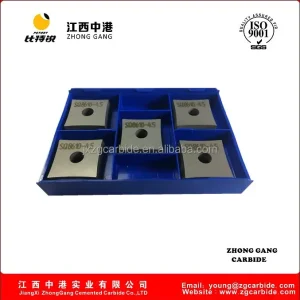
Tube and pipe fabrication involves extreme thermal shocks and abrasive flash removal. Heavy-duty scarfing inserts such as SPUB63, SPUB86, and SNMX19/25 are engineered with multi-layer TiAlN or TiN PVD/CVD coatings. These grades resist thermal shock, preventing edge micro-chipping while shearing through glowing internal and external weld beads at high continuous feed velocities.
Directional Drilling & Petrochemical Flow
Downhole Measurement While Drilling (MWD) assemblies require zero magnetic interference to maintain accurate sensor orientation in directional wells. We manufacture specialized nickel-bonded non-magnetic carbide mud nozzles, sleeves, and pulse valves that exhibit magnetic permeability (μ) of less than 1.05 while resisting severe hydro-abrasive cavitation from barite-loaded drilling mud.
Optimizing Total Cost of Ownership (TCO) for Enterprise Buyers
Purchasing managers and industrial supply chains are transitioning from initial purchase price accounting to lifecycle efficiency metrics.
Downtime vs. Tool Acquisition Economics
For automated stamping, machining, and wire-drawing facilities, the labor and lost throughput cost of a tool change frequently surpasses the tool's purchase cost by 10x. Sourcing consistent, HIP-sintered components reduces unplanned catastrophic line shutdowns, shifting maintenance schedules from reactive containment to predictable uptime planning.
Bespoke OEM Near-Net Shape Consolidation
Ordering preformed blanks shaped close to final drawing profiles drastically reduces expensive diamond wheel grinding passes at the buyer's mold shop. Chinese foundries utilize rapid prototyping EDM, custom powder compaction tooling, and 3D wax green-machining to deliver near-net blanks, reducing client finishing scrap and machining time.
Risk Mitigation Through Lot Audits
Global manufacturers require systematic metallurgical traceability. Established Chinese export partners supply certified QA documentation with every shipment—encompassing spectral purity audits, density measurements, saturation magnetic tests, and microscopic grain boundary evaluations—securing aerospace and automotive supply chain compliance.
Frequently Asked Questions on Sourcing Tungsten Carbide from China
Direct technical answers addressing pricing structures, custom tolerances, raw material integrity, and export procedures.
How are tungsten carbide component prices calculated by Chinese manufacturers?
What is the standard tolerance capability for custom ground rods and plates?
Why is 100% virgin tungsten carbide powder critical compared to recycled scrap?
What is the typical turnaround lead time for custom engineered carbide prototypes?
How does non-magnetic tungsten carbide differ from standard cobalt grades?
High-Performance Cemented Carbide Tooling Catalog (Part II)
Explore our specialized industrial inserts, railway tamping tines, precision ground strips, and custom wear parts engineered for demanding global tooling operations.