
Precision Carbide Tooling & Intermediate Sintered Components
Engineered from certified virgin powders and premium chemically regenerated tungsten carbide. Each insert and rod is vacuum-HIP sintered to eliminate structural microporosity.







Executive Whitepaper: Strategic Reclaimed Tungsten & Scrap Value Stream
A rigorous metallurgical analysis of global scrap circulation, secondary wolfram extraction, and how leading Chinese processing factories guarantee purity, ESG alignment, and mechanical equivalence to virgin ore.
The Geopolitical & Metallurgical Realities of Secondary Tungsten
Tungsten (Wolfram, atomic number 74) remains an indispensable strategic metal due to its unsurpassed melting point (3,422°C), extreme density (19.25 g/cm³), and exceptional hardness when carburized into tungsten carbide (WC). As primary extraction faces steep ore-grade degradation, geopolitical export quotas, and intense environmental scrutiny, secondary tungsten scrap has evolved from a marginal cost-saving feedstock into the foundation of global critical mineral resilience.
For industrial consumers—ranging from cutting tool fabricators and wear component OEM manufacturers to rotary die makers—securing reliable channels to buy tungsten scrap manufacturer and factory direct supply represents a structural operational hedge. Secondary tungsten bypasses the calcination, acid digestion, and solvent extraction steps required for wolframite or scheelite concentrates, decreasing energy intensity by up to 75% and reducing greenhouse gas (GHG) footprints by over 60% per ton of recovered metal.
Technical Metallurgy Axiom: "Secondary tungsten reclaimed via chemical digestion is atom-for-atom indistinguishable from primary mined wolframite. Chemical refining to Ammonium Paratungstate (APT) strips all previous metallurgical history, reset boundaries, and guarantees virgin mechanical performance."
Scrap Classification: Solid Carbide Scrap vs. Secondary Soft Sludges
Industrial tungsten scrap streams broadly diverge into two distinct physical and metallurgical classes, each demanding dedicated processing routes:
Class I: Premium Solid Scrap
Consists of worn CNC inserts, endmills, PCB micro-drills, wear blocks, and scarfing blades. Typically exhibits high purity (88–94% WC, 6–12% Co). Amenable to direct zinc recycling or rapid chemical dissolution with minimum slag loss.
Class II: Heavy Wear & Mining Scrap
Comprises tricone bit inserts, road planing picks, railway tamping tine tips, and drill buttons. Often contains brazing alloy contaminations (Cu-Zn or Ag solder) and adhering steel shank fragments that mandate thermal or acid stripping.
Class III: Soft Scrap & Grinding Swarf
Generated by tool grinding operations. Represents micro-sized carbide particulates contaminated with coolant oils, grinding wheel abrasive media (silicon carbide or resin-bonded diamond), requiring specialized pyro-metallurgical roasting.
Metallurgical Transformation Pathways: Zinc Process vs. Chemical Digestion
Selecting between the pyrometallurgical Zinc Process and hydrometallurgical Chemical Conversion determines the terminal microstructural integrity and mechanical suitability of recycled cemented carbide.
| Evaluation Parameter | Pyrometallurgical Zinc Process | Hydrometallurgical Chemical Reclamation |
|---|---|---|
| Operating Principle | Molten zinc forms an alloy with cobalt at 800–900°C; vacuum distillation removes zinc, leaving sponge WC powder. | High-pressure alkaline leaching converts tungsten into sodium tungstate, followed by solvent extraction into pure APT. |
| Microstructural Memory | Retains Original WC Grain Size | Complete Atomic Reset (Grain Resynthesized) |
| Trace Contaminants (Ti, Ta, Cr) | Retained in final powder cake; can alter grade properties. | Precipitated and separated completely; 99.95%+ pure W. |
| Cobalt Phase Separation | Cobalt is physically separated into the powder blend. | Cobalt is precipitated as pure cobalt sulfate or cathode metal. |
| Primary Industrial Applications | Mining tools, lower-stress wear parts, cold-heading backing dies. | Ultra-fine sub-micron drills, high-speed endmills, medical tools. |
| Processing Energy Consumption | Low (~3,500 kWh/t) | Moderate to High (~7,000 kWh/t, yet 70% below virgin mining) |
Microstructural Control: Preventing Decarburization and the Eta-Phase (Co3W3C)
When engineering high-integrity sintered carbide products from recycled powder batches, precise stoichiometric carbon control is critical. Any variation in carbon content within the narrow window of 6.13% wt. WC can drastically degrade mechanical strength:
Sub-stoichiometric Carbon (Decarburization): If secondary powder suffers oxygen intake during processing, carbon reacts to form CO/CO2, triggering the precipitation of fragile ternary carbide phases known as Eta-Phase (η-phase, $\mathrm{Co_3W_3C}$ or $\mathrm{Co_6W_6C}$). Eta-phase structures introduce brittle micro-notches, reducing transverse rupture strength (TRS) by as much as 45% and leading to catastrophic micro-fractures under cyclic mechanical shock.
Hyper-stoichiometric Carbon (Free Carbon Inclusion): Conversely, excessive carbon dosing during re-sintering results in unbonded graphite flakes. These free graphite flakes act as mechanical voids, sharply reducing compressive fatigue limits and surface polishability in precision EDM mold applications.
China Factory Advantages: Integrated Metallurgy & Capacity Hegemony
Why Tier-1 international tooling manufacturers and material distributors partner directly with Chinese manufacturers for secondary tungsten conversion and high-performance component fabrication.
80%+ Global Smelting Scale
China commands over 80% of global APT chemical capacity, centered in Jiangxi and Hunan provinces, ensuring complete raw material availability and resilience against cross-border supply shocks.
Closed-Loop Toll Conversion
Modern Chinese factories offer complete toll-conversion pipelines: international buyers export contaminated carbide scrap and receive standardized HIP-sintered inserts, ground rods, or dies with clear metallurgical tracing.
Pressure HIP-Sintering Control
Equipped with computerized high-pressure sinter-HIP furnaces operating at 100 bar argon atmospheres, eliminating all residual microporosity and producing densities matching theoretical maxima (14.5–15.1 g/cm³).
Total Cost of Ownership
Integration across powder extraction, ball-milling, spray-drying towers, multi-axis automated pressing, and centerless h6 grinding delivers up to a 28–38% unit-cost advantage over fragmented Western supply networks.
Assay & Spectrometry
Optical emission and ICP-OES validation of tungsten scrap mass, segregating high-cobalt from nickel-bonded materials.
De-brazing & Extraction
Thermal stripping of silver/copper solder, chemical dissolution, or controlled zinc-distillation at 900°C under vacuum.
Wet Ball Milling & Dopants
Wet milling with wax binders, grain-growth inhibitors (VC, Cr3C2), and nano-grain adjustments in alcohol slurries.
Spray Drying & Pressing
Transforming slurries into free-flowing spherical granules for automatic hydraulic or multi-action axial powder pressing.
100-Bar Sinter-HIP
Simultaneous dewaxing, liquid-phase sintering at 1,420°C, and 100 bar isostatic pressing for pore-free structure.
Global Enterprise Procurement Standards & Assay Specifications
Technical benchmarks for evaluating scrap lots, minimizing weight deductions, and negotiating moisture and foreign metallic tolerances in commercial master purchase agreements.
Scrap Inbound Acceptance Thresholds & Penalties
When purchasing tungsten scrap lots or dispatching feedstock to manufacturing factories for conversion, procurement managers must apply clear chemical parameters. Failure to track trace elements can result in batch poisoning during resintering:
| Impurity Element | Max Allowable Limit (ppm / %) | Metallurgical Hazard & Rejection Threshold |
|---|---|---|
| Free Iron (Fe) | < 0.15% (1500 ppm) | Promotes uncontrollable WC grain coarsening; reduces hardness and tool edge retention. |
| Copper (Cu) / Zinc (Zn) | < 0.05% (500 ppm) | Volatilizes inside the sinter-HIP furnace, inducing micro-porosity and heating element failure. |
| Sulfur (S) / Phosphorus (P) | < 50 ppm | Segregates to WC-Co grain boundaries, severely weakening cohesion and causing catastrophic chipping. |
| Moisture / Organic Oils | < 0.20% wt. | Moisture triggers erratic carbon oxidation; weight deduction applied directly to gross invoice value. |
Valuation Formulas and Inbound Pricing Algorithms
Pricing for tungsten scrap lots in international commerce correlates directly with the European Metal Bulletin (MB) or Argus Media spot quotations for Ammonium Paratungstate (APT, 88.5% WO3 basis). Leading manufacturers compute commercial settlement values using standardized formulas:
Settlement Index Formula:
Settlement ($/kg W contained) = [MB APT Quote ($/mtu) ÷ 10] × W_Purity_Factor × Yield_Efficiency − Smelting_Toll_Fee
Where 1 mtu (metric ton unit) contains 7.93 kg of pure tungsten, and Yield_Efficiency ranges between 94% (for solid clean inserts) and 82% (for oxidized grinding sludges).
Regulatory Compliance, Basel Convention & Cross-Border Logistics
Navigating transboundary waste regulations, the European Union Critical Raw Materials Act (CRMA), conflict-free smelting verifications, and duty-free tariff classifications.
Basel Convention & Green List Waste
Solid cemented carbide scrap classified under Basel Code B1010 (clean scrap metals) qualifies for streamlined green-list transit, avoiding lengthy hazardous waste notification cycles when certified clean and degreased.
EU CRMA & Scope 3 Decarbonization
Under the European Critical Raw Materials Act, tier-1 industrial companies must source at least 25% of strategic raw materials from secondary sources. Our certified reclaimed carbide components deliver full Scope 3 emissions reductions.
RMAP Conflict-Free Audits
Full compliance with the Responsible Minerals Initiative (RMI) under the Responsible Minerals Assurance Process (RMAP), verifying secondary scrap provenance and safeguarding against conflict-linked tungsten feedstocks.
Localized Engineering & Consignment Warehousing
Procuring from Chinese manufacturing hubs no longer means prolonged sea-transit vulnerabilities. Zhongfu Carbide operates dedicated localized technical hubs and consignment stocking buffers across key commercial zones in North America, Western Europe, and Southeast Asia. These local hubs provide:
- Fast Metallographic Audits: On-site microstructural verification and Rockwell HRA hardness testing within 24 hours of delivery.
- Consignment Inventory Buffers: Standardized plates, h6 rods, and tube scarfing inserts stocked locally, shielding buyers from freight disruptions.
- Scrap Buy-Back Programs: Direct collection contracts credited against deliveries of finished precision tooling, locking in cost advantages.
Industrial Application Scenarios for High-Integrity Reclaimed Carbide
Strategic deployment of reclaimed and hybrid tungsten carbide grades across high-wear, high-impact industrial operations.
Steel Tube Scarfing & Rolling
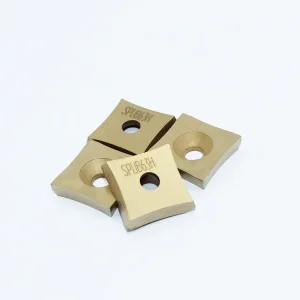
Heavy-duty scarfing inserts (SPUB63, SNMX19) endure severe thermal cycling and abrasive steel weld flash removal, relying on refined grain structures to prevent edge spalling.
Mining & Railway Ballast Tamping
Railway tamping tines and rock drill bits demand high cobalt binder ratios (8–15% Co) with optimized fracture toughness ($K_{1C} > 12\,\mathrm{MPa\cdot m^{1/2}}$) to withstand high-frequency ballast shock.
Non-Magnetic Metering Shafts
Nickel-bonded non-magnetic cemented carbide grades (substituting cobalt) eliminate electromagnetic interference in precision water meters, downhole MWD/LWD drilling tools, and inspection instruments.
Market Dynamics, Price Projections & Advanced Metallurgical Frontiers
The convergence of artificial-intelligence-driven scrap sorting, binder phase engineering, and shifts in global critical mineral trade policies.
Long-Term Pricing Pressures & Scrap Value Indexation
Over the next decade, secondary tungsten scrap is projected to command an increasing percentage of primary metal pricing. Environmental compliance fees associated with primary ore digestion in China and expanding global industrial electrification will keep the tungsten market tightly supplied. Manufacturers with closed-loop reclamation and integrated furnace assets will provide downstream industrial clients with stable long-term pricing, mitigating the volatility of primary ore markets.
Spectroscopic AI Sorting: Eliminating Chemical Contamination
The integration of Laser-Induced Breakdown Spectroscopy (LIBS) and automated X-ray Fluorescence (XRF) sorting robotics has transformed scrap receiving lines. Where manual sorting once carried contamination risks (such as unintended mixing of tantalum or titanium carbide grades into pure WC-Co streams), computer-vision sorting platforms inspect individual inserts at up to 15 pieces per second, ensuring feedstock purity matches rigorous virgin-grade specifications.
Frequently Asked Questions: Scrap Procurement & Toll Processing
Authoritative engineering insights addressing the key operational questions asked by purchasing directors and metallurgical specialists.
Can recycled tungsten carbide components match the mechanical performance of virgin ore?
What is the difference between scrap processed via the Zinc Process vs. Chemical Leaching?
What are the primary factors leading to scrap shipment price deductions?
How does Zhongfu Carbide prevent the formation of brittle Eta-phase (η-phase) in recycled carbide?
What export classifications and documentation are required to ship tungsten scrap to China?
Does Zhongfu Carbide provide customized toll-conversion services for global clients?
How does non-magnetic cemented carbide differ from standard cobalt-bonded grades?
What are the standard delivery lead times for custom tooling manufactured from reclaimed feedstocks?
High-Performance Cemented Carbide Wear Parts & Tooling Blanks
Manufactured from our integrated secondary & virgin metallurgy lines. Sinter-HIP consolidated to ensure zero structural microporosity and long wear life.







Secure Certified Secondary Tungsten Supply & Toll Conversion
Connect directly with our metallurgical engineering team in Nanchang, Jiangxi. We provide complimentary scrap lot evaluations, comprehensive ICP-OES assays, and factory-direct pricing on custom-sintered components within 8 operating hours.