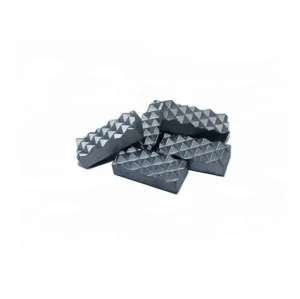
Standard & Custom Sintered Carbide Blanks
Fully dense, hot isostatically pressed (HIP) tungsten carbide blanks and profile tools engineered for maximum fatigue resistance in metalworking, energy, and downhole tooling.







Technical Roadmap & Powder Metallurgy Advancements
Demanding mechanical operating environments necessitate next-generation submicron microstructures, custom binders, and advanced sintering kinetics to surpass legacy wear life benchmarks.
Ultrafine & Nano-Grain WC Substrates
By controlling tungsten grain growth down to 0.2–0.4 µm using VC and Cr3C2 grain refiners, our sintered profiles attain hardness exceeding 93 HRA without forfeiting fracture toughness (K1c > 10.5 MPa·m½).
Alternative & Non-Magnetic Binders
Pioneering multi-element Ni-Cr-Mo matrix systems to eliminate ferromagnetic susceptibility for directional drilling sensors while providing exceptional resistance to acid attack in harsh electrochemical environments.
High-Pressure Sinter-HIP Consolidation
Our proprietary 100-bar argon atmosphere Sinter-HIP cycles ensure virtually A00/B00 porosity, completely healing micro-voids, elevating transverse rupture strength (TRS) to upwards of 4,000 N/mm².
Macro Industry Solutions & Application Scenarios
From heavy billet scarfing in high-throughput steel rolling mills to high-vibration downhole MWD assemblies, our custom cemented carbide grades resolve complex operational wear modes.
Energy & Geothermal Drilling
Severe abrasive drilling slurries, mud pulsation, and mechanical shock wear out traditional steels rapidly. We supply radial bearing sleeves, rotor-stators, and non-magnetic MWD housing components that thrive beyond 200°C downhole conditions.
Heavy Tube Scarfing & Steel Mills
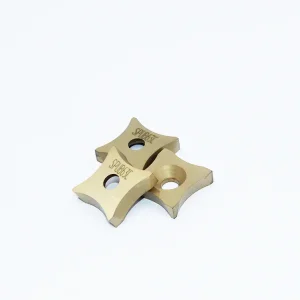
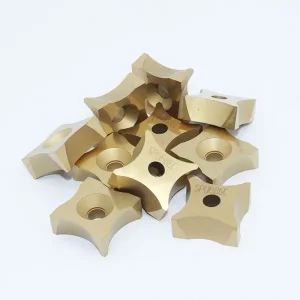
Our SPUB63, SPUB86, SNMX, and custom scarfing inserts feature advanced edge preparations and micro-hardness profiles formulated to slice weld beads and scale reliably from ERW pipes under thermal cycling.
Precision Progressive Dies & Punching
High-cobalt grades (YG15–YG20) provide structural compliance to resist cyclical mechanical impact during sheet metal stamping, connector punching, and semiconductor lead-frame tooling without micro-chipping.
China Factory 4.0: Supply Chain Resilience & Efficiency
Located in Nanchang, Jiangxi—the upstream hub of the world's primary tungsten deposits—our 5,000 m² smart plant integrates direct raw material security with closed-loop Industry 4.0 manufacturing.
Direct Upstream Mineral Integration
Being positioned alongside domestic APT (Ammonium Paratungstate) refining plants isolates our buyers from international raw material spikes, ensuring fixed supply quotas and guaranteed lot-to-lot purity.
Continuous In-Line Metrology
Every batch undergoes rigorous coercive force (Hc), magnetic saturation (4πσ), and density verification alongside laser-micrometric profiling, ensuring tolerances as narrow as ±0.002 mm on ground rods.
Agile Pilot-to-Volume Tooling
Flexible dry-bag isostatic presses combined with 5-axis CNC green-machining allow rapid prototyping of complex components without dedicated hard-die tooling costs, cutting lead times down to 10–14 days.
Global Enterprises Procurement Matrix & Metallurgical Guide
Material selection directly dictates downtime, tool re-grind intervals, and ultimate cost-per-part. Review our primary industrial grade specifications before submitting custom drawings.
| ISO / Grade | Binder (Co/Ni %) | Density (g/cm³) | Hardness (HRA) | TRS (N/mm²) | Primary Industrial Use-Case |
|---|---|---|---|---|---|
| YG6 (K10–K20) | 6.0% Co | 14.90 | 90.5 | 2,200 | Non-ferrous machining, wear plates, drawing dies, wire nozzles |
| YG8 (K20–K30) | 8.0% Co | 14.70 | 89.5 | 2,500 | Chuck jaws, gripper inserts, rock drilling bits, brazed cutting tips |
| YG15 (K40) | 15.0% Co | 14.00 | 87.0 | 3,100 | Heavy stamping punches, cold heading dies, metal forming tools |
| YG20 (Impact Grade) | 20.0% Co | 13.50 | 85.5 | 3,600 | Extreme impact cold heading dies, blanking punches, EDM blocks |
| NM-10 (Non-Magnetic) | 10.0% Ni Binder | 14.50 | 88.5 | 2,400 | MWD downhole subassemblies, magnetic punch molds, corrosion rings |
Localized Support & Global Compliance Framework
Exporting engineered carbide parts across North America, the European Union, Australia, and ASEAN regions backed by full material traceability and dedicated multi-lingual engineering teams.
Certificates of Analysis (CoA) & RoHs
Every export shipment is shipped alongside comprehensive 3.1 Mill Test Certificates containing chemical spectroscopy, grain sizing micrographs, and hardness curves meeting strict EU REACH & RoHS mandates.
DDP Logistics & Just-In-Time Warehousing
Offering door-to-door Delivered Duty Paid (DDP) logistics, customs clearance, and consignment buffer-stock programs for long-term contract manufacturers in North America and Western Europe.
Dedicated Metallurgical Consultation
Consult directly with our on-staff metallurgists to conduct premature failure analysis on competitor parts, fine-tuning binder fractions and cobalt leaching barriers to resolve your application pain points.
Frequently Asked Questions for Industrial Buyers
Clear, direct answers regarding custom tooling, tolerances, binder selection, and quality assurance processes.
Can Zhongfu manufacture tungsten carbide parts from my technical drawing?
What is the difference between standard WC-Co and non-magnetic carbide grades?
How does vacuum Sinter-HIP processing compare to conventional hydrogen sintering?
What standard tolerances can your factory maintain on ground carbide rods and wear parts?
What are your typical prototype and production lead times for overseas export?
Heavy Industrial Tooling & Specialized Inserts
Precision-engineered wear components, indexable turning tips, tube scarfing cutters, and railway tamping tines built to sustain continuous abrasive friction.