

Precision Engineering Catalog
High-Performance Scarfing, Peeling & Custom Carbide Inserts
Direct factory wholesale lines manufactured with virgin tungsten powder, sintered in 100-bar HIP furnaces, and ground to micron tolerances for seamless metalworking and steel mill operations.





Metallurgical Mechanics
What Is Carbide Used For? Comprehensive Industrial Material Mechanics
Cemented tungsten carbide (often referred to simply as "carbide" or hardmetal) is an inorganic composite consisting of equal parts tungsten and carbon atoms (WC) consolidated within a ductile metallic binder matrix (Cobalt or Nickel). Explore why modern industry considers it the apex engineering material for extreme environments.
Extreme Abrasive Wear Resistance
Carbide maintains a Mohs hardness of 9.0 to 9.5 and Vickers hardness ranging between HV 1200 and HV 2400. Unlike structural steels or tool steels (HSS) which soften dramatically above 400°C, tungsten carbide resists micro-cutting, sliding galling, and cavitation erosion at temperatures surpassing 800°C.
Wear Plates
Nozzles
Fluid Seals
Compressive Strength & Rigidity
Cemented carbide possesses a Young’s Modulus of Elasticity of 550 to 650 GPa—nearly three times that of standard alloy steel. Its ultimate compressive strength reaches 4,000 to 6,000 MPa, allowing cutting tools and forming punches to resist deflection, chatter, and plastic deformation under astronomical mechanical loads.
Heading Dies
Bar Peeling
Boring Bars
Microstructural Tailorability
By modulating the refractory WC grain boundary size (from sub-micron 0.2 µm nano-grains to coarse 5.0 µm mining grains) and tuning cobalt content from 3% to 25%, our factory alters the trade-off curve between fracture toughness (K1C) and abrasive resistance to match extreme application parameters.
YG6 to YG20
Ni-Bonded
ISO K10-K40
24+
Years Sintering Heritage
100 Bar
HIP Sintering Pressure
±0.002 mm
Grinding Tolerance Limit
< 8 Hours
DFM Engineering Response
Localized Heavy Industry
Mission-Critical Applications of Carbide in Global Manufacturing
From deep subterranean drilling in North America to high-speed steel tube mills across Europe and Asia, tungsten carbide provides the microscopic cutting edges and structural wear shields that keep heavy operations running without unplanned downtime.
ERW Steel Tube & Pipe Mills
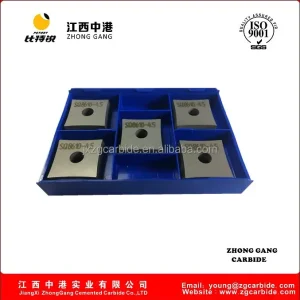
In continuous High-Frequency Electric Resistance Welded (ERW) tube mills, OD scarfing inserts (SQ8615, SDUW) strip fiery weld beads at line speeds up to 120 m/min under constant red-hot thermal shock. Carbide's elevated hot hardness prevents rapid cratering and edge micro-chipping.
CNC Machine Tools & Bar Peeling
During peeling of black hot-rolled alloy bars into mirror-finished bright bars, SPUB86 & SPUB63 inserts face severe interrupted cut loads, scale abrasion, and aggressive chip hammering. Premium grade carbide tips ensure vibration-free peeling and prolonged tool life.
Downhole MWD & Subsea Valves
Directional oil and gas drilling exposes components to high-velocity drilling mud containing quartz sand. For Measurement While Drilling (MWD) pulse generators, nickel-bonded non-magnetic carbide prevents electromagnetic distortion while withstanding erosion rates up to 10× longer than Stellite alloys.
Mining, Tamping & Civil Foundation
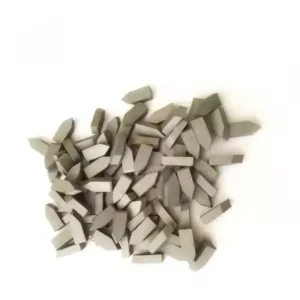
Railway ballast tamping picks and rock gripper buttons require extreme transverse rupture strength (TRS > 2,800 MPa). Cemented carbide tips absorb repetitive high-cycle impact against granite ballast, ensuring continuous ballast compaction without catastrophic tooth breakage.
Supply Chain Excellence
China Factory Direct: Upstream Vertical Integration & Agile Scale
Why Tier-1 industrial buyers, tooling distributors, and contract manufacturers partner directly with Jiangxi Zhongfu for wholesale carbide blanks, preforms, and finished ground wear solutions.
Raw Ore Upstream Proximity
Situated in Jiangxi Province—the epicentre of global tungsten reserves—our factory holds uninterrupted access to high-purity Ammonium Paratungstate (APT). We use 100% virgin tungsten powder, completely eliminating batch variations caused by scrap-reclaimed powders with uncontrolled trace impurities.
Advanced Sinter-HIP Metallurgy
Atmospheric sintering leaves micro-porosity (A04/B04 class), creating stress concentration zones under heavy shock. Our advanced Overpressure Sinter-HIP furnaces operate at 100 bar argon pressure at 1450°C, compressing internal voids to achieve near-theoretical density (>99.9%) and zero-defect microstructure.
Rapid Custom Tooling (DFM)
Our in-house tool and die design facility manufactures bespoke pressing dies and CNC preform profiles in 24–48 hours. Overseas buyers bypass multi-tier distributor markups, saving 30–45% on total cost of acquisition while cutting prototype lead times from 10 weeks to under 15 working days.
Material Selection Guide
Engineering Grade Specifications & Property Matrix
Shortlist optimal carbide grades based on your specific application severity. The fundamental rule of powder metallurgy: lower binder content yields superior abrasive wear resistance; higher cobalt yields greater impact fracture toughness.
| Standard Grade | Binder (Co/Ni %) | Grain Size (µm) | Density (g/cm³) | Hardness (HRA) | TRS (MPa) | Primary Industrial Application |
|---|---|---|---|---|---|---|
| YG6 (ISO K10-K20) | 6.0% Co | 1.2 – 1.6 | 14.90 – 15.00 | 90.5 | 2,100 | Chilled cast iron turning, wire drawing dies, wear strips |
| YG8 (ISO K20-K30) | 8.0% Co | 1.4 – 2.0 | 14.70 – 14.85 | 89.5 | 2,400 | Tube scarfing inserts, brazed tips, core drill bits |
| YG15 (ISO K40) | 15.0% Co | 2.0 – 3.2 | 14.00 – 14.15 | 87.0 | 2,800 | Cold heading dies, heavy stamping punches, high-impact tooling |
| YG20 (Heavy Impact) | 20.0% Co | 2.4 – 3.6 | 13.50 – 13.70 | 85.5 | 3,100 | Extrusion dies, fastener cold forging, thick EDM blank stock |
| UF06 (Nano-Grain) | 6.0% Co + Cr/V | 0.4 – 0.6 | 14.85 – 15.00 | 93.2 | 3,800 | Solid carbide endmills for hardened steel (HRC >60), micro-drills |
| YN8 (Non-Magnetic) | 8.0% Ni Binder | 1.5 – 2.2 | 14.60 – 14.80 | 88.5 | 2,200 | MWD downhole directional tools, magnetic media compaction dies |
Future-Proof Metallurgy
Technical Roadmap: Next-Generation Cemented Carbide Innovations
As global industries demand greater energy efficiency, higher surface machining speeds, and compliance with stringent chemical safety standards, our R&D team leads four transformative technological initiatives.
Alternative Green Binders (Co-Free)
To eliminate workplace cobalt exposure concerns and mitigate international REACH regulations, Zhongfu is advancing Fe-Ni-Cr intermetallic matrices. These sustainable binders deliver equivalent transverse rupture strength while yielding superior corrosion resistance in acidic drilling environments.
Multi-Layered AlTiSiN / Diamond Coatings
By pairing in-house HIP substrate preforms with plasma-enhanced Physical Vapor Deposition (PVD) and Chemical Vapor Deposition (CVD), we deposit nanostructured gradient TiAlSiN and diamond films up to 20 µm thick, enabling dry cutting of heat-resistant superalloys at 1100°C.
Binder Jetting 3D Sintering
Our additive manufacturing pipeline enables the printing of internal coolant channels and conformal geometries inside cemented carbide components without expensive tooling dies. Post-print Sinter-HIP processing restores 100% full density, bridging intricate rapid prototyping and series production.
Quality & Compliance
Global Standards Compliance & Engineering Assurance
Every shipment is certified against rigorous metallographic testing protocols. We eliminate the variability that causes unexpected production shutdowns for overseas end-users.
ISO 9001:2015 Traceability
End-to-end lot tracing from incoming raw wolframite concentrates to final dispatched pallets. Physical samples from every heat batch are archived for 36 months.
ASTM Porosity Verification
Substrates undergo 1000× optical metallography per ASTM B276 to verify uncombined carbon (graphite) and eta-phase embrittlement (Co3W3C), ensuring porosity rated A00-B00.
Sub-Micron Metrology (CMM)
Our temperature-controlled metrology lab employs Zeiss 3D coordinate measuring machines, optical projectors, and laser micrometers ensuring h6 roundness within ±0.002 mm.
Overseas DDP Logistics
Custom packaging with anti-rust vapor barrier films, shock-absorbing wood crates, and seamless door-to-door DDP air/sea freight clearing with full mill test certificates (MTC).
Technical FAQ
Frequently Asked Engineering & Procurement Questions
In-depth responses from our chief metallurgists to resolve technical and supply-chain inquiries prior to placing OEM wholesale contracts.
What makes cemented tungsten carbide radically superior to High-Speed Steel (HSS) and silicon carbide?
Cemented tungsten carbide is a metal matrix composite (cermet) where hard tungsten carbide grains are cemented by metallic cobalt. Unlike HSS, which suffers rapid thermal softening at temperatures over 500°C, carbide retains its high hardness (HRA 88–93) up to 800°C–900°C. While pure ceramics like silicon carbide or alumina have high hardness, they suffer from extreme brittleness with low fracture toughness. Cemented carbide balances diamond-adjacent hardness with mechanical impact resistance (TRS up to 3,800 MPa), making it the only viable material for high-speed interrupted metal cutting, rock drilling, and severe cold forming.
How do I determine whether my application requires a fine-grain or coarse-grain carbide grade?
Grain size dictates the microscopic mean free path of the binder phase. Sub-micron and nano-grains (0.2 µm – 0.8 µm) minimize the inter-particle distance, dramatically increasing hardness and compressive strength. They are essential for solid carbide endmills, PCB micro-drills, and finishing inserts cutting abrasive titanium or hardened steels. Conversely, coarse grain sizes (2.5 µm – 5.0 µm) blunt micro-crack propagation under heavy impact, providing exceptional fracture toughness required for railway tamping picks, rotary mining chisel bits, and heavy cold heading punches.
Why is 100-bar Sinter-HIP processing mandatory for industrial wear parts?
Conventional vacuum sintering relies solely on capillary liquid-phase forces to collapse porosity, often leaving residual microporosity (ASTM A04–A08 class). In high-stress applications like tube scarfing or high-pressure waterjet orifices, these residual microscopic voids serve as crack initiation nuclei that lead to sudden catastrophic breakage. Our Overpressure Sinter-HIP furnaces inject up to 100 bar of inert argon gas during the final liquid binder stage, forcing molten cobalt into any residual micro-voids to deliver 99.99% theoretical density and near-zero internal defect rates.
Under what operating circumstances should Nickel binder be chosen over Cobalt?
Cobalt is inherently ferromagnetic and prone to galvanic leaching when exposed to acidic fluids (pH < 7), marine chloride atmospheres, or chemical slurries. Nickel-bonded carbide offers non-magnetic properties (magnetic permeability µ < 1.05), which is mandatory for downhole Measurement While Drilling (MWD) directional guidance tools to prevent compass deflection. Furthermore, nickel matrices resist electrochemical corrosion up to 10× better than cobalt in wet food processing, pharmaceutical tablet punches, and corrosive subsea valve trims.
Can Zhongfu manufacture non-standard geometry parts from 3D CAD models?
Yes. Custom OEM/ODM manufacturing represents more than 60% of our total factory throughput. Clients can submit STEP, IGES, or DXF files. Our engineers conduct rapid Design for Manufacturability (DFM) reviews within 8 hours. We determine whether the part should be shaped via uniaxial hydraulic pressing, cold isostatic pressing (CIP) with green-state 5-axis CNC machining, or diamond-wheel grinding post-HIP sintering. Custom tooling dies can be completed in-house in 3–5 working days.
What parameters cause tube scarfing inserts (SQ8615, SDUW) to fail prematurely?
Early failure in ERW tube scarfing typically originates from three variables: incorrect corner radius selection causing stress concentration, thermal fatigue micro-cracking (thermal checking) due to intermittent cooling water splashing on the red-hot cutting zone, or excessive cobalt leaching during hot steel weld bead removal. We counter this by formulating dedicated scarfing grades (such as SQ8615WCB) incorporating secondary cubic carbide additives (TaC/NbC) to boost hot plastic deformation resistance, along with radius profiling to distribute cutting pressures evenly.
Advanced Hardware Catalog
Precision Ground Rods, Tamping Teeth & Heavy Alloy Preforms
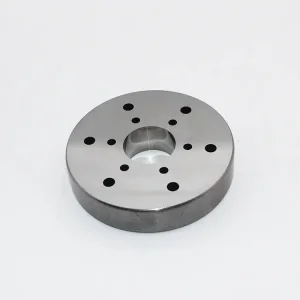
Complete your supply chain requirements with ground h6 rods, heavy machinery gears, flange components, railway picks, and heavy alloy shielding plates engineered to international standards.







Accelerate Your Tungsten Carbide Sourcing Direct from Factory
Whether you require standard SPUB bar peeling inserts, high-precision h6 round rods, or bespoke wear components engineered to CAD drawings, our technical engineering team delivers quotation packages and DFM feedback in under 8 hours.