
High-Performance Scarfing, Peeling & Tooling Inserts
Direct manufacturer allocation of extreme-durability cemented carbide grades, CVD/TiN engineered coatings, and tight dimensional tolerance blanks designed for continuous industrial machining.







Strategic Advantages of Sourcing from China's Tungsten Hubs
How deep territorial concentration in Jiangxi and Hunan drives unmatched raw material access, furnace throughput stability, and direct cost leadership for international tooling conglomerates.
In the global powder metallurgy and hardfacing sectors, purchasing tungsten directly from China’s leading production corridors represents more than a logistical convenience—it is a core structural hedge against global supply volatility. China accounts for over 80% of the world’s refined tungsten reserves and primary output. By situating heavy manufacturing in provinces such as Jiangxi (the historical cradle of wolframite deposits) and Hunan (the hub of scheelite concentration), state-of-the-art smelting operations maintain direct, frictionless access to Ammonium Paratungstate (APT), pure Tungsten Oxide (WO3), and ultrafine Tungsten Carbide (WC) powders.
For global procurement executives and original equipment manufacturers (OEMs), procuring tungsten raw stock, sintered plates, and finish-ground inserts from vertically integrated factories eliminates the compound margin layers created by international intermediaries. Because the upstream conversion—from black wolframite concentrate to pure blue oxide, then to reduced tungsten metal powder via hydrogen reduction—occurs locally, material consistency is rigorously preserved. Every batch demonstrates uniform grain distribution, tight carbon saturation windows, and trace impurity controls (limiting Fe, Al, Si, and S below 15 ppm).
100% Virgin Powder Integrity
Unlike regional outfits dependent on recycled turnings and contaminated scrap, premier industrial suppliers process pure virgin APT, safeguarding continuous fracture toughness and eliminating micro-void formation under cyclic thermal loads.
- Controlled Fischer Sub-Sieve Sizer (FSSS) range
- Near-zero tramp element contamination
Complete Sinter-HIP Consolidation
By pairing high-pressure Sinter-HIP furnaces operating at 1,450°C and 100 bar argon overpressure, factories completely collapse internal microporosities, elevating transverse rupture strength (TRS) to maximum theoretical density.
- ISO-rated A02/B00 porosity ratings
- Superior resistance to subsurface shear fracture
Flexible Microstructure Formulation
Proprietary grain growth inhibitors such as Vanadium Carbide (VC) and Chromium Carbide (Cr3C2) are dosed precisely during ball milling, arresting abnormal WC grain growth to guarantee high-uniformity submicron matrices.
- Submicron (0.4–0.8 µm) to coarse (3.0–5.0 µm)
- Tailored cobalt binder content from 3% to 25%
Global Tungsten Industry Trends: Nanograins, Cobalt Substitution & Smart Tooling
Analyzing key structural shifts across powder metallurgy: the move toward ultra-clean virgin refining, nickel-bonded corrosion matrices, and the integration of CVD/PVD wear-protective architectures.
The global cemented carbide landscape is evolving under twin pressures: the aggressive requirement for prolonged cutter life in high-speed, dry machining, and international supply chain mandates requiring clear ESG auditing and traceability. Modern metallurgical research has shifted from simple hardness-vs-toughness trade-offs toward nanostructured composite matrixes, where tungsten carbide grain sizes are engineered below 0.2 micrometers. When sintered with precise temperature ramps, these nanograin materials achieve extreme hardness ratings surpassing 93.5 HRA without forfeiting critical fracture resistance.
Concurrently, the vulnerability of cobalt supplies—driven by battery electric vehicle demand and geopolitical sensitivity—has spurred accelerated development in non-magnetic, nickel-bonded (Ni) and iron-nickel (Fe-Ni) alternatives. As represented in specialized product lines, non-magnetic cemented carbide components are vital for electromagnetic sensing devices, downhole measurement-while-drilling (MWD) housings in oilfields, and precision water meter shafts where paramagnetic interference cannot be tolerated.
Next-Gen Multi-Layer Coating
Coupling fine-grain WC substrate materials with multi-layer AlTiN, TiAlSiN, and thick diamond-like CVD matrices allows cutting edges to endure temperatures above 1,100°C without plastic deformation or thermal spalling.
Zero-Magnetic Field Permeability
By engineering austenitic nickel binders with controlled micro-alloying elements, factories achieve magnetic permeability values (μ) approaching 1.001, completely eliminating galvanic cell corrosion in aggressive saline water.
Closed-Loop Circularity
Advanced factories deploy chemical digestion (zinc recycling and hydrometallurgical extraction) strictly segregated from virgin powder production lines, guaranteeing standard industrial items remain at high purity without cross-contamination.
Cemented Tungsten Carbide Grade Matrix & Physical Properties
A comprehensive engineering guide for materials scientists, mold designers, and tool room managers specifying hardness, binder ratio, and density for severe abrasive conditions.
Selecting the optimal tungsten carbide formulation requires balancing two competing mechanical behaviors: wear resistance (primarily governed by WC hardness, carbide grain size, and low binder content) and toughness against dynamic impact (governed by higher percentages of ductile cobalt or nickel binder). When specifying raw plates, solid rods, or scarfing blanks, designers must avoid misapplying ultra-hard cutting grades to high-impact stamping operations where shock fracture will occur.
| ISO / Grade Designation | Binder Content (wt%) | Average WC Grain Size (μm) | Density (g/cm³) | Hardness (HRA) | T.R.S. (N/mm²) | Recommended Industrial Applications |
|---|---|---|---|---|---|---|
| YG6 / K10-K20 | 6.0% Cobalt | 1.2 – 1.8 (Medium-Fine) | 14.85 – 15.00 | 90.5 ± 0.5 | ≥ 1,900 | Finishing chilled cast iron, non-ferrous metals, wire drawing dies, wear plates. |
| YG8 / K20-K30 | 8.0% Cobalt | 1.4 – 2.2 (Medium) | 14.60 – 14.80 | 89.5 ± 0.5 | ≥ 2,200 | Rough turning, rock drill bit inserts, pipe scarfing inserts, cold-heading dies. |
| YG15 / K40 | 15.0% Cobalt | 1.8 – 2.6 (Coarse) | 13.90 – 14.15 | 87.0 ± 0.6 | ≥ 2,800 | Heavy stamping punches, cold-extrusion molds, shearing blades for thick metal stock. |
| YG20 / G50 | 20.0% Cobalt | 2.2 – 3.0 (Coarse) | 13.40 – 13.65 | 85.5 ± 0.6 | ≥ 3,100 | High-impact forming tools, thick EDM blocks, fastener forging dies subjected to heavy shock. |
| NM-10 (Non-Mag) | 10.0% Nickel | 1.0 – 1.6 (Fine) | 14.45 – 14.70 | 89.0 ± 0.5 | ≥ 2,100 | Water meter shafts, magnetic sensor housings, subsea MWD probe guides, corrosive media seals. |
| UF-06 (Submicron) | 6.0% Co + VC/Cr3C2 | 0.4 – 0.6 (Submicron) | 14.90 – 15.05 | 92.8 ± 0.4 | ≥ 3,600 | Solid carbide end mills, micro-drills for PCB fabrication, aerospace titanium machining. |
Technical Note on Carbon Balance: Zhongfu’s production protocol strictly controls the carbon saturation index within the narrow ±0.05% corridor. Operating outside this envelope generates either brittle brittle η-phase (eta-phase, W3Co3C) under decarburization conditions, or detrimental graphite precipitation under excessive carbon states, both of which severely degrade fatigue endurance.
Mission-Critical Industrial Applications for Sintered Tungsten
Examining operational parameters where extreme heat, continuous mechanical friction, and violent gouging demand the superior hardness of wolfram-based carbide components.
Continuous Welded Tube Scarfing
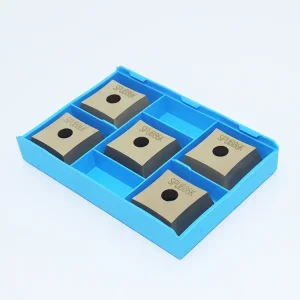
During High-Frequency Induction (HFI) and Electric Resistance Welding (ERW) of steel pipes, outer diameter (OD) and inner diameter (ID) weld beads must be planed instantly while incandescent. Heavy-duty scarfing inserts such as SPUB63, SPUB86, and SNMX series maintain a razor-sharp profile against continuous 900°C thermal cycling, ensuring smooth pipe finishes and preventing costly mill halts.
Centerless Bar Peeling & Lathe Turning
Processing hot-rolled alloy bars into bright steel shafts requires aggressive metal removal rates. Sintered peeling inserts (such as SPUB86I) operate at high feed velocities, stripping scale, decarburized outer layers, and inclusions from stainless, tool, and bearing steels without chatter or edge micro-chipping.
Electrical Discharge Machining (EDM) Blocks
Progressive stamping dies and silicon steel lamination tooling mandate block stock with absolute zero internal voiding. Thick tungsten carbide plates undergo full HIP sintering to allow deep wire EDM sectioning without stress cracking, shape distortion, or surface pitting along spark paths.
Non-Magnetic Precision Shafts & Gauging
Urban water metering, flow control instruments, and aerospace downhole guidance packages deploy non-magnetic solid carbide rods and pin plug gauges. The substitution of nickel matrixes prevents hysteresis interference, resists chloride pitting, and maintains sub-micron concentricity over decades of submerged duty.
Workholding Chuck Jaws & Grippers
Severe torsional stresses in high-speed CNC turning chucks demand aggressive friction-grip inserts. YG8 standard torque gripper inserts bite securely into raw cast or forged billets, eliminating slippage, minimizing vibration harmonics, and maximizing cutting safety under heavy chip loads.
Mining, Trenching & Rock Excavation
From water well drill bit buttons to asphalt scarifiers and railway ballast tamping tines, coarse-grain WC-Co formulations offer the high impact resistance needed to withstand brutal, repeated percussion against quartzite and granite without cataclysmic head shearing.
Global Procurement Architecture: Quality Verification & Audit Protocols
How senior purchasing officers mitigate international procurement risks, conduct metallographic verification, and enforce dimensional compliance across volume shipments.
Purchasing wholesale tungsten raw products across borders requires strict technical due diligence. Low-bid quotes from non-integrated brokers frequently mask critical structural flaws: the inclusion of dirty zinc-reclaimed scrap, high porosity resulting from vacuum-only (non-HIP) sintering, and severe cobalt pooling. To protect production schedules, global buyers should establish clear vendor qualification frameworks built around three foundational quality criteria:
1. Metallographic Microstructure Audits
Mandate cross-sectional scanning electron microscopy (SEM) or optical metallography at 1,000× magnification. Inspections must verify zero continuous eta-phase crystallization, complete absence of cobalt lakes (>5 μm), and porosity conforming strictly to ISO 4505 ratings (A00-A02, B00, C00).
2. Coercivity & Magnetic Saturation
Non-destructive electromagnetic testing evaluates both magnetic saturation (4πσ) and coercive force (Hc). These rapid measurements immediately disclose whether the carbon window is maintained: low coercivity indicates abnormal grain growth, while low saturation signals incipient eta-phase embrittlement.
3. Metrological & Tolerance Certification
For precision rod blanks and scarfing blades, ensure laser micrometry confirms outer diameter runouts within h6 tolerance standards (+0 / -0.008 mm) and circularity under 0.002 mm. Flat plate stock must be checked for surface parallelism and Ra 0.2 μm micro-finish after diamond grinding.
Frequently Asked Questions: Global Sourcing & Engineering Specifications
Clear, direct technical answers to the most common inquiries faced by international logistics directors, metallurgical engineers, and procurement teams.
Virgin tungsten carbide is synthesized directly through chemical reduction of Ammonium Paratungstate (APT), generating crystalline WC grains with ultra-low trace impurities (<15 ppm). Zinc-recycled carbide is recovered through molten zinc expansion of industrial scrap; while cost-effective, it contains higher levels of residual titanium, tantalum, and iron, leading to unpredictable grain boundaries and lower transverse rupture strength under impact.
Standard vacuum sintering allows microscopic pores to remain within the consolidated carbide matrix. When wire-cutting thick plates via EDM or subjecting wear tiles to severe hydraulic forces, these voids become stress concentrators that trigger micro-cracking and premature tool failure. Sinter-HIP applies up to 100 bar of argon pressure at the liquid phase, collapsing all internal voids to achieve near-zero porosity (ISO A02/B00).
Cobalt is naturally ferromagnetic, making standard WC-Co grades unsuitable for proximity to magnetic flow sensors, MWD exploration tools, or electronic manufacturing machinery. By substituting an austenitic nickel-based alloy binder, magnetic relative permeability (μ) is suppressed to below 1.005 while simultaneously enhancing corrosion resistance in acid-leaching and marine environments.
Standard stock geometries—including h6 ground rods, common SPUB63/86 scarfing inserts, and standard plate blanks—are maintained on inventory with low MOQs (typically 10 to 50 pieces). Custom engineered blanks, non-standard powder formulations, or complex pre-formed tooling dies generally require a 5 kg minimum lot size with production lead times running 12 to 21 working days including precision HIP cycles and metrology reporting.
Yes. We specialize in custom powder metallurgy formulations. By adjusting the cobalt content between 3% and 25%, varying the tungsten carbide grain size from submicron (0.4 μm) up to coarse rock-drilling grades (3.5 μm), and adding VC/Cr3C2 dopants, our engineering team tailors the mechanical profile precisely to your operating conditions.
All tungsten carbide components undergo ultrasonic cleaning and receive a light micro-coating of synthetic rust-preventative oil. Finished inserts are packed in sealed, compartmentalized shock-proof plastic cases. Heavier plates and bulk ground rods are vacuum-sealed in anti-corrosion barrier film and boxed within reinforced export cartons cushioned inside custom timber crates to prevent transit impact.
Precision Ground Plates, Grippers, Strips & Tube Scarfing Tools
Explore our extended series of heavy-duty tungsten carbide solutions engineered for aggressive metal removal, chuck workholding, pipe manufacturing, and wear tooling.







