
Primary Tungsten Tooling Blanks & Inserts
Ultra-dense, HIP-sintered blanks and wear-resistant substrates direct from our manufacturing floor.






China Factory Advantages & Sinter-HIP Technological Supremacy
Leveraging deep territorial supply chains, virgin chemical precursors, and state-of-the-art densification techniques to reduce cost per cutting edge globally.
Vertically Integrated Raw Supply
Situated within Jiangxi—the epicenter of global tungsten reserves—our manufacturing node ensures pristine supply-chain continuity. From Ammonium Paratungstate (APT) reduction to virgin tungsten carbide (WC) crystallization, our chemical purity mitigates microporosity and unpredictable thermal stress fractures.
Overpressure Sinter-HIP Systems
Standard vacuum sintering often allows residual sub-surface micro-voids. Zhongfu integrates 60-bar overpressure Sinter-HIP consolidation furnaces. Under extreme isostatic argon pressure at molten-phase temperatures, internal voids are completely healed, yielding theoretical density and unmatched transverse rupture strength (TRS).
Complete Powder Metallurgy Control
Unlike commercial stock re-sellers, our metallurgical laboratories tailor binder phase fractions from 3% to 25% Co/Ni. We precisely manipulate grain boundaries using grain growth inhibitors such as Cr3C2 and VC, balancing rock-drilling fracture toughness against ultra-hard titanium finishing specifications.
Carbide Industry Horizons: Macro Trends & Tool Life Optimization
Technical evaluation of emerging high-temperature alloys, physical vapor deposition (PVD), and sustainability lifecycles.
Sub-Micron and Nanocrystalline WC Matrix Formulations
The global metal cutting and tooling industry is experiencing a seismic transition toward nanocrystalline carbide systems (0.2µm - 0.5µm). As aerospace and precision medical components transition from standard structural steels to hardened martensitic alloys, titanium grade 5 (Ti-6Al-4V), and nickel superalloys (Inconel 718), traditional micro-grain cutting tools succumb rapidly to thermal notch wear and edge chipping.
By engineering sub-micron grain structures, our material scientists maximize the grain-boundary density. This acts as a physical barrier against catastrophic micro-crack propagation while preserving hardness levels upwards of 92.5 HRA. When married with specialized AlTiN or TiAlSiN PVD coatings, our finished cutting grades sustain hot hardness exceeding 1000°C within continuous dry-machining envelopes.
Nickel-Bonded Non-Magnetic Alloys in Severe Environments
In high-interference electromagnetic environments and highly corrosive chemical workflows, cobalt-bonded WC suffers from galvanic dissolution and erratic magnetic deflection. Standard cobalt is ferromagnetic and rapidly degrades when exposed to acidic fluids encountered in deep-well directional drilling (MWD/LWD sensors) and battery slurry dispersing nozzles.
Zhongfu provides proprietary nickel-bound and specialty non-magnetic matrix cemented carbides. By systematically replacing cobalt with fine Ni-Cr matrix formulations, our wear components achieve non-magnetic permeability (µ < 1.005) while delivering complete passivity against pitting corrosion across harsh chemical media. This extends duty cycles by over 300% in petrochemical downhole applications and EV pouch-cell manufacturing dies.
Cross-Sector Engineering Scenarios & Turnkey Solutions
Custom structural carbide adaptations tailored for severe wear, extreme abrasion, and dynamic shearing loads.
Heavy Metallurgy: Continuous Tube Scarfing
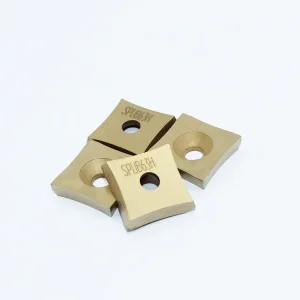
Welded steel pipe manufacturing demands continuous flash removal under extreme red-hot thermal gradients. Our SPUB63, SNMX, and SNMG scarfing inserts are pressed with micro-engineered beveling and TiN/TiAlN coatings to resist edge spalling, ensuring uninterrupted runouts on ERW (Electric Resistance Welded) pipe production lines without seam scoring.
Civil Infrastructure: Railway Tamping Tines
Railway track ballasts subject maintenance machinery to dynamic impact and extreme stone abrasion. By brazing custom-graded YG8 and YG11C cemented carbide wear tips onto dynamic tamping arms, we ensure aggregate penetration life cycles exceed 150,000 meters of rail maintenance prior to re-tipping interventions.
Toolmaking & Die Stamping: EDM Blocks
Mold makers require internal integrity free of structural micro-porosity during Wire Electrical Discharge Machining (WEDM). Zhongfu provides HIP-processed stress-relieved plates and blocks (YG15 to YG20) that preserve structural equilibrium post-wire cut, completely avoiding internal stress cracking and micro-flaking.
Serving International Supply Chains: The Procurement Perspective
Addressing the core criteria of enterprise MRO heads, toolmakers, and defense-aerospace procurement networks.
Metallurgical Traceability
Every export shipment is dispatched with standardized 3.1 Inspection Certificates encompassing spectrographic powder analyses, density determination (ISO 3369), coercive force (Hc), magnetic saturation (4πσ), and Rockwell hardness (HRA) documentation.
Total Cost of Ownership (TCO)
Industrial profitability relies on mean-time-between-replacements (MTBR). By stabilizing cobalt distribution and eliminating sub-surface void clustering, our wear parts decrease unplanned CNC toolholder spindle stoppages and die maintenance intervals by an average of 28%.
Agile OEM & Drawing Customization
With an engineering response commitment under 8 hours, our technical office works directly from customer STP, STEP, DWG, and PDF schematics. We review internal clearances, recommend pre-forming shrinkage ratios, and supply precision-ground blanks optimized for downstream production.
Frequently Asked Questions (Technical Sourcing & Quality FAQ)
Comprehensive engineering clarifications for industrial procurement specialists, quality inspectors, and machinists.
What metallurgical advantages does Sinter-HIP processing offer over standard vacuum sintering?
How do I balance binder percentage (Cobalt/Nickel) against grain size for severe applications?
Why are nickel-bonded cemented carbides mandatory for non-magnetic and corrosive service?
What dimensional tolerances can be guaranteed on centerless ground rods and flat plates?
Specialty Carbide Plates, Custom Die Parts & Inserts
Comprehensive portfolio of wear-resistant inserts, plate stock, and custom tooling components.







