Precision Carbide Cutting, Drilling & Wear Components
Engineered directly from 100% virgin submicron wolfram powders to eliminate micro-voids, maximize tool fracture resistance, and deliver extended feed endurance.





The Physics of Drill Bit Longevity: Submicron Grain Synthesis & Sinter-HIP Optimization
A comprehensive examination of how binder phase dynamics, solid-solution alloying, and isostatic pressing resolve severe gouging abrasion and cyclic impact failure in deep-hole operations.
Sinter-HIP Porosity Elimination
Traditional vacuum sintering often leaves sub-surface micro-porosity (A02-B02 classifications) that acts as stress concentrators during high-torque percussive rock drilling. By applying 60 to 100 bar of ultra-pure Argon pressure at liquidus temperatures (1420°C–1480°C), our Sinter-HIP process collapses internal gas voids, elevating relative density to >99.95% and raising transverse rupture strength (TRS) by 25% to 35% compared to conventionally treated carbides.
Defect Density <0.01%Binder Phase Grain Control
The delicate equilibrium between Rockwell hardness (HRA 88.5–93.0) and fracture toughness (K1C 10.5–18.2 MPa·m½) is governed strictly by the mean free path of the metallic binder. Our metallurgical engineering adjusts cobalt (Co) content from 6% in extreme abrasive wear rock formations up to 15% in heavy percussion hammer bits, introducing grain growth inhibitors (VC, Cr3C2) to constrain tungsten carbide crystal growth to precise submicron windows (0.6 µm to 1.2 µm).
Inhibited WC CoalescenceThermal Shock Dissipation
Frictional interface temperatures during continuous subterranean reaming or deep gun-drilling rapidly exceed 800°C. Our specialized refractory grades integrate tantalum-niobium carbide (TaNbC) additives, dramatically improving thermal conductivity (up to 80 W/m·K) and buffering against cyclic thermal fatigue, heat-checking fractures, and premature insert debonding during aggressive coolant cycling.
Stable up to 950°CQuantified Benchmark: Advanced Cemented Carbide vs Conventional Tool Steels
Rigorous mechanical, thermal, and tribological data comparing factory-direct Sinter-HIP tungsten carbide inserts against legacy high-speed tool steels across continuous operation cycles.
| Tool Material Classification | Hardness Rating (HRA / HRC) | Transverse Rupture Strength (TRS) | Max Operational Temp (°C) | Compressive Strength (MPa) | Primary Industrial Drilling Domain |
|---|---|---|---|---|---|
| Ultrafine WC-Co (Zhongfu YG6X) | 92.5 HRA | 2,800 - 3,200 MPa | 900°C | 5,800 MPa | High-precision PCB, composite CFRP drilling, micro-machining |
| Mining Percussion Grade (YG8C / YG11C) | 88.5 - 90.0 HRA | 3,000 - 3,400 MPa | 850°C | 4,900 MPa | DTH percussive hammers, quarry blast-hole, geotechnical anchors |
| Non-Magnetic Ni-Bonded Carbide | 89.0 - 90.5 HRA | 2,400 - 2,700 MPa | 800°C | 4,600 MPa | Directional MWD/LWD drilling tools, magnetic sensor housing zones |
| Cobalt M42 High-Speed Steel (HSS) | 66 - 69 HRC (~84 HRA) | 1,800 - 2,200 MPa | 550°C | 3,100 MPa | Shallow general-purpose alloy steel and mild iron drilling |
| Titanium Nitride Coated M2 HSS | 64 - 66 HRC (~82 HRA) | 2,000 - 2,300 MPa | 600°C | 2,800 MPa | Standard workshop twist drill tooling, non-critical fabrication |
The Strategic Supply Advantages of China-Based Carbide Manufacturing
Unlocking raw material sovereignty, rapid multi-axis CNC EDM tooling agility, and inflation-hedged volume cost structures for international distributors and heavy-duty drilling OEMs.
Upstream Wolfram Proximity
Situated in Jiangxi Province, our manufacturing operations sit at the absolute epicenter of the world's most concentrated tungsten reserves. By acquiring Ammonium Paratungstate (APT) directly at the primary smelting phase, we bypass multi-tiered commodity markups, guarantee zero secondary contamination, and insulate overseas clients from sudden international trade crunches.
Vertical In-House Compounding
Unlike secondary tool repackagers that assemble pre-sintered blanks, our plant maintains proprietary ball-milling, spray-drying, and automated isostatic multi-cavity presses under one roof. Every batch of spray-dried granulated WC powder is checked for grain uniformity, carbon stoichiometry balance, and exact liquidus binder distribution before entering the sintering furnaces.
Rapid Tooling & EDM Prototyping
Procuring specialized non-standard button inserts, custom brazing shanks, or proprietary tube scarfing geometries requires rapid mold design. Our facility houses wire-EDM cutting centers, precision optical CNC profile grinders, and rapid modular tooling dies, decreasing custom sample prototyping times from typical 8-week overseas industry cycles down to just 10–14 business days.
Scalable Enterprise Volume
With an annual capacity reaching thousands of metric tons across our cemented carbide production lines, wholesale enterprise orders receive absolute volume stability. Our multi-zone batch dispatch capabilities support container-load ocean freight alongside time-critical air shipments for emergency downtime replacements in drilling fields worldwide.
Global Enterprise Procurement Dynamics: Total Cost of Ownership (TCO) vs Per-Unit Pricing
Why Tier-1 industrial buyers in North America, Western Europe, and Australasia are structuring procurement around drill bit survival hours, zero-failure brazing, and auditable ISO/MTR compliance.
Mitigating Rig Downtime Penalties
In offshore hydrocarbons, blast-hole quarrying, or high-throughput automotive CNC machining lines, the actual cost of a drill bit is minuscule compared to rig downtime or tool-change labor rates. A premature insert failure at 3,000 meters downhole can incur hundreds of thousands of dollars in extraction trips. Our rigorous magnetic saturation and coercivity testing ensure each button insert exhibits rock-solid batch consistency, eliminating catastrophic premature fractures.
Zero-Catastrophic Failure GoalAuditable Metallurgical Certifications
Every dispatch container is accompanied by comprehensive EN 10204 Type 3.1 Mill Test Reports (MTR). This includes detailed chemical X-ray fluorescence (XRF) alloy breakdowns, optical microstructural photographs confirming zero free-graphite or harmful eta-phase (Co3W3C) formations, and certified Rockwell HRA, density, and magnetic property verifications satisfying strict ISO 9001:2015 frameworks.
RoHS & REACH CompliantRegionalized Logistics & Local Engineering
To eliminate transatlantic transit risks and buffer against geopolitical logistical shocks, our international trade division works seamlessly with localized stocking partners in the USA, Germany, Australia, and Brazil. Our technical sales engineers coordinate directly with your field tooling managers, interpreting custom 3D STEP/DWG drawings, advising on optimal brazing alloy shims (Cu-Zn-Ni), and fine-tuning tool geometry.
Global Strategic WarehousingTailored Application Profiles: Matching Carbide Formulations to Extreme Geology & Alloys
Explore how our custom drill bit inserts, button tips, and scarfing blanks withstand abrasive quartz, ductile stainless steels, and corrosive deep-sea formation environments.
DTH Percussive & Rotary Mining Bits
Down-the-hole (DTH) hammer bits and rotary tricone bits encounter extreme compressive shocks when pulverizing granite, basalt, and iron ore formations. We formulate specialized grades such as YG11C and YG15C with spherical, ballistic, and conical carbide geometries. The coarse-grain microstructure retards micro-cleavage crack propagation under crushing 35-bar percussive pneumatic pulses.
Grades: YG8C, YG11C, YG13CAerospace & Superalloy Deep-Hole Machining
Gun-drilling titanium alloys (Ti-6Al-4V) and nickel superalloys (Inconel 718) requires extreme cutting-edge sharpness paired with thermal resilience. Our ultrafine submicron rods and indexable inserts incorporate multilayer PVD AlTiN and AlCrN nano-coatings that form an active aluminum-oxide passivation barrier at cutting velocities exceeding 90 m/min, preventing chemical adhesion and built-up edge.
Submicron WC + Nano-PVDPipe Scarfing & High-Frequency Tube Welds
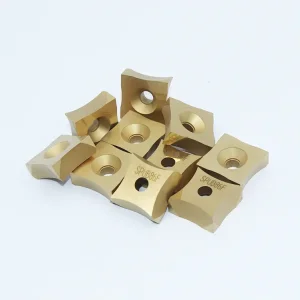
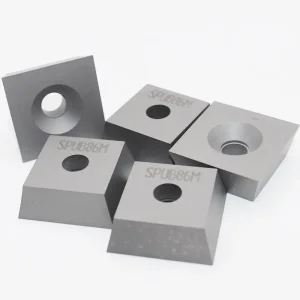
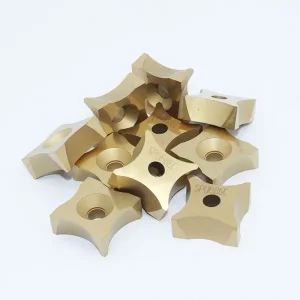
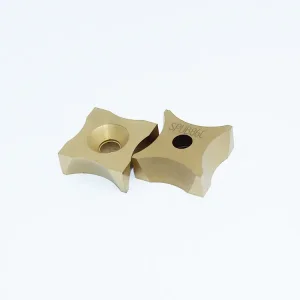
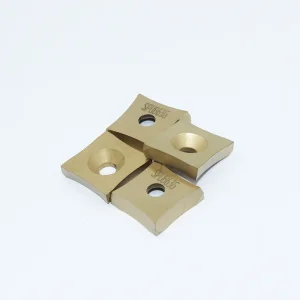
During the continuous production of longitudinal submerged-arc and high-frequency welded steel pipes, excess flash must be precisely stripped at high temperatures while the workpiece moves at speeds up to 120 m/min. Inserts like our SPUB86 and SQ86 series are engineered to withstand severe dynamic mechanical gouging without chipping or catastrophic edge breakage.
Heavy Impact ToughnessEmerging Horizons: Functionally Graded Carbides & Diamond-Intermetallic Synthetics
A technical preview into next-generation metallurgical advancements transforming industrial drilling efficiency, subterranean telemetry, and tool life predictability.
Functionally Graded Dual-Cobalt Architectures
Historically, tool metallurgists had to choose between surface hardness and core toughness. Modern Sinter-HIP protocols utilize controlled gas atmosphere decarburization/recarburization cycles to generate functionally graded cemented carbides (FGCC). The resulting drill bit exhibits an ultra-hard, wear-resistant outer shell (YG6 equivalent) transitioning smoothly into an impact-absorbing, cobalt-enriched ductile inner core (YG12 equivalent).
Gradient MetallurgyPCD-Tipped Hybrid Sintering
For abrasive geothermal formations and high-quartz sandstones, standard tungsten carbide inserts are being fused with polycrystalline diamond compact (PDC) cutters using high-pressure, high-temperature (HPHT) catalytic press cycles. This hybrid assembly pairs the extreme shear cutting efficiency of diamond tables with the tough, ductile foundation of our premium wolfram carbide substrates.
HPHT Catalyzed BondingAI-Simulated Flute & Discharge Geometries
Modern drill blank manufacturing increasingly incorporates computational fluid dynamic (CFD) simulations to model chip evacuation dynamics in real-time. By optimizing internal through-coolant channel helical angles and flute core tapers directly during the initial green-compact pressing phase, we reduce cutting thrust loads by 18% and prevent catastrophic chip packing in deep-hole processing.
CFD Streamlined FlutesDrill Bit Procurement, Engineering & Sourcing Inquiries
In-depth responses to critical technical specifications, custom blueprint workflows, brazing recommendations, and batch traceability from our Chief Metallurgical Officer.
How does Sinter-HIP processing directly influence drill bit transverse rupture strength?
Standard vacuum sintering relies strictly on capillary action of liquid cobalt to wet WC particles, often leaving internal micro-voids under high-temperature expansion. Sinter-HIP introduces up to 10 MPa of pressurized argon gas during the sintering phase, mechanically forcing the molten binder into any remaining voids. This elevates density to practically 100% of theoretical maximum, increasing transverse rupture strength by 25% to 35% and drastically mitigating fatigue cracks in heavy percussive drilling.
What is the recommended brazing technique to prevent insert detachment during thermal spikes?
Carbide insert detachment is usually caused by excessive thermal expansion differential between the steel drill body (CTE ~12×10⁻⁶/K) and the tungsten carbide insert (CTE ~5×10⁻⁶/K). We recommend using sandwich tri-foil silver-copper-silver brazing shims (such as BAg-22 or BAg-24) combined with an active fluoroborate flux. The copper core acts as a ductile cushion that plastically deforms to absorb internal shear stresses during cooling, preventing post-braze micro-cracking.
How should procurement teams choose between YG6, YG8, and YG11C grades?
The decision relies on balancing abrasive wear versus impact resistance. YG6 (6% Co) features the highest hardness (HRA 90.5–91.5) and is tailored for steady, highly abrasive tasks like cast iron boring, rotary soft rock reaming, and wear parts. YG8 (8% Co) represents the gold standard balanced workhorse for rotary drilling and lathe brazed tools. YG11C and YG15C (11–15% coarse-grain Co) provide superior fracture toughness (K1C >16 MPa·m½) to withstand severe shock loads in DTH hammer percussion and fractured geology.
Can you produce custom carbide blanks directly from proprietary 2D/3D CAD models?
Yes. Custom carbide engineering accounts for over 65% of our production throughput. We accept native 3D STEP, IGES, Parasolid, and 2D DWG/DXF files. Our engineering staff performs dynamic mold-shrinkage calculations (typically 18% to 22% volumetric shrinkage during sintering), designs precision graphite tooling fixtures, and manufactures near-net or ground parts with dimensional tolerances down to ±0.002 mm via optical profile and centerless grinding.
What testing ensures complete absence of brittle Eta-phase (Co3W3C) in sintered batches?
Eta-phase is a brittle ternary carbide (Co3W3C or Co6W6C) that forms when carbon stoichiometry drops below critical thresholds during thermal processing, severely degrading impact toughness. We verify carbon saturation across three inspection tiers: raw powder Fischer sub-sieve analysis, magnetic saturation (Cobalt-magnetization ratio), and high-magnification metallographic microscope cross-section analysis at 1,000x magnification to confirm clean alpha-plus-binder microstructures.
Why is nickel-bonded tungsten carbide essential for directional MWD/LWD drilling?
Conventional tungsten carbide utilizes a ferromagnetic cobalt binder. In Measurement-While-Drilling (MWD) and Logging-While-Drilling (LWD) downhole systems, magnetic interference from cobalt parts distorts sensitive directional magnetometers, causing borehole navigation errors. Nickel-bonded carbide is completely non-magnetic (magnetic permeability µ <1.005) and offers elevated corrosion resistance against hostile hydrogen sulfide (H2S) and chloride-rich drilling muds.
What are standard lead times for high-volume custom wholesale orders?
Standard catalog blanks, scarfing inserts (SPUB/SQ series), and standard round rods are typically maintained in stock for rapid dispatch within 48 to 72 hours. Custom formulated or newly pressed geometries require 10 to 14 days for tooling die manufacture and initial prototype sign-off, with full volume production dispatched within 21 to 28 business days via major ocean logistics or prioritized express air cargo.
How does your facility enforce full raw material batch traceability?
Traceability begins with the unique lot numbers assigned to incoming Ammonium Paratungstate (APT). From hydrogen reduction into tungsten powder, carburization into WC, automated wet ball milling, spray drying, pressing, and Sinter-HIP firing, each furnace charge is assigned a tracked batch QR code. We archive physical sintered witness coupons from every charge for 5 years, providing full retrospective metallurgical verification whenever needed.
Industrial Molds, Gripper Tips & Custom Threading Blanks
Explore our extended series of precision-sintered tungsten carbide components engineered for heavy chuck clamping, pipe scarfing, rock drilling, and precision milling assemblies.