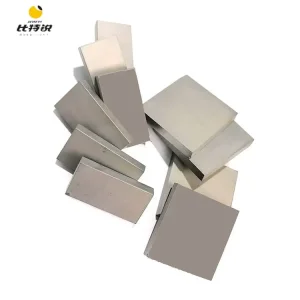
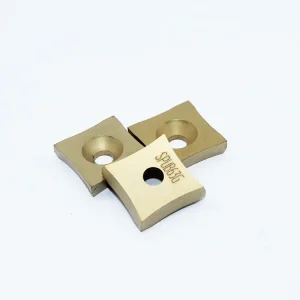
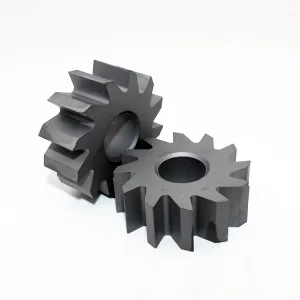
High-Precision Carbide Tools, Wear Blanks & Assemblies
Direct from Jiangxi's primary tungsten smelting hub: inspect our verified OEM/ODM stock line engineered for demanding woodturning, metal cutting, chuck jaws, and heavy alloy applications.






Tungsten (Wolfram) vs Tungsten Carbide (WC-Co): The Complete Engineering Contrast
A systematic metallurgical breakdown contrasting pure/alloyed elemental tungsten with cemented carbide matrices. Choose the exact composition required for your mechanical stress, wear vector, and operating thermal regime.
Elemental Tungsten (W)
Pure tungsten and refractory Tungsten Heavy Alloys (W-Ni-Fe / W-Ni-Cu) are characterized by the highest melting temperature of all non-carbon elements, dense radiation attenuation, and high thermal shock resistance.
- Melting point: 3,422 °C (6,192 °F)
- Density: ~19.25 g/cm³ (High radiation cross-section)
- Hardness: Moderate (~350–450 HV)
- Best for: Vacuum furnace heaters, collimators, balance weights
Cemented Tungsten Carbide (WC-Co)
A metal matrix composite (cermet) where hard stoichiometric WC crystals (0.2–5.0 µm) are bonded by a ductile binder phase (cobalt or nickel). Designed specifically for severe sliding, abrasion, and cyclic metal removal.
- Hardness: 85.5 to 94.0 HRA (1300–2200 HV)
- Transverse Rupture Strength: 1800–3800 MPa
- Modulus of Elasticity: Up to 650 GPa (3x high-carbon steel)
- Best for: CNC cutting tools, wear tiles, dies, rock drilling
Selection Pitfalls in Sourcing
Buyers often mistakenly specify "pure tungsten" when their actual failure mode is abrasive wear or erosion. Pure tungsten will wash out or gall under mechanical shear, whereas WC-Co provides superior micro-hardness and cutting-edge longevity.
- Impact vs. Abrasive balance: Dependent on Co %
- Corrosion limit: Co leaches in acidic/brine media (Ni binder required)
- Brittleness factor: Lower fracture toughness than tool steel
- EDM considerations: Surface micro-cracks require polishing
| Physical / Mechanical Property | Pure Tungsten (W 99.95%) | Tungsten Heavy Alloy (W-Ni-Fe) | Cemented Carbide (YG6 / WC-6%Co) | Cemented Carbide (YG15 / WC-15%Co) |
|---|---|---|---|---|
| Primary Composition | 99.95% Elemental W | 90–97% W, balance Ni-Fe/Cu | 94% WC + 6% Co | 85% WC + 15% Co |
| Density (g/cm³) | 19.25–19.30 | 17.0–18.5 | 14.80–15.00 | 13.90–14.20 |
| Hardness (HRA / HV) | ~350–450 HV | ~28–36 HRC (300–350 HV) | 90.5–91.5 HRA (1450 HV) | 86.5–87.5 HRA (1150 HV) |
| Transverse Rupture Strength (MPa) | N/A (Yield ~550–700 MPa) | Tensile: 700–1000 MPa | 2,000–2,400 MPa | 2,800–3,400 MPa |
| Modulus of Elasticity (GPa) | 400–410 | 360–380 | 620–640 | 520–550 |
| Melting Point / Sinter Range (°C) | 3,422 °C | Sintered at ~1450–1520 °C | Liquid phase HIP @ 1380–1440 °C | Liquid phase HIP @ 1360–1420 °C |
| Primary Wear Mechanism | Adhesive oxidation wear | Erosive surface flow | Micro-chipping, ultra-low abrasion | Heavy impact deformation resistance |
Global Enterprise Procurement Demands & China Manufacturing Ecosystem
With more than 80% of the world's upstream tungsten reserves concentrated in China, international industrial buyers increasingly shift from buying generic standard tooling to partnering with integrated Chinese manufacturers capable of raw-powder level customization.
Supply Chain Integration & APT Reserves
The Jiangxi tungsten corridor (Nanchang & Ganzhou) provides uninhibited direct access to Ammonium Paratungstate (APT) and pure virgin tungsten powder. This shields overseas procurement departments from intermediate raw material surcharges, volatile commodity traders, and unpredictable mill delays.
- 100% Virgin Powder Traceability
- Zero scrap-dilution guarantees
- Price resilience via long-term contracts
Overpressure Sinter-HIP Technology
Standard vacuum sintering often leaves microporosity (A04/B04 levels) that creates fracture nuclei under extreme impact. Modern Chinese top-tier suppliers utilize 100-bar overpressure Sinter-HIP furnaces, dissolving micro-voids to deliver theoretical density and pore-free metallographic polish.
- ISO Porosity Grade: A00, B00, C00
- Elimination of internal crack origins
- Superior mirror polishing for dies & punches
Total Wear-Life Cycle Management
Enterprise procurement is evolving from lowest-unit-cost to total operational expenditure (TCO). A cemented carbide wear part that lasts 3.8x longer than cold-work tool steel (D2/M2) prevents thousands of dollars in line stoppage, re-tooling labor, and scrap product generation.
- Up to 70% decrease in scheduled downtime
- Predictable tool degradation curves
- Custom grain tailoring (0.4 µm to 4.5 µm)
Localized Engineering Support & International Compliance Assurance
Enterprise buyers require more than high hardness—they demand full regulatory compliance, conflict-free raw materials, micron-level measurement protocols, and reliable cross-border logistics.
Conflict-Free & ESG Audited
Fully compliant with OECD Due Diligence Guidance and the Responsible Minerals Initiative (RMI). Every batch of tungsten ore is tracked to non-conflict mines with full CMRT certification.
- RMI / CMRT 100% compliant
- RoHS 3 & REACH SVHC certified
Advanced Metrology Check
Every shipment is verified with optical coordinate measuring machines (CMM), Rockwell & Vickers hardness testers, coercive force meters (Hc), and magnetic saturation (4πσ) checks.
- DIN EN ISO 9001:2015 QC
- Detailed 3.1 Inspection Certificates
DDP Air/Sea Hub Delivery
Providing friction-free Delivered Duty Paid (DDP) logistics directly to machine shops and OEM assembly centers in the USA, Germany, Japan, Mexico, and Australia.
- Zero customs paperwork for buyers
- Expedited door-to-door air freight (3–6 days)
Drawing & Grade Optimization
Submit 2D DWG/DXF/PDF or 3D STEP/IGES files. Our metallurgical engineers optimize chamfers, braze clearances, draft angles, and advise on grain sizes for specific chip-load conditions.
- Sub-8-hour DFM engineering response
- Bilingual technical account managers
Technical Roadmap: Beyond Conventional Tungsten & WC-Co
The boundary between pure refractory materials and hard composites is advancing. Explore the emerging material classes shaping aerospace, EV battery tooling, and extreme downhole exploration.
Binderless Tungsten Carbide
Eliminating the cobalt and nickel binder phase completely (WC content > 99.5%) yields a ceramic-like hardness exceeding 2600 HV. These parts survive severe abrasive slurry erosions and aggressive acid environments where cobalt leaching causes premature surface spalling.
- Ultra-high resistance to pitting corrosion
- Ideal for chemical seal rings & sandblast nozzles
- Spark Plasma Sintering (SPS) densification
Ultrafine & Nano-Grain WC Formulations
By refining WC grain sizes down to 0.2–0.4 µm (submicron/nanograin), engineers achieve high hardness and high transverse rupture strength simultaneously, defying the classical trade-off rule of powder metallurgy.
- Sharp, chip-free micro-cutting edges
- Exceptional performance in PCB micro-drills (< Ø0.1 mm)
- Superior wear life on abrasive CFRP/titanium stacks
Additive Manufacturing & Binder Jetting (AM)
Direct 3D printing of green-state cemented carbide via binder jetting allows complex internal conformal cooling channels within drill bodies, scarfing heads, and extrusion dies previously impossible via standard uni-axial die pressing.
- Near-net shape production without expensive tooling
- Complex fluid-dynamic pathways inside boring bars
- Reduced raw powder waste on low-volume custom geometries
Frequently Asked Questions: Sourcing Tungsten vs Tungsten Carbide
Direct answers addressing real-world engineering inquiries, minimum order quantities (MOQs), tolerances, and tooling performance parameters.
What is the core metallurgical difference between pure tungsten and tungsten carbide?
Can you produce non-magnetic tungsten carbide parts for MWD/LWD drilling tools?
What dimensional tolerances can you achieve on ground rods and EDM blocks?
How do I determine the right cobalt percentage (YG6 vs YG8 vs YG15 vs YG20)?
What is your typical production lead time and minimum order quantity (MOQ)?
Ready to Evaluate Engineering Blanks or Optimize Tool Life?
Submit your part blueprints, target operational hours, and workpiece material. Our metallurgical engineering desk provides detailed DFM analysis and grade recommendations within 8 business hours.
Precision Ground Rods, Heavy Wear Plates & Specialized Inserts
Explore our extended series of HIP-sintered flat blanks, railway ballast tamping tines, precision centerless-ground rods, and ISO standard pipe scarfing tips.