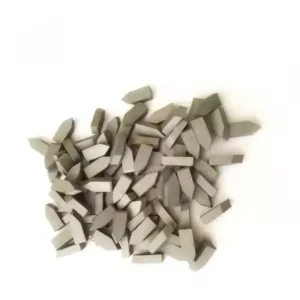
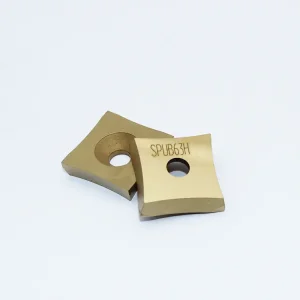
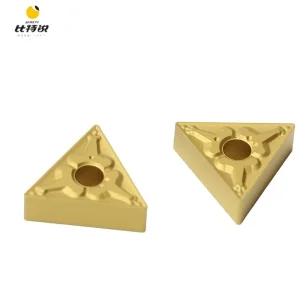
Featured Cemented Carbide Turning Inserts & Blanks
Precision indexable turning inserts, tube scarfing geometry, nano-grain tool rods, and specialized blanks engineered for extreme metal removal rates and prolonged tool longevity.


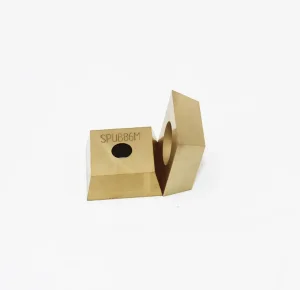





Global Procurement Demands for Cemented Carbide Inserts
The high-precision machining sector faces compounding operational pressures: the machining of refractory superalloys, tight tolerances, and total cost of ownership reduction.
Thermal & Chemical Stability
Modern turning operations on Inconel, Monel, and Titanium alloys generate localized temperatures exceeding 1,000°C. Tier-1 buyers demand WC substrates engineered with secondary carbides (TaC, NbC, TiC) to arrest thermal plastic deformation and mitigate crater wear at sustained cutting speeds.
Automated Lights-Out Machining
Unattended CNC turning cells cannot tolerate unpredictable tool failures or premature flank wear. Procurement criteria focus heavily on microstructural consistency across sintered batches, eliminating micro-voids, and guaranteeing uniform edge pre-honing (ER radii) within ±2 µm tolerances.
Traceability & Supply Assurance
Geopolitical turbulence has exposed single-source vulnerabilities in the tungsten upstream market. Sourcing managers actively prioritize Chinese manufacturers with integrated domestic powder extraction, stable ammonium paratungstate (APT) reserves, and full lot-level ESG compliance.
Macro-Industry Turning Applications & Solutions
How customized tungsten carbide insert profiles and specialized metallurgy solve complex manufacturing bottlenecks across major industrial sectors.
Aerospace Superalloys
For rotating turbine disks and blisks made of Inconel 718, our submicron WC-Co grades with multi-nanolayered AlTiN/TiSiN PVD coatings provide extreme red hardness and resist chemical micro-welding at elevated feeds.
Automotive Powertrain
High-volume cast iron brake disc and camshaft turning utilizes functionally graded substrates with MT-CVD TiCN + Al2O3 coatings, delivering maximum abrasive wear resistance and predictable insert index life.
Heavy Tube & Bar Peeling
Heavy-duty centerless peeling inserts (such as SPUB, SNMX, and SNMG series) are engineered with tough YG8/YG15 coarse-grain cobalt matrices to absorb continuous mechanical shock on unconditioned hot-rolled billets.
Oilfield Thread Turning
Precision API / premium connection casing and tubing threading mandates tight tooth contour retention. Custom full-profile chaser inserts eliminate burring and deliver gas-tight dimensional stability on duplex stainless steels.
Metallurgical Grade Selection & Performance Architecture
Aligning tungsten carbide cobalt ratios, grain morphologies, and mechanical thresholds to targeted operational cutting regimes.
| Grade Designation | Cobalt Binder (%) | WC Grain Size (µm) | Hardness (HRA) | TRS (MPa) | Target Substrate Purpose & Cutting Dynamics |
|---|---|---|---|---|---|
| YG6 / K10 | 6.0% | 1.0 – 1.4 (Fine) | 90.5 – 91.5 | ≥ 1,900 | Finishing & semi-finishing of chilled cast iron, non-ferrous alloys, and abrasive phenolic plastics. High flank wear resistance. |
| YG8 / K20 | 8.0% | 1.4 – 2.0 (Medium) | 89.0 – 90.0 | ≥ 2,200 | General lathe turning, roughing of cast iron, brazed tips, and torque chuck jaw grippers subject to vibration. |
| YG15 / K40 | 15.0% | 2.0 – 3.2 (Coarse) | 86.5 – 87.5 | ≥ 2,800 | Heavy interrupted cutting, heavy-duty bar peeling, cold heading tools, and deep roughing passes on rough-forged steel shafts. |
| Nano-WC (0.25µm) | 10.0% – 12.0% | 0.2 – 0.4 (Ultra-Fine) | 92.0 – 93.0 | ≥ 3,800 | Precision micro-boring, solid carbide tool blanks, and high-speed finishing where razor-sharp cutting edge retention is paramount. |
| Ni-Bonded Grade | 8.0% – 12.0% (Ni) | 1.2 – 1.8 (Medium) | 88.0 – 89.5 | ≥ 2,000 | Non-magnetic environments, MWD downhole oil tools, corrosive marine valve components, and magnetic stamping tools. |
Technological Horizons: Next-Generation Carbide Tooling
Our technological roadmap focuses on nanoscale crystal stabilization, high-entropy binders, and advanced surface conditioning to meet future manufacturing demands.
Cobalt-Alternative & High-Entropy Binders
To address Cobalt supply constraints and toxicity regulations, our metallurgical labs are optimizing Fe-Ni-Co and multi-principal high-entropy alloy (HEA) binder systems that provide equal or superior fracture toughness and high-temperature corrosion resistance.
HiPIMS Nanocomposite Coatings
Deploying High-Power Impulse Magnetron Sputtering (HiPIMS) allows for extremely dense, droplet-free AlTiSiN and CrN coatings with high residual compressive stress. This prevents catastrophic crack propagation during dry turning.
AI-Designed 3D Chipbreaker Geometries
Leveraging finite element modeling (FEM) and generative fluid dynamic algorithms, our newest turning geometries dynamically balance cutting force reduction, effective chip curl curl-radius control, and superior edge heat dissipation.
Localization Support, Quality Assurance & Regulatory Compliance
Providing seamless B2B integration through certified metallurgical processes, complete traceability, and reliable international logistics support.
Full Inspection Certifications (3.1 MTR)
Every production run leaves our facility backed by comprehensive metallographic inspection reports, detailing exact density, HRA hardness, coercivity (Hc), magnetic saturation (4πσ), and grain porosity ratings according to ISO 4505 standards.
Strict Conflict-Free Mineral Compliance
In adherence to international trade guidelines (RMAP, Dodd-Frank Section 1502, EU Conflict Minerals Regulations), 100% of our raw tungsten powder is refined from vetted, conflict-free domestic Chinese mineral concentrates.
Technical Sourcing Engineers
Direct communication with experienced powder metallurgists eliminates communication gaps. Our engineering group delivers comprehensive drawing reviews, CAD/CAM optimization suggestions, and custom grade recipes within 8 business hours.
Tungsten Carbide Turning Inserts: Technical & Sourcing FAQ
Critical answers for machine shop superintendents, tooling engineers, and procurement directors evaluating Chinese carbide manufacturers.
How does sinter-HIP processing differ from conventional vacuum sintering?
Conventional vacuum sintering removes binding agents and densifies the powder, but microscopic internal pores may persist. Sinter-HIP applies isostatic inert gas pressure (typically 60 to 100 bar of Argon) while the cobalt binder is molten, closing micro-cavities and eliminating structural porosity to ISO class A00/B00. This increases transverse rupture strength (TRS) by 15–25% and reduces tool edge chipping.
When should a buyer select PVD versus CVD coated turning inserts?
PVD (Physical Vapor Deposition) processes run at lower temperatures (400–500°C), preserving fine-grain sharp cutting edges and introducing beneficial compressive surface stress. This makes PVD optimal for interrupted cuts, stainless steels, threading, and heat-resistant superalloys. CVD (Chemical Vapor Deposition) runs at 900–1050°C and yields thick, highly wear-resistant multi-layer coatings (e.g., MT-TiCN + thick alpha-Al2O3), making it the primary choice for continuous high-speed turning of abrasive carbon steels and cast irons.
Can you formulate non-standard carbide grades based on custom client drawings?
Yes. Beyond standard ISO K, P, and M grades, our engineering team routinely customizes carbide grain sizes (ranging from 0.2 µm ultra-fine up to 5.0 µm coarse structures) and adjusts cobalt binder concentrations from 4% to 25%. We also synthesize nickel-bonded formulations for non-magnetic or chemically corrosive operational environments based directly on 2D/3D component drawings.
What is the standard turnaround time for quotation and technical review?
Our engineering desk guarantees a thorough technical response within 8 hours. This includes manufacturability assessment, recommendations on dimensional tolerances, grade optimization, and structured FOB/CIF pricing. Tooling prototypes are typically sintered, ground, and shipped within 15–20 working days.
Brazed Tool Tips, Bar Peeling Inserts & Precision Wear Components
Discover our industrial portfolio: large blank turning inserts, tungsten carbide brazing tips, concrete scarifier teeth, and heavy-duty bar peeling cutters.