
Precision Tungsten Carbide & Alloy Products (Batch A)
Direct supply of precision-sintered inserts, scarfing tooling, cold heading dies, and wear plates manufactured from 100% virgin tungsten carbide powder.

China Tungsten Tool Holder Lathe Cemented Carbide Cutting Tool Inserts for Chain Saw
View Specifications
Wholesale Custom Tungsten Carbide Spiral Bevel Gear Milling Cutters for High-Speed Cutting
View Specifications
Customized Tungsten Carbide Cold Heading Molds, Punch Dies & Wire Drawing Dies
View Specifications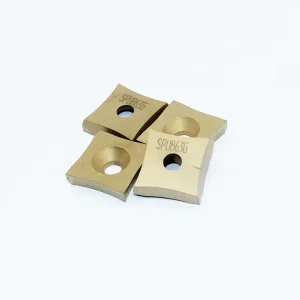
Wear-Resistant SPUB 63G Tool Holder Insert Carbide Cutting Inserts Turning Tools
View Specifications
SPUB-63C Cemented Mining Tungsten Tools Heavy-Duty Carbide Drill Inserts
View Specifications
High-Quality Tungsten Carbide Strips - Durable Sintered Wolfram Flat Wear Bars
View Specifications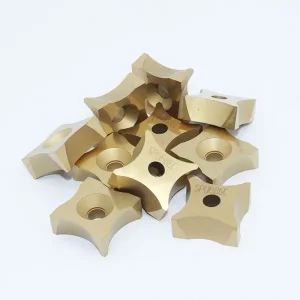
SPUB86C P40 Tungsten Carbide Outside Tube Scarfing Insert for Heavy Machining
View Specifications
Indexable Carbide CNC Milling & Turning Tool Inserts for Heat-Resistant Alloys
View SpecificationsThe Evolution of Tungsten Alloys: Strategic Demand & Material Science
How nanoscale powder control and liquid-phase sintering are redefining performance limits across aerospace, deep-hole drilling, and defense engineering.
High Density & Inertial Mass
Tungsten heavy alloys balance maximum concentrated mass inside restrictive structural volumes. Vital for aerospace flight control counterweights, directional downhole drilling collars, crankshaft harmonic balancers, and kinetic penetrators where geometric constraints demand mass densities between 17.0 and 18.5 g/cm³.
Radiation Attenuation
Tungsten alloys deliver superior linear attenuation coefficients against gamma rays and hard X-rays compared to elemental lead (Pb). Being non-toxic and environmentally stable, tungsten collimator apertures, multileaf collimators (MLC), and nuclear shielding vials eradicate toxic disposal risks without compromising attenuation thickness.
Extreme Wear & Micro-Spalling Resistance
Sintered tungsten carbide (WC-Co and non-magnetic WC-Ni) systems provide microhardness ratings up to HRA 93. Nano-grain matrix structures suppress catastrophic cleavage fracturing during severe impact cycles, abrasive geological extraction, high-tonnage stamping, and metal-to-metal high-friction drawing operations.
Upstream Vertical Hegemony: Metallurgical Purity & Process Resilience
Controlling the transformation pipeline from Ammonium Paratungstate (APT) reduction to Hot Isostatic Pressing (Sinter-HIP) guarantees batch-to-batch microstructural consistency.
Unlike intermediaries who purchase third-party blended powders or recycled scrap (which introduces unmonitored trace tramp elements like Ti, Cr, and Fe that precipitate brittle eta-phase crystals), our integrated 4.0 infrastructure utilizes exclusively virgin tungsten powder. Closed-loop computerized ball milling, ultrasonic spray dry granulation (producing ultra-spherical granules with optimized bulk flowability), and multi-axial CNC compaction guarantee density uniformities before thermal processing.
The true differentiator occurs inside our high-vacuum, computerized Sinter-HIP (Hot Isostatic Pressing) autoclaves. Operating under 100 bar (10 MPa) ultra-pure argon at temperatures up to 1,520°C, internal micro-voids, porosity, and gas occlusions are driven to near-zero levels (ISO porosity class rating A02/B00). This eliminates premature thermal fatigue, pitting, and edge chipping under heavy industrial cutting, tube scarfing, and cold heading impacts.
| Alloy Classification | Nominal Composition | Density (g/cm³) | Hardness | Tensile Strength (MPa) | Primary Industrial Utility |
|---|---|---|---|---|---|
| WHA Class 1 (ASTM B777) | 90W - 7Ni - 3Fe | 17.00 - 17.20 | HRC 30 - 35 | 850 - 950 | Aerospace Balances & Vibration Dampers |
| WHA Class 3 (ASTM B777) | 95W - 3.5Ni - 1.5Fe | 17.90 - 18.20 | HRC 32 - 38 | 900 - 1050 | Radiation Shielding & Downhole MWD Tools |
| WHA Class 4 (ASTM B777) | 97W - 2.1Ni - 0.9Fe | 18.40 - 18.60 | HRC 34 - 40 | 850 - 980 | High-Energy Physics & Collimator Blades |
| Cemented Carbide YG6 (ISO K10) | 94 WC - 6 Co | 14.90 - 15.00 | HRA 90.5 | 1900 (TRS) | Chilled Cast Iron Machining, Wire Dies |
| Cemented Carbide YG15 (ISO K40) | 85 WC - 15 Co | 13.90 - 14.10 | HRA 87.0 | 2800 (TRS) | Cold Heading Molds, Heavy Punching |
| Non-Magnetic Ni-Carbide | 92 WC - 8 Ni Binder | 14.60 - 14.80 | HRA 89.0 | 2200 (TRS) | Sensor Casing, Electronic Punching, MWD Tools |
Engineered Component Deployment in Critical Operating Environments
Real-world integration points where precision manufacturing and tailored metallurgical binders mitigate operational failure modes.
Downhole Oil & Gas (MWD/LWD)
During directional drilling, telemetry sensors detect geomagnetic formations. Standard cobalt-bonded carbides interfere with inductive sensor arrays. Our proprietary Nickel-Binder Non-Magnetic Tungsten Carbide maintains zero magnetic permeability (< 1.005 µ) while withstanding high-velocity drill mud cavitation and abrasive sand slurries.
Heavy Pipe & Tube Scarfing
External and internal weld bead removal on high-frequency longitudinally welded pipe lines demands inserts capable of handling severe thermal shock and continuous interrupted cutting. Our SPUB63, SPUB86, and SNMX series feature specialized cobalt enrichment gradients and CVD TiAlN/Al2O3 multi-layer coatings preventing micro-chipping at 900°C interface temperatures.
Railway Track Maintenance
Ballast tamping tines strike hard granite ballast rocks at continuous vibration frequencies exceeding 35 Hz. By vacuum-brazing customized contoured carbide wear blocks onto forged alloy steel tamping arms, we increase service operating life from 60 track-kilometers to over 220 track-kilometers, drastically cutting maintenance line downtime.
Precision Tungsten Carbide & Alloy Products (Batch B)
Ground rods, anti-magnetic pin gauges, scarfing tips, tamping tine inserts, and heavy-duty crushing blocks customized to CAD specifications.

Tungsten Carbide Solid Round Rod Blanks for High-Performance End Mills & Drills
View Specifications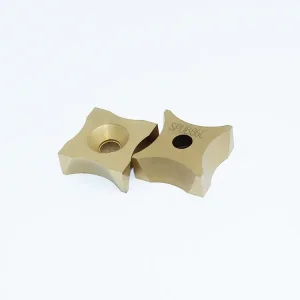
SPUB86C P40 CVD Coated Tungsten Carbide Tube Scarfing Inserts for Welded Steel Pipes
View Specifications
Non-Magnetic Solid Cemented Carbide Pin Plug Gauges & Inspection Rods
View Specifications
Heavy-Duty Square Indexable Tungsten Carbide Cutting & Planing Tool Inserts
View Specifications
Precision Ground Tungsten Carbide Turning Inserts for Cast Iron & Stainless Machining
View Specifications
Nickel-Binder Non-Magnetic Cemented Carbide Rods for Corrosion & Electronic Tooling
View Specifications
Sintered Tungsten Carbide Tamping Tine Armor Tools for Railway Track Maintenance
View Specifications
Heavy Impact Tungsten Carbide Wear Inserts for Mining Roller Press Crushing Rolls
View SpecificationsStrict Quality Control Protocols: Ensuring 100% Traceability and Consistency
Defect-free manufacturing verified through advanced metallography, magnetic saturation analysis, and non-destructive ultrasonic scanning.
Magnetic Property Analysis
Using digital coercimeters and magnetic saturation (Compsat) testers, our metallurgical lab precisely monitors the dissolution level of tungsten in the cobalt binder. This detects unwanted free carbon (graphite rosettes) or carbon deficiency (eta-phase Co3W3C), ensuring balanced fracture toughness.
Metallographic SEM Verification
Sections cut from each Sinter-HIP heat are polished down to 1-micron diamond paste and analyzed under high-resolution Scanning Electron Microscopes (SEM). We confirm uniform submicron grain boundary spacing without abnormal grain growth (AGG), qualifying parts for ASTM B657 standards.
Sub-Micron Laser Metrology
For precision ground round rods, scarfing tooling, and wire drawing dies, non-contact laser micrometer systems inspect outside diameter runout and roundness along the entire longitudinal profile. We reliably deliver h6 cylindrical tolerances (down to +0.000/-0.009 mm) ready for automated tool clamping.
Questions Overseas Procurement & Tooling Engineers Ask Before Ordering
Clear, unhedged metallurgical answers addressing technical tolerances, alloy formulations, non-magnetic criteria, and global logistics execution.