
Featured Tungsten Carbide Blanks, Rods & Industrial Inserts
Factory-direct sintered blanks, nano-grain ground rods, and specialized scarfing and threading inserts engineered in Nanchang, Jiangxi for demanding CNC machine shops.





Semantic Distinction: "Titanium Drill Bits" vs. Monolithic Cemented Carbide
Resolving the pervasive market ambiguity between surface-coated high-speed steels and solid tungsten carbide matrices for engineering procurement specialists.
Titanium-Coated HSS (TiN / TiAlN)
Commonly marketed as "Titanium Bits," these tools utilize an M2, M35 (5% Co), or M42 (8% Co) High-Speed Steel core surrounded by an ultra-thin (2–4 µm) Physical Vapor Deposition (PVD) coating of Titanium Nitride. The core limits operational red hardness to approximately 600°C; once the microscopic surface wear layer breaches, the soft ferrous core encounters thermal catastrophic failure rapidly.
Solid Sintered Tungsten Carbide (WC-Co)
A true powder metallurgy composite where high-purity Tungsten Carbide grains (0.2 µm to 3.0 µm) are liquid-phase sintered within a ductile Cobalt or Nickel matrix. Exhibiting exceptional hardness (88 to 94 HRA) and extreme thermal stability exceeding 1000°C, solid carbide preserves edge geometry throughout the entire cross-section, enabling sustained high-speed CNC milling and deep-hole drilling.
Titanium Carbonitride (TiCN) & Cermets
Positioned as an intermediate metallurgical solution, Titanium Carbonitride and Titanium Carbide-based cermets offer heightened surface lubricity and resistance to abrasive crater wear. However, Chinese cemented carbide factories synthesize submicron WC-Co substrates coated with multi-layer AlTiN/AlCrN to radically surpass monolithic TiCN in fracture toughness and thermal shock resistance.
| Physical & Mechanical Property | Titanium Nitride Coated HSS (M2/M35) | Solid Cemented Carbide (YG6 / YG8 / Nano-WC) | Industrial Impact on Machining Centers |
|---|---|---|---|
| Substrate Hardness | 62 – 67 HRC (Substrate) | 88.5 – 93.5 HRA (≈72–82 HRC) | Carbide maintains structural integrity on hard alloys >45 HRC; HSS blunts rapidly. |
| Thermal Red Hardness Limit | 550°C – 620°C | 950°C – 1150°C | Permits 3x to 8x higher cutting speeds (Vc m/min) without thermal softening or plastic deformation. |
| Modulus of Elasticity (Young's E) | 200 – 220 GPa | 550 – 650 GPa | 300% greater rigidity mitigates drill deflection, ensuring precise hole cylindricity and runout <0.005 mm. |
| Thermal Conductivity (W/m·K) | 20 – 25 W/m·K | 70 – 110 W/m·K | High thermal dissipation transfers cutting heat directly into chips rather than degrading the drill body. |
| Transverse Rupture Strength (TRS) | 3200 – 3800 MPa | 2200 – 3800 MPa (HIP Sintered) | Advanced Sinter-HIP processing eliminates internal voids, narrowing the fracture gap with HSS. |
| Machining Economics & Tool Life | Low initial investment; frequent re-sharpening | Higher tool purchase cost; 10x–25x prolonged tool life | Dramatically reduces machine downtime, spindle re-indexing, and cost per finished bore. |
China Factory 4.0: The Supply Chain Moat in Hard Metal Production
How Jiangxi Zhongfu Cemented Carbide Co., Ltd. leverages upstream tungsten resource reserves and automated closed-loop sintering to deliver batch consistency worldwide.
The Jiangxi Tungsten Corridor Advantage
Jiangxi Province contains the world's most concentrated geological deposits of wolframite and scheelite. By controlling domestic Ammonium Paratungstate (APT) refinement and localized chemical reduction into pure Tungsten powder (W) and Carbonized WC, Chinese factories eliminate oceanic freight volatility on core raw materials, insulating global procurement contracts from violent index spikes.
100% Virgin Powders & Controlled Grain Growth
Unlike secondary workshops that blend recycled tungsten scrap (zinc process powders), Tier-1 Chinese manufacturing facilities maintain strict 100% virgin crystal policies. Utilizing specialized grain growth inhibitors (Vanadium Carbide VC, Chromium Carbide Cr3C2) within wet-milling ball mills guarantees grain distributions down to 0.25 µm without micro-segregation or cobalt pooling.
Overpressure Sinter-HIP Consolidation (10 MPa)
Traditional vacuum sintering leaves residual sub-surface micro-porosity (A02, B02 classes) which creates catastrophic failure stress concentrators during high-load drilling. Our integrated Sinter-HIP furnaces execute 1450°C vacuum thermal treatment combined with 100 bar (10 MPa) isostatic Argon gas pressure, closing internal micro-voids and achieving 99.98% theoretical metallurgical density.
Macro-Industry Engineering Solutions: Where Substrates Matter
Tailoring binder percentages, grain size selections, and coating structures to combat wear mechanisms across global core industries.
Aerospace & Superalloys
Workpiece: Inconel 718, Titanium Grade 5 (Ti-6Al-4V).
Challenge: Extreme chemical affinity, work hardening, low thermal dissipation.
Substrate Choice: Ultrafine 0.4 µm WC with 10% Co content, reinforced with AlTiSiN PVD coating to resist thermal shock and notch wear.
Automotive Powertrain
Workpiece: CGI (Compacted Graphite Iron), Gray Cast Iron, Case-hardened 20CrMnTi.
Challenge: Continuous high-speed boring, abrasive tool wear.
Substrate Choice: YG6/YG6X low-cobalt fine grade providing extreme hardness (91.5 HRA) and wear resistance during deep engine block drilling.
Energy & Downhole MWD/LWD
Workpiece: Non-magnetic drill collars, subterranean directional sensors.
Challenge: Magnetic interference, severe slurry abrasion, downhole shocks.
Substrate Choice: Nickel-bonded non-magnetic cemented carbide parts displaying magnetic permeability µr < 1.005 and high impact survival.
Tube Manufacturing & Scarfing
Workpiece: Longitudinal welded steel tubes, hot ERW flash line removal.
Challenge: Red hot steel impact (850°C+), vibration, dynamic mechanical cycling.
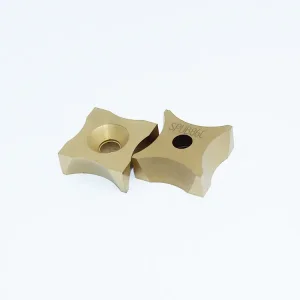
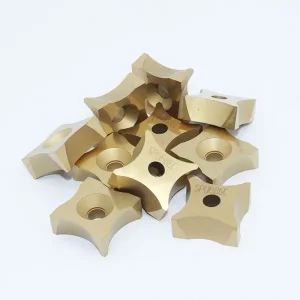
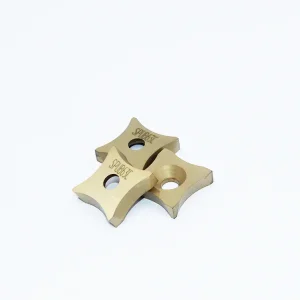
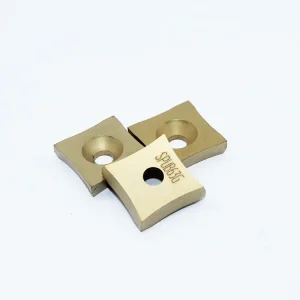
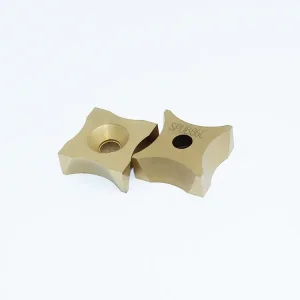
Substrate Choice: SPUB63 / SPUB86 P40-class carbide scarfing inserts with heavy CVD Ti(C,N)+Al2O3 thick thermal barriers.
Total Cost of Ownership (TCO): The Fallacy of Unit Price in Tooling
Evaluating the micro-economic parameters governing drill bit selection: Why titanium-coated HSS costs more per bore in modern volume production.
Spindle Downtime & Tool Exchange
Every tool exchange in a 5-axis CNC machining center incurs between 12 to 25 minutes of lost production, including spindle braking, mechanical probing, tool height offset validation, and scrap baseline testing. Solid carbide's 15x extended working life eliminates frequent re-tooling stops, reclaiming up to 140 productive spindle hours annually per machine.
Feed Rate Acceleration (Cycle Compression)
Because monolithic carbide features a Young's modulus exceeding 600 GPa and red hardness past 1000°C, machine operators can program cutting feeds (fn) 250% higher and surface speeds (Vc) 400% faster than the most premium cobalt-alloyed titanium-coated HSS tools, effectively compressing unit production cycles and increasing factory throughput.
Scrap Mitigation & Tolerance Yield
As titanium-coated HSS bits reach thermal degradation, edge micro-chipping alters hole diameter and introduces conical taper distortion. Solid tungsten carbide's dimensional stability maintains strict H7 tolerance standards across thousands of identical cycles, safeguarding expensive forged parts and aerospace castings from zero-tolerance rejection.
Technological Roadmap: The Next Frontier in Cemented Carbide
R&D breakthroughs steering China's cutting tool metallurgy from conventional WC-Co blends toward atomic-layer engineered structures.
Nano-Crystalline Substrates (Grain Size < 0.2 µm)
Through wet-chemical ball milling and plasma synthesis, grain growth is restrained below 200 nanometers. This provides hardness exceeding 93.8 HRA combined with elevated fracture toughness, addressing the historic metallurgical trade-off between hardness and brittleness.
HiPIMS (High-Power Impulse Magnetron Sputtering) Coatings
Transitioning beyond conventional arc PVD, HiPIMS creates an exceptionally dense, droplet-free coating morphology with extreme ionization levels. Coatings like nano-composite AlCrSiN exhibit oxidation thresholds above 1200°C with near-zero internal residual stress.
Alternative Green Binders (Co-Free Metallurgy)
To decouple from geopolitical cobalt constraints and resolve health and regulatory scrutiny (REACH SVHC lists), our metallurgy laboratories are scaling High-Entropy Alloy (HEA) and Fe-Ni-Cr intermetallic binder systems offering equivalent toughness and superior corrosion resistance in acidic operating media.
Additive Powder Sintering for Complex Internal Coolant Geometries
Leveraging binder jetting 3D printing of WC-Co green bodies allows the integration of curved, helical, and non-uniform internal coolant passages within drills and boring tools, optimizing high-pressure fluid delivery directly to cutting zones to evacuate chips efficiently.
Localization Support, Regulatory Compliance & Export Verification
Meeting North American and European industrial audit benchmarks through rigorous material traceability and certified manufacturing systems.
Material Traceability (EN 10204 3.1)
Every commercial delivery includes comprehensive Material Test Certificates (MTC) documenting lot-specific cobalt percentages, grain size classification, Rockwell hardness (HRA), density (±0.05 g/cm³), and transverse rupture strength (TRS). Complete lot pedigree traces back to the primary APT batch.
RoHS, REACH & Conflict-Free Compliance
Our raw material supply chains comply fully with Responsible Minerals Initiative (RMI) standards, confirming non-conflict provenance. All products are verified compliant with EU REACH Annex XVII, SVHC regulations, and RoHS 3 directives, ensuring frictionless customs clearance across US and European ports of entry.
Export Dual-Use Compliance Governance
Certain high-precision hard metal rods and tooling components fall within international dual-use export classification lists. Our experienced export compliance desk coordinates necessary end-user undertakings, export licenses, and customs declarations to eliminate delivery halts or regulatory exposure.
Frequently Asked Technical & Sourcing Questions (FAQ)
Direct metallurgical answers from our production engineering desk to support your vendor qualification process.
Can titanium coatings (TiN, TiAlN) be deposited onto solid tungsten carbide drills?
Why do solid carbide drill bits fracture more easily than titanium-coated HSS in handheld drilling?
How should a procurement team choose between YG6, YG8, and submicron WC grades?
• YG6 (6% Cobalt, fine grain): Exhibits high hardness (~90.5 HRA) and wear resistance; ideal for non-ferrous metals, cast iron machining, and continuous light-load cutting.
• YG8 (8% Cobalt, medium grain): Higher shock absorption and toughness (~89.5 HRA); favored for rock drilling, interrupted lathe cutting, brazed drill tips, and general steel fabrication.
• Nano-Grain WC (0.2–0.6 µm, 10–12% Co): Delivers both high hardness (>92 HRA) and high fracture toughness via nanoscale grain boundary locking; the industry standard for solid carbide drill bits, end mills, and precision PCB micro-drills.
What differentiates Chinese Factory 4.0 carbide production from legacy workshops?
What are the key technical parameters required when submitting an OEM drawing to Zhongfu?
1. 2D drawing (PDF/DWG) with dimensional tolerances (e.g., h6, runout, edge chamfer specifications) and surface finish requirements (Ra values).
2. 3D solid model (STEP or IGES format) for complex geometries or internal coolant hole designs.
3. Workpiece material details (hardness, alloy classification, abrasive characteristics) to guide substrate grade and coating selection.
4. Planned order volumes and delivery timeline to optimize sintering batch runs.
Specialized Inserts, Wear Blanks & Tooling Components
High-performance indexable inserts, chuck jaw grippers, and wear-resistant carbide plates manufactured for worldwide distribution.





Accelerate Your Tooling Performance with Chinese Metallurgy
Contact our engineering desk today with your dimensional drawings, required tolerances, and workpiece specifications for an in-depth technical analysis and transparent factory-direct pricing.