Industrial Tungsten Carbide Tooling & Components
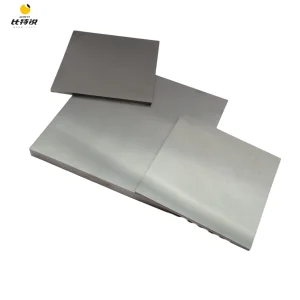
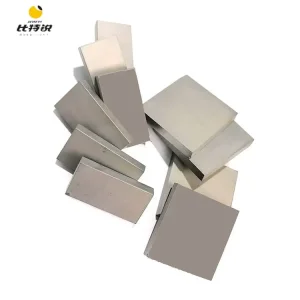
Engineered with ultra-pure virgin raw materials and optimized scrap return value. Fully sintered for supreme wear, high-impact strength, and extended operation cycles.
The Dynamics of "Precio De Chatarra" in Tungsten Metallurgy
Navigating raw material price shifts, Ammonium Paratungstate (APT) indices, and the lifecycle value of cemented tungsten carbide across heavy industry.
Ammonium Paratungstate (APT) Indexation
Global cemented carbide pricing is inextricably tied to the international spot price of APT. In Spanish and Portuguese speaking industrial sectors, inquiries into "precio de chatarra de carburo" (scrap carbide valuation) determine critical capital recovery decisions for machining shops, tube mills, and mining operators seeking circular credit.
Chemical Leaching vs. Zinc Process Reclamation
Reclaiming high-grade tungsten scrap requires either zinc-treatment or hydrometallurgical digestion. High-yield scrap with minimal cobalt dissolution commands premium salvage values, allowing manufacturers like Jiangxi Zhongfu to offer competitive buy-back allowances on worn inserts, dies, and drill components.
Closed-Loop Circular Supply Chains
Modern enterprises no longer treat spent hard metal as waste. By calculating residual tungsten concentrations (ranging from 82% to 94% WC content), tier-1 suppliers integrate transparent scrap credit offsets into custom manufacturing contracts, lowering total cost of ownership (TCO) by up to 28%.
Why Chinese Manufacturing Dominates the Global Hard Metal Supply Chain
Capitalizing on domestic tungsten ore deposits in Jiangxi, vertically integrated sintering facilities, and advanced precision grinding technologies.
Supply Chain Proximity & Raw Material Security
Jiangxi Province represents the epicenter of the global tungsten belt. Located in Nanchang, Jiangxi Zhongfu Cemented Carbide Co., Ltd. operates with immediate upstream access to ultra-fine tungsten trioxide and pure cobalt powders, eliminating international freight markups on primary feedstock and sheltering overseas buyers from supply disruptions.
Automated Sinter-HIP Consolidation
Unlike standard vacuum sintering furnaces that often leave residual microporosities in heavy tungsten sections, our pressure-sintering (Sinter-HIP) autoclaves operate at up to 10 MPa of inert argon pressure at 1450°C. This process dissolves trace microvoids, guaranteeing near-theoretical density and doubling structural impact toughness.
Micron-Scale CNC & Optical Metrology
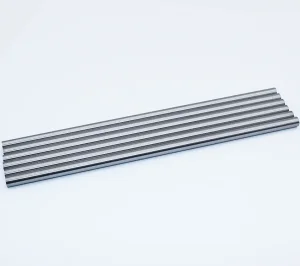
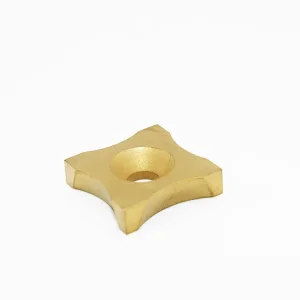
We blend competitive production scale with stringent micro-structural controls. In-house centerless grinders achieve h6 tolerances on solid round rods, five-axis profile grinders deliver complex chipbreakers on heavy scarfing inserts, and metallographic digital image analyzers ensure flawless grain size uniformity (0.2µm to 5.0µm).
Engineering Hard Metal for Harsh Real-World Stress Profiles
From heavy metallurgical flash removal in longitudinal pipe mills to non-magnetic directional drilling subs.
| Application Scenario | Predominant Wear Mechanism | Recommended Grade | Cobalt / Binder % | Hardness (HRA) | Scrap Value Recovery Potential |
|---|---|---|---|---|---|
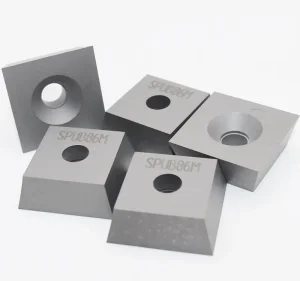
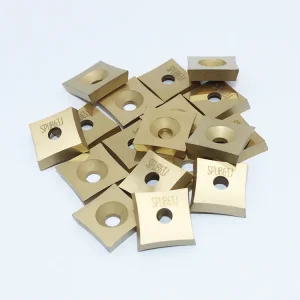
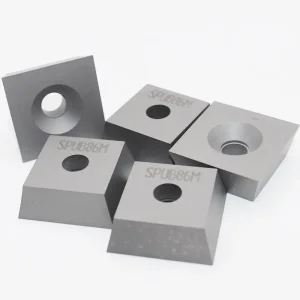
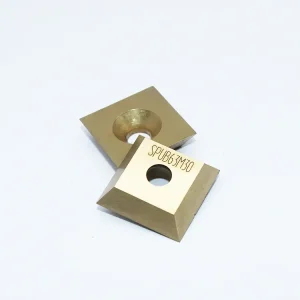
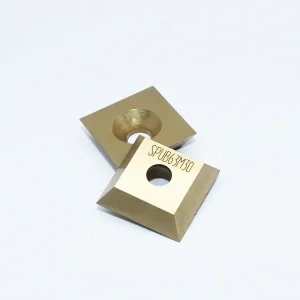
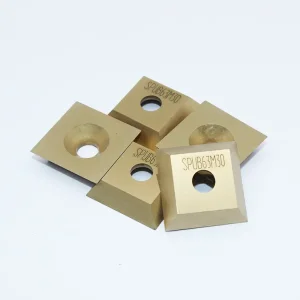
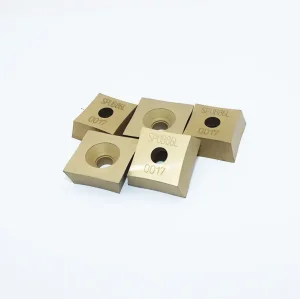
| Steel Tube Outside Scarfing (SPUB63 / SNMX) | Extreme thermal shock & continuous weld bead friction | Custom Heavy Tooling (P30/P40) | 9.5% – 12.0% Co | 88.5 – 89.8 | High Residual Yield |
| Railway Ballast Tamping Tines | Severe cyclic shock impact & quartz granite abrasion | YG11C / YG15 Coarse Grain | 11.0% – 15.0% Co | 86.5 – 87.8 | Moderate Salvage Rate |
| Progressive Sheet Stamping Dies | High sliding friction & edge micro-chipping | YG20 / Fine Grain Matrix | 20.0% Co | 85.0 – 86.5 | High Residual Yield |
| Directional Drilling (MWD/LWD Tools) | Electrochemical corrosion & magnetic interference | Nickel-Binder Non-Magnetic | 8.0% – 10.0% Ni | 89.0 – 90.5 | Specialized Chemical Recovery |
| Solid End Mill & Drill Blanks | High shear stress, flank abrasion, cratering | Ultra-Fine Nano Grade (0.4µm) | 10.0% – 12.0% Ultra-pure Co | 91.8 – 92.6 | Top Market Value (Pure Scrap) |
Emerging Trends: The Next Decade in Sintered Carbides
Anticipating regulatory tightening, secondary raw material usage benchmarks, and micro-alloying enhancements.
Buyer's Technical Evaluation Framework
How senior procurement officers ensure strict compliance and maximize component life before finalizing OEM volume contracts.
Porosity & Microstructure Certification
Require ISO 4505 metallographic inspection charts. Premium tungsten carbide must exhibit zero A-type and B-type porosity exceeding class A02/B02, and strictly forbid eta-phase (carbon deficient ternary phase Co3W3C) formations which trigger catastrophic brittle cracking under mechanical shock.
Grade Matching to Stress Conditions
Avoid generic off-the-shelf selections. High abrasive loads (e.g., centerless bar peeling, drawing wire dies) demand fine grain structures with lower cobalt content (6%), whereas high dynamic shock (e.g., railway tamping, cold forging punches) necessitates 15% to 20% binder content with coarse grain topologies.
Scrap Return Allowances & Tool Life Credits
Structure long-term blanket purchase orders with a reciprocal scrap return agreement. By returning spent inserts, broken rod ends, and worn wear plates to Jiangxi Zhongfu, multinational buyers offset the baseline replacement invoice against prevailing "precio de chatarra" indexes.
Frequently Asked Questions
Clear, direct metallurgical and commercial answers for purchasing managers, tool engineers, and logistics specialists.
Specialty Inserts, Rods & Industrial Tooling
Precision-ground, HIP-densified carbide parts built for high metal-removal rates and sustained duty cycles.