
High-Precision Carbide Milling & Tooling Portfolio
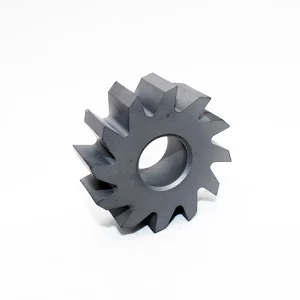
Manufactured from 100% virgin ultra-fine submicron tungsten carbide powder through high-pressure sinter-HIP metallurgical processes.





Macro Commercial Status & Strategic Supply Chain Dynamics
Evaluating the paradigm shift from basic powder consolidation to advanced nano-grain metallurgy across tier-one industrial ecosystems.
Supply Concentration & Direct Sourcing
China holds over 80% of the world's upstream tungsten reserves and intermediate ammonium paratungstate (APT) processing capacity. Jiangxi Zhongfu Cemented Carbide Co., Ltd., based in Nanchang, leverages this geographic proximity to ensure uninterrupted access to 100% virgin WC powder without secondary batch contamination.
High-Productivity Machining Pressures
Global aerospace, defense, and electric vehicle drivetrain machining demand higher chip-removal rates (MRR) under extreme thermal loads. Modern milling inserts must resist plastic deformation at interface temperatures exceeding 1000°C while resisting mechanical shock during interrupted cuts.
Corrosion & Non-Magnetic Integration
Severe environments—such as subsea oil downhole measurement tools (MWD/LWD) and cleanroom semiconductor die-handling—require zero cobalt leaching. Replacing cobalt with engineered nickel binders eliminates magnetic interference while providing superior cavitation protection.
High-Stress Operational Use Cases & Engineering Solutions
How our custom-sintered tungsten carbide components solve extreme abrasion, thermal stress, and dimensional drift across heavy industries.
Hot Steel Tube Scarfing & Bar Peeling
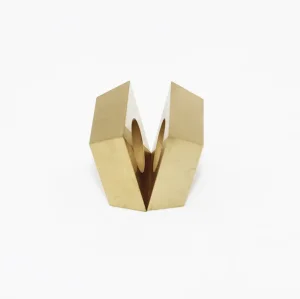
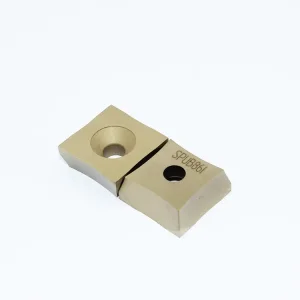
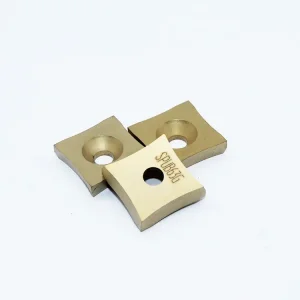
Heavy continuous pipe and tube welding lines utilize our SPUB63, SPUB86, and SNMX series scarfing inserts to continuously shear hot weld beads. Formulated with tough, high-cobalt gradient substrates and multi-layer CVD coatings, they eliminate micro-chipping even at linear feeds exceeding 120 m/min.
Downhole Drilling & Geological Exploration
Deep water-well drilling, core extraction, and mineral exploration rely on our YG8 and YG11C brazed carbide tips and gripper inserts. Sintered under 60-bar HIP conditions, our tungsten matrices ensure crack propagation arrest under heavy cyclic impact against fractured quartz and granite.
Solid End Mills & Precision Micro-Drills
Our h6-ground solid carbide rods (ranging from Ø1 mm to Ø40 mm) serve as standard tooling blanks for manufacturing aerospace end mills, dental burs, and PCB drills. With grain sizes refined down to 0.25 µm, tool fabricators achieve clean cutting edges that preserve tool life in heat-resistant superalloys (HRSA).
Cold Heading & Stamping Die Tooling
Heavy punch matrices and cold forming dies experience cyclic compressive stresses over 3,000 MPa. Zhongfu’s YG15 and YG20 grades offer balanced cobalt dispersion, which prevents internal fatigue fracture and expands cycle life from thousands to millions of press hits.
Engineering Grade Comparison Matrix & Mechanical Criteria
Cross-reference Cobalt/Nickel binder concentrations, density targets, and hardness thresholds to match specific application demands.
| Carbide Grade | Binder Phase (%) | Grain Size Class (µm) | Density (g/cm³) | Hardness (HRA / HV) | Transverse Rupture (TRS, MPa) | Recommended Industrial Scope |
|---|---|---|---|---|---|---|
| YG6 (ISO K10-K20) | 6.0% Co | 1.0 – 1.4 (Fine) | 14.85 – 15.00 | 90.5 HRA / 1580 HV | ≥ 2000 MPa | Cast iron turning, wear strips, wire drawing dies, thin blanks |
| YG8 (ISO K20-K30) | 8.0% Co | 1.4 – 2.0 (Medium) | 14.60 – 14.80 | 89.5 HRA / 1450 HV | ≥ 2400 MPa | Brazed tool tips, rock drilling bits, rough lathe cutting blades |
| YG15 (ISO K40) | 15.0% Co | 1.8 – 2.6 (Coarse) | 13.90 – 14.15 | 87.0 HRA / 1200 HV | ≥ 2800 MPa | Cold heading dies, punching pins, metal forming wear blocks |
| YG20 (Heavy Impact) | 20.0% Co | 2.2 – 3.2 (Coarse) | 13.45 – 13.65 | 85.5 HRA / 1080 HV | ≥ 3100 MPa | Heavy stamping tooling, thick EDM blocks, extreme shock wear parts |
| ZF-Nano05 (Tool Blank) | 10.0% Co + Cr/V | 0.4 – 0.6 (Ultra-Fine) | 14.40 – 14.55 | 92.5 HRA / 1800 HV | ≥ 3800 MPa | Solid carbide end mills, titanium machining, high-speed drills |
| ZF-NM12 (Non-Magnetic) | 12.0% Ni Binder | 1.2 – 1.6 (Medium) | 14.45 – 14.65 | 88.5 HRA / 1350 HV | ≥ 2200 MPa | MWD oilfield sensors, magnetic coil dies, corrosive fluid seals |
Advanced Metallurgy & Industry 4.0 Trajectory
Investing in automated sintering technology, AI defect inspection, and closed-loop lifecycle recycling.
Hot Isostatic Pressing (HIP)
Integrating 100-bar Sinter-HIP furnaces to eliminate interior micro-voids, elevating transverse rupture strength by over 18% compared to standard vacuum sintering systems.
High-Power Impulse Magnetron (HiPIMS)
Applying dense AlTiN, AlCrN, and CVD diamond coatings to enhance friction resistance and extend oxidation stability up to 1150°C during dry milling runs.
Automated Vision & Ultrasonic Testing
Implementing inline ultrasonic scanning and AI vision sorting to verify edge geometry, concentricity, and internal density uniformity down to ±0.002 mm.
Clean Zinc-Recovery Metallurgy
Building eco-friendly recycling systems to recover industrial scrap, converting used end mills and inserts back into submicron powder to reduce lifecycle carbon footprints.
Standard & Custom Carbide Industrial Components
Explore additional specialized solutions for tube scarfing, bar peeling, tool holders, and precision machining.







Frequently Asked Questions on Tungsten Carbide Machining & Sourcing
Detailed technical and operational insights addressing common engineering, quality control, and procurement queries.