
Featured Tungsten Carbide Engineered Components
Explore our premier heavy-stock removal inserts, high-shock railway components, pressureless sintered plates, and non-magnetic nickel-binder rods engineered to exact micrometer tolerances.







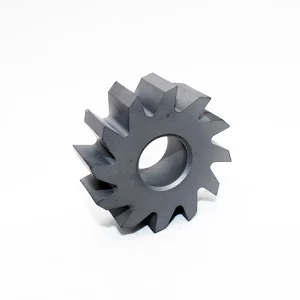
Fundamental Properties & Microstructural Mechanics of Cemented Carbide
Cemented tungsten carbide (WC-Co / WC-Ni) represents the pinnacle of powder metallurgy, bridging the gap between extreme diamond-like hardness and structural metallic toughness.
Phase Composition: Alpha Hard Phase vs. Metallic Binder Phase
The quintessential mechanical properties of cemented carbide are governed by the composite equilibrium between two primary phases: the refractory ceramic tungsten carbide hard phase (α-phase) and the ductile cobalt or nickel binder phase (β-phase). Tungsten carbide crystals exhibit a hexagonal close-packed crystal lattice offering exceptional resistance to plastic deformation, high-temperature softening, and abrasive scratching.
When selecting a manufacturing partner, understanding powder stoichiometry is paramount. Incorrect carbon balance leads to brittle sub-carbide precipitates—known as the detrimental η-phase (W₃Co₃C or W₆Co₆C)—which drastically reduces transverse rupture strength (TRS) and induces catastrophic early tool cracking. Conversely, excessive carbon results in free graphite flakes, attenuating overall wear longevity.
Physical, Thermal & Tribological Characteristics
Carbide maintains elastic stiffness nearly three times greater than high-strength alloy steels. This tremendous modulus of elasticity mitigates chatter, deflection, and dimensional instability during precision boring, high-feed centerless turning, and deep-hole drilling operations across modern industrial tooling suites.
Standard WC-Co and Specialized Non-Magnetic Grade Specification Matrix
Empirical laboratory benchmarks evaluated under ISO 3327 (TRS) and ISO 3738 (Hardness HRA).
| Carbide Grade | Binder Type & Wt% | Grain Size (µm) | Density (g/cm³) | Hardness (HRA) | TRS (MPa) | Dominant Wear / Shock Application |
|---|---|---|---|---|---|---|
| YG6 (ISO K10-K20) | 6% Co | 1.2 – 1.6 | 14.90 – 15.05 | 90.5 ± 0.5 | ≥ 1,900 | Cast iron machining, wire drawing dies, wear liners, precision nozzles |
| YG8 (ISO K20-K30) | 8% Co | 1.4 – 2.0 | 14.65 – 14.85 | 89.5 ± 0.5 | ≥ 2,200 | Rock drill bits, railway tamping tine tips, lathe brazed cutting tips |
| YG11C (Impact Mining) | 11% Co | 2.2 – 3.2 | 14.30 – 14.50 | 87.5 ± 0.5 | ≥ 2,600 | Foundation drilling, heavy scarifier cutters, asphalt road milling picks |
| YG15 (Cold Heading) | 15% Co | 1.6 – 2.4 | 13.95 – 14.15 | 87.0 ± 0.5 | ≥ 2,800 | High-impact stamping dies, cold extrusion molds, bolt heading punches |
| YG20 (Heavy Impact) | 20% Co | 2.0 – 3.0 | 13.45 – 13.65 | 85.5 ± 0.5 | ≥ 3,100 | Severe shock cold forming, automotive structural coin dies, thick blocks |
| ZF-N08 (Non-Magnetic) | 8% Ni (Cobalt-Free) | 1.0 – 1.4 | 14.60 – 14.80 | 89.0 ± 0.5 | ≥ 2,100 | MWD/LWD oilfield tools, magnetic sensor dies, corrosive valve seals |
Jiangxi China Production Advantages: Sinter-HIP & Raw Material Security
Strategic mineral dominance combined with continuous capital reinvestment positions Jiangxi Zhongfu at the epicenter of the international tungsten carbide supply chain.
Direct Mine-to-Furnace Ore Proximity
Jiangxi Province commands over 60% of global tungsten reserves, centering the primary ammonium paratungstate (APT) smelting infrastructure right at our doorstep. This geographic synergy eliminates volatile transnational ore markups, guarantees uninterrupted production continuity, and enforces strict raw material purity devoid of contaminated secondary scrap.
100% Virgin Powder Formulation
Unlike low-tier suppliers using recycled zinc-reclaimed WC powder—plagued with trace impurity segregation, unpredictable thermal expansion, and variable sintering shrinkage—our facility adheres to 100% virgin tungsten carbide and cobalt/nickel matrices, ensuring predictable metallographic microstructure from batch to batch.
Sinter-HIP (Overpressure Sintering)
Operating vacuum sinter-HIP furnaces rated up to 10 MPa (100 bar) argon overpressure at 1450°C, we achieve total elimination of internal micro-voids and microporosity (evaluated up to ISO A02-B02 standards). This overpressure consolidation elevates transverse rupture strength by up to 25% over atmospheric sintering.
Future Trends in Powder Metallurgy & Superhard Alloys
The global cemented carbide sector is undergoing rapid technological disruption driven by nanostructured powder synthesis, alternative binder formulations, and integrated surface diffusion enhancements.
Submicron & Nano-Grain WC
Shifting from conventional coarse grain sizes (2.0–3.5 µm) to ultrafine (<0.5 µm) and nano-scale (<0.2 µm) carbide grades using vanadium carbide (VC) and chromium carbide (Cr₃C₂) grain growth inhibitors. This yields unprecedented edge sharpness and mirror finishes in solid carbide end mills and PCB drills.
Non-Magnetic & Cobalt-Free Binders
Driven by EU REACH regulatory guidelines regarding cobalt handling alongside demand from downhole measurement sensors, non-magnetic nickel-based (WC-Ni-Cr-Mo) cemented carbides are supplanting traditional cobalt grades, delivering total immunity to magnetic interference alongside vastly superior chemical corrosion resistance.
Advanced PVD & CVD Nanocoatings
Surface functionalization via high-power impulse magnetron sputtering (HiPIMS) and multi-layer CVD technologies (AlTiN, TiAlSiN, and CVD thick diamond coatings) creates thermal diffusion barriers exceeding 1100°C, preventing crater wear and adhesion during dry machining of titanium and Inconel superalloys.
Near-Net-Shape Additive Tooling
Binder jetting 3D printing and custom precision micro-pressing allows for internal helical cooling channel integration and complex external conformal profiles directly into green-state carbide bodies, reducing expensive diamond EDM and grinding cycles by more than 40%.
Localized Application Scenarios: Engineering Solutions in the Field
From extreme impact tamping on continental railways to severe hot-scarfing in steel mills, our custom carbide formulations perform where generic tooling fails.
Railway Ballast Tamping Tines
Railway maintenance machinery relies on tamping tines vibrating at 35 Hz to pack ballast beneath track sleepers. Unprotected steel tines erode within 30 operating hours. By vacuum brazing specialized YG8/YG11C carbide wear tiles to tine attack edges, working life is extended past 350 track kilometers, mitigating catastrophic track misalignment.
Heavy Metallurgical Scarfing
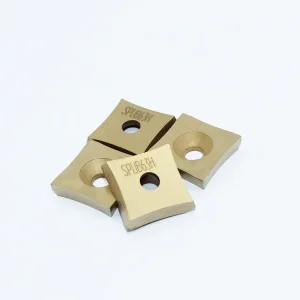
In continuous welded tube mills and hot slab conditioning, SPUB63, SPUB86, and SQ8615WCB scarfing inserts endure thermal shock, scale abrasion, and intermittent cutting forces while leveling longitudinal weld seams. Our CVD-coated carbide grades resist notch wear and catastrophic edge chipping under 800°C red-heat conditions.
MWD/LWD Subsea Oilfield Components
Directional drilling utilizes sophisticated Measurement-While-Drilling (MWD) magnetometer arrays susceptible to ferromagnetic interference. Our nickel-binder non-magnetic carbide rods and wear bushings offer magnetic permeability μ ≤ 1.005 while resisting corrosive drilling muds containing H₂S and abrasive silica cuttings.
EV Stator & Battery Stamping Dies
High-speed stamping of silicon steel motor laminations and battery connector foil demands sub-micron grain carbide punches (YG15/YG20). Our HIP-densified plates eliminate micro-flaking along punch edges, maintaining burr-free tolerances across millions of continuous high-speed strokes.
Mining Picks & Scarifier Cutters
Road milling, asphalt planing, and underground trenching subject cutting heads to catastrophic impact. Zhongfu produces custom dome and chisel carbide buttons brazed to heavy alloy shanks, formulated with coarse WC grains (3.0µm) to arrest microcrack propagation caused by quartz impact.
Chuck Jaws & Torque Grippers
Precision CNC turning and automated clamping systems depend on high-friction, wear-resistant carbide gripping pads. Our YG8 diamond-pyramid serrated inserts provide slippage-free chucking on unmachined forgings without micro-chipping under cyclic clamping pressures.
Macro Industry Solutions: Mitigating Downtime & Optimizing TCO
In high-volume automated manufacturing, component failure costs extend far beyond the procurement invoice. Tool changeover downtime, dimensional scrap, and line stoppages drive true operational expense.
The True Equation of Total Cost of Ownership
A typical steel tube rolling mill or progressive stamping facility incurs hundreds of dollars per minute in lost output during an unexpected tooling changeover. Low-grade carbide sourced at a nominal 20% discount that chips prematurely causes thousands in secondary downtime and tool re-grinding costs.
Zhongfu engineers focus on extending the mean time between replacements (MTBR). Through strict control over magnetic saturation ($4\pi\sigma$) and coercive force ($H_c$), we verify phase purity and binder dispersion in every batch, eliminating unpredictable brittle failures and erratic tool life curves.
Quality Assurance & Metallographic Verification
Every export batch undergoes rigorous quality validation before release:
- Microstructural Porosity: Evaluated at 100x and 200x magnification to guarantee ISO A02, B00, C00 compliance.
- Rockwell Hardness (HRA): Calibrated diamond indenter testing across multiple cross-sections.
- Coercivity ($H_c$): Magnetic measurement ensuring exact WC grain size control without overheating during sintering.
- Optical Profile Projector: Dimensional CMM inspection confirming tolerances within microns (±0.002 mm).
Global Procurement Requirements: Tolerances, Grades & RFQ SLA
We streamline overseas purchasing with engineering-first responsiveness, transparent drawing reviews, and complete export documentation.
Comprehensive CAD/Drawing Ingestion
Our engineering center accepts 2D/3D models in DXF, DWG, STEP, IGES, and PDF formats. We review critical geometric dimensioning and tolerancing (GD&T), recommending draft angle adjustments, chamfers, and wall thickness modifications to eliminate green-compact cracking during axial pressing.
Sub-Micron Precision Grinding
From as-sintered blanks with standard ±0.3 mm sintering allowances to final finish-ground components, our in-house centerless, surface, and profile CNC grinders achieve h6 outer diameter tolerances, flatness within 0.002 mm, and mirror surface finishes down to Ra 0.05 µm.
Export Compliance & Global Logistics
Exporting regularly to tier-one industrial hubs across the USA, Germany, Canada, Mexico, and Australia, we manage export customs clearance, dual-use tungsten licensing, shockproof vacuum packaging, and certified material test reports (MTRs) according to EN 10204 3.1.
Frequently Asked Questions for Overseas Procurement Teams
Clear, definitive metallurgical answers to resolve common purchasing, engineering, and material selection questions.
What is the metallurgical difference between cobalt-bonded and nickel-bonded tungsten carbide?
Why is Sinter-HIP overpressure superior to standard vacuum sintering?
How do grain size and cobalt content interact in wear resistance?
What tolerances can your factory maintain on ground carbide rods and custom plates?
Can Zhongfu manufacture custom shapes directly from CAD drawings?
What is your typical quotation turnaround and production lead time?
Specialized Carbide Inserts, Wear Parts & Tooling Blanks
Explore our heavy-duty pipe scarfing blades, precision torque grippers, non-magnetic pin gauges, and woodworking inserts manufactured under strict metallographic process controls.






Initiate Your Custom Carbide Engineering Project
Connect directly with our senior metallurgical engineering staff. Upload your CAD drawings, specify your environmental wear/shock conditions, and receive a complete material recommendation and factory-direct quotation within 8 hours.
Request an Engineering Quote