
Cold Forming / Belgium

Direct-from-factory sintered carbide dies, cold-heading tooling, and high-velocity scarfers engineered for low radial runout and maximum thermal shock resistance under severe cyclical fatigue.



Located at the absolute heart of Europe's industrial corridor, Belgium maintains a uniquely dense and demanding manufacturing base. From precision stainless-steel wire drawing operations in Kortrijk to advanced automotive assemblies around Ghent and aerospace tooling in Liège and Charleroi, Belgian plants consume substantial volumes of ultra-dense cemented tungsten carbide.
The Flemish industrial belt relies on high-speed progressive blanking, cold heading, and precision wire drawing. Companies in West Flanders and Antwerp demand micro-grain tungsten carbide dies capable of delivering sub-micron tolerances over continuous 1,000,000+ stroke cycles without galling.
The industrial heritage of Wallonia (Charleroi, Liège basin) centers on heavy metallurgy, pipe tube scarfing, hot rolling, and defense tooling. Tooling specifications here emphasize severe thermal shock absorption, cobalt binder optimization, and high fracture toughness (K1C ≥ 14 MPa·m1/2).
Belgium serves as the primary logistical artery for North-West Europe. Tooling buyers in Brussels, Ghent, and Hasselt demand streamlined, air-freighted or bonded-warehouse delivery routes with complete dual-use customs clearance and zero demurrage delays.
Tungsten carbide mold components fail primarily due to three mechanisms: micro-chipping caused by unbonded inclusions, micro-cavitation under extreme compressive shock, and adhesive binder depletion. Our 24-year metallurgical process directly addresses these root failure modes.
| Carbide Grade | Binder (Co / Ni %) | Grain Size Class | Hardness (HRA) | TRS (N/mm²) | Typical Belgian Industrial Application |
|---|---|---|---|---|---|
| ZF-UF06 (K10/K20) | 6.0% Co | Ultrafine (0.5 μm) | 92.6 – 93.2 | 2,600 | High-precision wire drawing dies, stainless steel slitters in Flanders |
| ZF-MD10 (G20/G30) | 10.0% Co | Medium (1.2 μm) | 90.2 – 91.0 | 2,950 | Automotive fastener cold heading dies, progressive stamping punches |
| ZF-HD15 (Impact) | 15.0% Co | Medium-Coarse | 87.8 – 88.6 | 3,200 | Heavy cold extrusion dies, bolt heading dies, thick-gauge shearing |
| ZF-MX20 (Shock) | 20.0% Co | Coarse (2.5 μm) | 85.0 – 86.2 | 3,450 | Heavy railway tamping tools, hot nut forging dies, Wallonia steel mills |
| ZF-NM08 (Non-Mag) | 8.0% Ni-Cr-Mo | Submicron (0.8 μm) | 89.5 – 90.5 | 2,400 | Magnetic sensor components, battery slitting knives, chemical pumps |
Standard vacuum sintering leaves microscopic internal voids (A02 to A04 class porosity). Our production applies 100 bar isostatic argon pressure during sintering at 1450°C. This eliminates internal micro-pores, ensuring zero porosity (ISO 4499 A00 B00 C00 rating) and increasing transverse rupture strength by over 25%.
By preventing brittle η-phase (eta-carbide) formation and controlling carbon balance within a strict 0.05% margin, our carbide blanks resist cyclic fatigue cracking. For applications exposed to corrosive coolants, our nickel-bonded formulations prevent cobalt leaching and pitting.
Utilizing vanadium carbide (VC) and chromium carbide (Cr3C2) grain growth inhibitors, we maintain uniform crystalline structures throughout the die core. This prevents surface pull-outs during Wire EDM (electrical discharge machining) and diamond lapping.
Sourcing cemented carbide molds from Asia requires more than catalog availability. Belgian procurement managers need certainty in chemical safety, supply chain ESG, and documentation conforming to EU industrial regulations.
Every shipment to Belgian ports arrives with complete mill test certificates (MTC) detailing density, magnetic saturation (Cobalt magnetic force), coercivity (Hc), Rockwell hardness (HRA), and metallographic microstructure images.
Strict European chemical standards govern heavy metal handling. Our virgin tungsten carbide powders and binders contain zero unauthorized Substances of Very High Concern (SVHC) and comply with all European environmental safety mandates.
We provide complete Delivered Duty Paid (DDP) logistics into Belgium, handling all EU import tariffs, customs clearance at Brussels National Airport (BRU) or Port of Antwerp, and rapid local courier transit directly to your factory door.
Traditional procurement focuses solely on initial tooling purchase price. However, in automated stamping, cold forming, and continuous tube scarfing lines across Belgium, unexpected downtime costs dwarf tooling expenses by up to 20:1.
By leveraging high-tonnage multi-axis automatic hydraulic presses and CNC green machining, we produce mold blanks that minimize expensive wire EDM cutting time and diamond wheel grinding stock. This reduces finish grinding time by up to 40% for Belgian toolmakers.
Frictional heating is the primary cause of galling in high-speed sheet stamping. Our factory offers pre-polished carbide cores with mirror-finish internal bores (Ra 0.05 μm to Ra 0.02 μm), dramatically lowering friction coefficients and prolonging die cycle life.
For high-abrasion steel tube scarfing and abrasive alloy drawing, we offer optional AlTiN, TiAlSiN, and CVD diamond coatings that serve as a thermal barrier, enabling high-temperature cutting without chemical breakdown of the cobalt matrix.
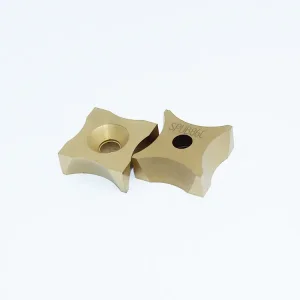
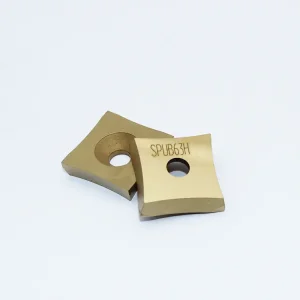
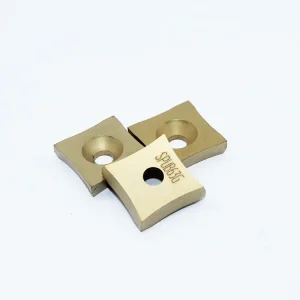
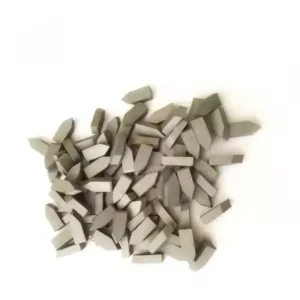
Explore our precision sintered components, lathe inserts, tooling blanks, and brazed cutting tips manufactured under strict ISO 9001 quality protocols.




Direct answers addressing technical qualification, metallurgical properties, Wire EDM considerations, and supply chain logistics into Belgium.
Send us your 2D/3D component drawings, target cycle life parameters, and annual production forecasts. Our metallurgical team will provide comprehensive grade recommendations, DFM manufacturability reviews, and direct factory pricing within 8 hours.