
Featured Industrial Cemented Carbide Inserts & Blanks
Directly procured from ISO9001 certified sinter-HIP production facilities, covering precision turning, ERW pipe scarfing, rock extraction, and wear components.

Wholesale Customized Cemented Carbide Plate — Factory-Direct Blanks

Buy Wholesale SPUB63M30 Tungsten Carbide Welding Inserts

China Factory Coated Tungsten Cemented Blank Inserts

China SPUB86C P40 Uncoated Blank Cemented Carbide Inserts

Wholesale Nickel-Based Tungsten Carbide Rods with Nickel Binder
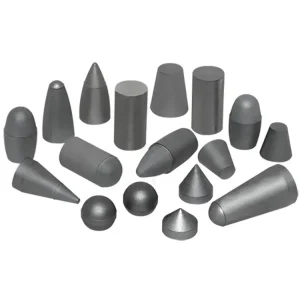
Round Billet Metal for High Strength Cemented Carbide Tools
SPUB86 CVD Coating Tungsten Carbide Turning Inserts Factory
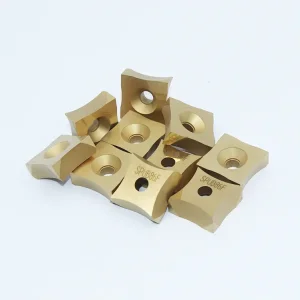
Factory Direct Tungsten Carbide CNC Indexable Turning Inserts
The Global Landscape of Spub86b Manufacturing & Wholesale Supply
Understanding the macro-economic forces, metallurgical challenges, and factory automation architectures driving modern tungsten carbide indexable tooling procurement.
Thermodynamic Sinter-HIP Synthesis
The manufacturing of genuine SPUB86B indexable inserts requires precise control over the cobalt binder liquidus phase. Modern wholesale factories utilize ultra-high-pressure Overpressure Sintering (Sinter-HIP) at 1450°C and 60–100 bar of Argon gas. This process eliminates sub-surface micro-porosity (reaching ISO A00, B00 porosity levels), directly preventing catastrophic edge fracture during extreme interrupted cutting operations.
Extreme Wear & Thermal Resistance
Unlike generic ISO milling inserts, SPUB86B is engineered for high-temperature shear stresses. In longitudinal High-Frequency Electric Resistance Welded (ERW) pipe mills, scarfing inserts must remove external weld beads glowing between 850°C and 1050°C at line speeds exceeding 90 meters per minute. A specialized composite binder matrix enriched with TiC, TaC, and NbC grain growth inhibitors ensures plastic deformation resistance under heavy mechanical load.
Factory Standardization & Geometry
Standard SPUB86B configurations conform to rigid geometric envelopes (Square insert, 0° normal clearance, utility tolerance Class U, single-sided unthreaded countersink/fixing configuration). Leading wholesale manufacturers employ multi-axis CNC peripheral diamond profile grinding to maintain cutting edge roundness (honing radius r = 0.03–0.06 mm) consistently across multi-ton production batches.
Technical Metallurgy: Spub86b Chemical Matrix & Mechanical Constants
A granular breakdown of metallurgical grades used by premier wholesale factories for heavy-duty metal removal, external weld peeling, and high-impact turning operations.
| Substrate Grade Designation | Cobalt Binder (% Co) | Grain Inhibitors (TaC+NbC %) | Mean WC Grain Size (µm) | Hardness (HRA / HV30) | Transverse Rupture Strength (TRS MPa) | Density (g/cm³) | Recommended Industrial Domain |
|---|---|---|---|---|---|---|---|
| ZF-P30 (Heavy Roughing) | 8.5% ± 0.3 | 1.8% | 2.2 – 2.8 | 89.6 / 1420 | 2,450 | 14.50 ± 0.1 | Heavy railway wheel turning, interrupted shaft peeling |
| ZF-P40 (ERW Scarfing Master) | 10.0% ± 0.3 | 2.2% | 2.5 – 3.2 | 88.8 / 1360 | 2,680 | 14.35 ± 0.1 | Continuous hot OD tube scarfing (API 5CT / 5L pipes) |
| ZF-M30 (Stainless & Duplex) | 7.8% + Ni/Co | 3.0% | 1.4 – 1.8 | 91.0 / 1530 | 2,380 | 14.62 ± 0.1 | Austenitic/Ferritic tube peeling, work-hardening alloys |
| ZF-K20 (Abrasive Castings) | 6.0% ± 0.2 | 0.5% | 1.2 – 1.6 | 92.1 / 1640 | 2,150 | 14.90 ± 0.1 | Chilled iron rolls, ductile pipe trimming, non-ferrous bars |
| ZF-U50 (High Impact Shaper) | 12.0% ± 0.4 | 1.5% | 3.0 – 4.0 | 87.4 / 1250 | 2,950 | 14.15 ± 0.1 | Extreme shock resistance, railway tamping base components |
Factory Engineering Insight: Sub-Micron Defect Prevention
Wholesale manufacturing of SPUB86B blanks requires strict control over the carbon balance (Carbon Window). Even a 0.05 wt% deviation can trigger either brittle Eta-phase (W3Co3C / W6Co6C double carbide) precipitates that induce premature edge chipping, or free carbon porosity (graphite flakes) that degrades transverse rupture strength. Our sinter-HIP cycle utilizes in-situ vacuum decarbonization coupled with high-purity hydrogen reduction to guarantee optimal binder phase plasticity.
Localized Application Scenarios: Where Spub86b Outperforms Generic Inserts
A deep dive into mission-critical production environments where tool failure leads to catastrophic line halts and astronomical downtime costs.
1. High-Frequency ERW Outer Bead Scarfing
In continuous high-frequency induction welded steel tube production (ranging from structural hollow sections to high-strength API casing), the outer weld flash (bead) must be planed flush instantaneously. Operating under extreme radiant heat, SPUB86B provides four usable square cutting edges. The massive carbide volume (thickness t ≈ 6.35 mm or 8.0 mm) serves as a dedicated heat sink, preventing thermal edge collapse and preserving flawless tube roundness.
2. Heavy-Duty Centerless Bar Peeling
Steel mills converting continuously cast round billets into precision bright bar stock deploy multiple SPUB86B units in rotating peeling heads (Kieserling, Hetran, or Landgraf machine configurations). These inserts strip decarburized skin, hot-rolled scale, and surface seams at deep depths of cut (ap = 2.0–6.0 mm). Coated with multi-layer Al2O3 CVD, the inserts resist severe chemical cratering caused by high-speed frictional iron diffusion.
3. Railway Wheelset & Track Reprofiling
Maintenance depots and mobile rail maintenance trains encounter severe work-hardened zones (white-etching layers up to 65 HRC) along with embedded ballast stones on railway wheel treads and turnouts. The high transverse rupture strength of SPUB86B (exceeding 2,600 MPa) absorbs violent intermittent impact without catastrophic structural shattering, preventing costly toolholder damage.
4. Industrial Valve Flange & Pressure Vessel Machining
Heavy engineering foundries handling massive cast iron valves, stainless pump housings, and offshore oilfield manifolds deploy SPUB86B inserts for rough face milling and heavy counterboring. The rigid square geometry provides superior back-support during aggressive feeds (f > 0.45 mm/rev), enabling faster stock removal rates and significantly lower machine cycle times.
5. Cold Heading Dies & Hot Forging Pre-Trimming
In precision forging and fastener manufacture, excess hot flash along parting lines must be cut back before thermal contraction locks in residual stresses. Tool holders fitted with SPUB86B inserts provide robust shearing edges that cleanly remove heavy burrs without dulling prematurely in dirty forging atmospheres.
Technological Evolution: 2026–2030 Cemented Carbide Roadmap
How tier-1 wholesale factories are re-engineering the next generation of SPUB inserts through nanostructured binders, advanced thin-film coatings, and green recycling circuits.
Gradient Sintering
Engineering a cobalt-enriched outer zone (15–25 µm thick) free of cubic carbide phase, backed by a hard, deformation-resistant core. This yields extreme edge toughness without losing substrate rigidity.
Nano-Multilayer Coatings
Transitioning from standard TiN/TiCN/Al2O3 CVD to High-Power Impulse Magnetron Sputtering (HiPIMS) and MT-CVD with alpha-Al2O3 textures oriented along the (001) crystal plane for superior thermal barrier properties.
Sub-Micron Grain Refinement
Synthesizing 0.4–0.8 µm tungsten carbide raw powders with VC and Cr3C2 doping. This preserves hardness at high operating temperatures and stops grain growth during the sinter-HIP cycle.
Automated Edge Honing
Replacing manual brush honing with robotic slurry jet polishing and drag finishing. This produces an asymmetrical waterfall cutting edge (K-factor 1.2–1.5), optimizing chip formation and reducing cutting force.
Circular Zinc Recycling
Adopting closed-loop chemical and zinc-melt reclamation processes. Scrap tungsten carbide is recovered without degrading virgin grain size, cutting the carbon footprint by over 65% while keeping quality consistent.
Total Cost of Ownership (TCO): The Economics of Wholesale Factory Partnerships
Direct factory sourcing of SPUB86B inserts goes beyond per-unit pricing—it redefines plant efficiency, tool changer uptime, and inventory capital turnover.
Direct-from-Source Margin Recovery
Bypassing multiple regional distributors eliminates standard 40–80% retail markups. Wholesale purchasing allows tube mills, rolling operations, and machine shops to source container-scale or custom batches directly from the sintering floor, reducing annual consumable tooling expenses.
Downtime Suppression
In high-speed ERW tube production, an unexpected insert chipping event requires an immediate line shutdown, costing thousands of dollars per hour in scrap and lost throughput. High-integrity SPUB86B inserts deliver predictable wear curves, enabling planned tool indexes between shifts.
Custom Tooling & Grade Tailoring
Off-the-shelf catalog products are often compromised for broad utility. OEM partnership with a specialized carbide factory lets buyers specify custom corner chamfers, specialized rake face chip grooves, or adapted binder compositions matched directly to specific pipe steel chemistry (e.g., J55, N80, X70).
Frequently Asked Questions: Sourcing Spub86b Inserts
Direct answers to the most common questions raised by procurement managers, machine shop directors, and tooling engineers.
The fundamental alphanumeric code follows standard industrial and ISO guidelines: "S" designates a square geometry (90° corner angles); "P" signifies a 0° normal clearance angle (negative insert for heavy dual-sided or single-sided roughing); "U" reflects tolerance class (typically utility commercial tolerance for scarfing and billet peeling); "86" indicates an 8/8-inch (25.4 mm) cutting edge length and an approximate thickness code of 6 (or custom 6.35 mm/8.0 mm). The suffix letters "B" and "C" typically denote proprietary factory variations regarding corner edge preparations, clamping pin countersink angles, chip groove depths, or specialized cutting edge chamfers (e.g., negative T-land width and angle) designed for distinct tube-wall thicknesses.
Standard atmospheric or vacuum sintering can leave micro-voids (0.5 to 10 µm) inside thick carbide blanks. Under the high cyclic impact loads of ERW weld scarfing or peeling cast billets, these internal voids act as stress concentrators where micro-cracks originate and quickly cause catastrophic edge breakage. Sinter-HIP combines high vacuum sintering with the injection of 60 to 100 bar of high-purity Argon gas at the liquidus phase (around 1420–1460°C). This pressure collapses all internal gas voids, bringing the material to near-theoretical density (porosity ratings A00, B00, C00) and increasing transverse rupture strength by 20% to 35%.
Application conditions dictate coating selection:
Uncoated (P40/K20): Preferred for high-temperature hot scarfing where the steel weld bead is above 900°C. At this temperature, traditional thin PVD coatings can quickly abrade away. Uncoated, shock-resistant carbide relies on substrate toughness and thermal mass to shed heat into the chip.
CVD Multilayer (TiCN + Al2O3 + TiN): Ideal for cold bar peeling, heavy rail turning, and dry machining of hard alloys. The thick Al2O3 ceramic layer acts as a thermal barrier, resisting chemical crater wear up to 1100°C.
PVD Nanocomposite (TiAlN / AlCrN): Well-suited for stainless steel (ZF-M30) and high-nickel alloys where razor-sharp honed edges are needed to prevent work hardening and material built-up edge (BUE).
Reputable wholesale carbide factories supply comprehensive metallurgical inspection documentation for each batch, including:
1. Chemical & Physical Inspection Sheet: Density (Archimedes balance), Hardness (Rockwell HRA), Coercive Force (Hc in kA/m to confirm grain size), Magnetic Saturation (Comsol 4πσ to verify carbon stoichiometry and ensure zero Eta phase).
2. Microstructure Metallographic Images: 500x and 1500x magnification verifying grain distribution and porosity levels per ISO 4505 standards.
3. Coordinate Measuring Machine (CMM) Dimensional Reports: Validating corner radius, edge profile, rake angle, and thickness tolerances.
Standard inventory blanks in universal grades (P30, P40) typically ship within 3 to 7 working days. Custom geometries—such as special chip grooves, non-standard thickness, or private-label laser marking—usually require 20 to 30 days for precision mould development, pressing, sinter-HIP firing, and CNC profile grinding. Minimum Order Quantities (MOQ) for catalog items generally start at 100 to 500 units, while specialized formulations or custom geometry runs start at 1,000 units.
Explore Related Factory-Direct Carbide Products
Browse our extended product portfolio of cold heading dies, wear pins, scarfing inserts, railway tamping tools, and CNC cutting components.

China Factory Supply Non-Magnetic Carbide Pin for Jewelry
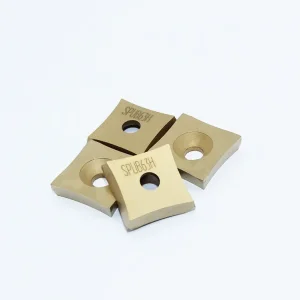
Buy SPUB-63 Welding Tube Scarfing & Pipe Peeling Insert

Customized Cemented Carbide Water Jet Nozzle Seat Valves
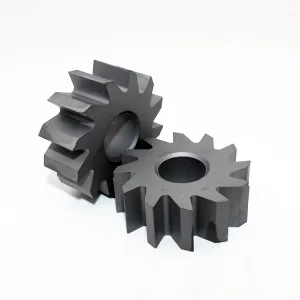
Custom Precision Metal Parts Spur Gear & Cultivator Components
Buy SPUB86C Customized CNC Metal Cutting Inserts Tools

New Shape Tungsten Carbide Railway Tamping Tine Tools

Custom Tungsten Carbide Module Gear Milling Shaper Cutters

Customized Carbide Cold Heading Molds & Punch Drawing Dies
Wholesale Factory Auditing & Quality Certification Standards
Every SPUB86B insert undergoes a multi-stage validation framework from virgin powder synthesis through optical coordinate coordinate inspection.
Powder Purity Validation
Inductively Coupled Plasma Mass Spectrometry (ICP-MS) tests verify virgin WC-Co powder, confirming trace elements (Fe, Ca, Al, S) stay under 100 ppm to prevent intergranular embrittlement.
Pressure Chamber Telemetry
Multi-zone thermocouple logging monitors Sinter-HIP cycles, ensuring chamber thermal consistency within ±3°C to eliminate localized grain variation across the furnace load.
Sub-Micron Edge Profiling
High-precision optical contour sensors and laser confocal microscopes verify that cutting edge hone radius, negative land angle, and surface roughness (Ra < 0.2 µm) meet drawing specifications.
Adhesion & Stress Testing
For CVD-coated inserts, Rockwell diamond indentation tests (HF1–HF4 rating) and scratch testers verify thin-film adhesion strength, preventing premature coating delamination during heavy cuts.