
Primary Tube Scarfing & Heavy-Duty Cutting Inserts
Direct factory inventory featuring outer diameter (OD) and internal diameter (ID) deburring tools, centerless bar peeling blanks, and wear-resistant carbide components.
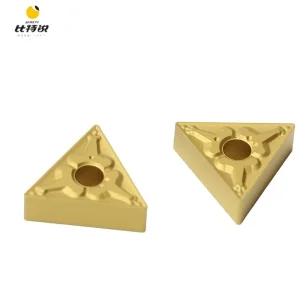



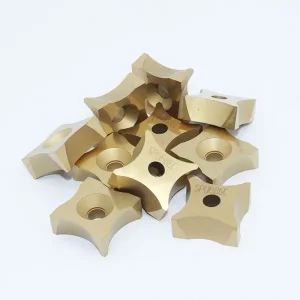

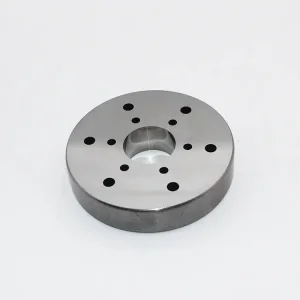

Macro-Industry Solutions: The ERW & HFW Tube Trimming Ecosystem
A comprehensive metallurgical and tribological analysis of continuous weld seam flash removal in high-speed structural, automotive, and OCTG tubular manufacturing.
In modern continuous welded tube manufacturing—encompassing High-Frequency Induction Welding (HFIW) and Electric Resistance Welding (ERW)—the molten squeeze-out created under forged roller pressure forms severe outer diameter (OD) and inner diameter (ID) flash ridges. This continuous flash material consists of oxidized iron, decarburized slag, and heat-affected parent steel solidifying at extreme velocities ranging from 40 to 180 meters per minute. Removing this longitudinal weld bead flush to the nominal wall thickness without gouging parent stock is the critical mission executed by cemented carbide scarfing inserts.
Operating directly inline downstream from the squeeze rolls, the scarfing insert endures severe thermo-mechanical fatigue. The cutting edge interacts with a red-hot metal strip at temperatures exceeding 850°C to 1100°C, compounded by torrential flood cooling of aqueous synthetic emulsions. This thermodynamic environment induces rapid thermal cycling, leading directly to comb-crack formations, edge spalling, micro-welding of high-temperature ferritic steel to the rake face, and sudden brittle fracture if the tungsten carbide substrate lacks microstructural integrity.
Tribological Friction and Mechanical Shock Mechanisms
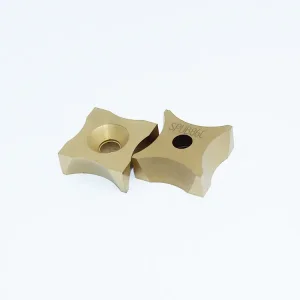
Unlike standard static turning or CNC milling operations, scarfing tooling engages with an uninterrupted, oscillating work surface characterized by variable seam heights, high tensile steel chemistry variations (e.g., API 5L X42 through X80 grades), and localized hardness peaks caused by rapid inline quench rates. The cutting geometry—principally circular radius scrapers (such as SPUB63, SPUB86, SNMX15, SNMX19, and SNMX25 series)—must maintain exact continuous clearance to prevent chatter marks, tube wall thinning, and strip breakage downstream.
At Jiangxi Zhongfu Cemented Carbide Co., Ltd., our formulation engineering addresses these multi-variable stress points. By precisely governing cobalt binder volume fractions (typically 8% to 12% in scarfing grades) and incorporating critical transition metal carbide grain-growth inhibitors such as TaC, NbC, and VC, we yield a microstructure featuring elevated hot-hardness coupled with exceptional transverse rupture strength (TRS exceeding 2,800 MPa). This metallurgical balance eliminates premature thermal fracture while resisting severe abrasive wash.
Thermal Shock Mitigation
Specially formulated Sinter-HIP processing completely eliminates micro-porosity (A00, B00 rating), preventing thermal-fatigue stress cracks from propagating during rapid water-quench cycles.
Hot Hardness Retention
Maintains cutting flank rigidity and prevents plastic deformation even when engaging red-hot weld beads exceeding 900°C along continuous 120 m/min pipe mill lines.
Edge Chipping Resistance
Optimized cobalt phase distribution dampens severe mechanical shockwaves triggered by flash height variations and intermittent weld inclusions.
Global Steel Pipe Landscape & Procurement Economics
Analyzing global mill productivity, total cost of ownership (TCO) variables, and supply chain strategies across North American, European, and Asian manufacturing corridors.
The global welded steel tube and pipe market continues to experience significant transformation driven by energy infrastructure investments, automotive light-weighting directives, and urban civil modernization. In regions like North America (US & Canada), the surge in Oil Country Tubular Goods (OCTG) production requires stringent adherence to API Spec 5L and API Spec 5CT. These standards prohibit weld seam flash protrusion on pipe internal surfaces beyond 0.38 mm, and mandate absolute outer surface concentricity to avoid stress concentration under cyclic hydraulic pressure.
Simultaneously, within the European Union and Asia-Pacific automotive sectors, the expansion of high-strength structural tubing (Dual Phase steels, DP600 to DP1000) and ferritic/austenitic stainless steel exhaust systems creates severe cutting conditions. Standard commercial indexable carbide grades fail within 20 to 45 minutes of continuous operation under these extreme yield-strength materials, forcing frequent mill shutdowns.
Every unscheduled production stoppage on a continuous tube mill incurs astronomical costs—averaging between $800 and $2,400 per hour in lost throughput, scrap strip generation during ramp-up, and labor overhead. Therefore, Tier-1 pipe manufacturers no longer evaluate scarfing inserts solely on piece-part purchase price. Procurement teams rigorously apply Total Cost of Ownership (TCO) formulas, prioritizing edge durability, dimensional consistency, and batch-to-batch predictability.
| Industrial Region | Predominant Tube Grades | Primary Scarfing Demand | Core Tool Failure Mode | Zhongfu Metallurgical Solution |
|---|---|---|---|---|
| North America (US / MX) | API 5L X52 - X80, ASTM A500 Gr B/C | Heavy-wall OD / ID Pipe Scarfing | High mechanical impact & comb cracking | YG15 / Custom P40 Sinter-HIP Substrates |
| European Union (DE / IT / PL) | DIN EN 10305 Precision, 304/409 SS | Precision ID Scraper Rings & Inserts | Galling, build-up edge (BUE) & chipping | Submicron CVD TiCN+Al2O3 Multi-coatings |
| Asia-Pacific & Middle East | Structural Hollow Sections, ERW Water Pipe | Standard SPUB63 / SPUB86 OD Blades | Rapid abrasive wear & thermal erosion | Patented YG8N / P30 Formulation Balance |
| Latin America & Australia | Slurry Transport, Mining Tamping & Piling | Extra-Heavy Duty Welded Pipe Scarfing | Gross fracture from weld start-up shocks | Cobalt-Enriched YG20 Ultra-Tough Blanks |
Sinter-HIP Science & Advanced Nanocomposite PVD/CVD Systems
How patented grain-size engineering and post-sinter thermal treatments unlock maximum wear resistance without sacrificing catastrophic impact toughness.
At Jiangxi Zhongfu Cemented Carbide Co., Ltd., every scarfing insert begins with 100% virgin ammonium paratungstate (APT) derived tungsten carbide powder. Recycled or scrap carbide powder introduces tramp element contamination (Fe, Ni, Cr oxides) that causes micro-structural embrittlement and catastrophic tool fracture during heavy weld-seam engagement. Our powder formulation is governed by high-precision planetary ball milling under inert alcohol environments, ensuring homogeneous distribution of cobalt binders and micro-alloyed carbide inhibitors.
Following high-precision automatic multi-cavity press compaction, insert blanks undergo Sinter-HIP (Hot Isostatic Pressing) inside dedicated furnaces operating under 100 bar of ultra-pure argon at 1450°C. This dual thermal-pressure cycle forces residual micropores to collapse completely, achieving near-theoretical density (greater than 99.98%). The resulting microstructure delivers unprecedented fracture toughness ($K_{1C} \ge 11.5 \text{ MPa}\cdot\text{m}^{1/2}$), providing an unyielding foundation against severe thermal shockwaves.
Gradient Nano-Coatings: CVD vs. PVD for Severe Flash Deburring
Depending on tube metallurgical chemistry and line speed parameters, our scarfing inserts receive optimized surface coatings engineered for thermal barrier isolation and chemical wear resistance:
CVD Multilayer TiCN + Al₂O₃ + TiN
Applied via medium-temperature chemical vapor deposition (MT-CVD) at 8-12 µm thickness. The columnar TiCN layer resists severe abrasive wear, while the crystalline α-Al₂O₃ layer provides an impenetrable thermal shield against weld flash heat exceeding 1050°C.
PVD Nano-Composite AlCrN / AlTiN
Deposited under physical vapor deposition at lower process temperatures (450°C-500°C) with 3-5 µm thickness. Retains ultra-sharp edge radius geometry, vital for light-wall stainless steel tubing where low cutting forces and zero adhesive smearing are mandatory.
Precision Radius Honing & Edge Prep
Every scarfing insert undergoes automated brush and micro-blasting preparation, achieving a controlled edge radius ($r_\beta = 25\text{--}40\ \mu\text{m}$). This eliminates micro-burrs and drastically delays premature cutting-edge micro-flaking.
Localized Application Scenarios & Real-World Field Implementations
Proven engineering outcomes across critical industrial applications, from heavy-duty structural steel to critical oil & gas pipeline projects.
OCTG API 5L Line Pipe & Casing
Scenario: 16-inch OD, 12.7 mm wall thickness ERW pipe, API X70 steel grade operating at 65 m/min continuous speed.
Challenge: Excessive seam height variation causing edge chipping on conventional SNMX inserts every 1.5 hours.
Solution: Custom SPUB86C P40-grade insert with specialized concave top chip-groove and MT-CVD TiCN/Al₂O₃ coating.
Field Result: Continuous tool life extended to 4.8 hours per edge. Total tool indexing downtime dropped by 68%.
Automotive Precision Hydroforming Tubes
Scenario: 50 mm OD, 1.8 mm wall thickness automotive suspension tubing using DP780 high-strength low-alloy steel.
Challenge: Inside ID weld flash must be trimmed flat ($< 0.05\text{ mm}$) to prevent tube burst during high-pressure water forming.
Solution: Ultra-fine submicron YG6X internal scarfing rings with polished rake surfaces and multi-layer PVD AlCrN.
Field Result: Flawless interior seam finish without micro-grooves. Hydroforming rupture scrap rate reduced from 3.2% to 0.1%.
Ferritic 409 Stainless Exhaust Systems
Scenario: 63.5 mm OD stainless tubing welded at 90 m/min under synthetic emulsified flood coolant.
Challenge: Severe work-hardening of the stainless flash, leading to catastrophic built-up edge (BUE) and tearing.
Solution: Positive-rake SPUB63M30 geometry featuring mirror-polished micro-finishing and high-adhesion PVD TiAlSiN.
Field Result: Completely suppressed adhesive welding at the cutting zone. Consistent 8,500 meters trimmed per cutting edge.
Compliance, Standards & Quality Verification Framework
Full batch traceability and third-party laboratory verification ensuring zero structural defects across all exported tungsten carbide components.
Operating as a globally recognized exporter to over 20 countries—including the United States, Germany, Canada, Mexico, and Australia—Jiangxi Zhongfu Cemented Carbide Co., Ltd. enforces exhaustive quality assurance under strict ISO 9001:2015 certified quality management workflows. All raw materials and finished inserts comply with environmental directives including EU RoHS 2.0, REACH regulations, and Conflict-Free Smelter Initiative (CFSI) tungsten provenance standards.
Our in-house metallographic evaluation center tests every production batch prior to packaging and dispatch. Testing protocols incorporate:
Metallographic Microstructure Inspection
Optical and electron microscope scanning verifying uniform cobalt phase distribution, near-zero porosity (ISO 4505 rated A00, B00), and complete absence of free graphite or embrittling eta-phase ($\text{Co}_3\text{W}_3\text{C}$).
Magnetic Saturation & Coercivity (Hc)
Precise measurement of coercivity and magnetic saturation ($4\pi\sigma$) confirming exact carbon-to-tungsten chemical equilibrium and binder-phase alloying depth.
Coordinate Measuring Machine (CMM) Validation
Multi-axis optical profiling verifying critical dimensions, corner radius concentricity, and chip-groove geometries down to $\pm 0.01\text{ mm}$ tolerance thresholds.
Technology Roadmap: Intelligent Scarfing & Next-Gen Tooling
Forward-looking innovations in sensor-integrated toolholders, cryogenic deep treatments, and advanced composite binder matrices.
As the steel pipe industry embraces Industry 4.0 automation, inline deburring operations are evolving from passive mechanical scrapers into actively monitored, digitally integrated manufacturing stations. Zhongfu Carbide maintains a dedicated engineering team collaborating with leading metallurgical institutes to develop next-generation scarfing solutions:
Acoustic Emission Wear Sensing
Engineering insert holder interfaces compatible with high-frequency piezo-acoustic sensors that detect micro-flaking in real-time, signaling automated tool indexing before strip gouging occurs.
Cryogenic Deep Treatment (DCT)
Subjecting post-sintered inserts to sub-zero temperatures ($-196^\circ\text{C}$) to convert retained binder phases, refining the sub-grain crystal structure and increasing wear resistance by an additional 25%.
Cobalt-Alternative Green Binders
Developing eco-friendly Fe-Ni-Cr intermetallic matrix binders that match traditional cobalt toughness while providing enhanced corrosion resistance against severe acid-treated cooling fluids.
Specialty Carbide Wear Parts, Tooling & Inserts
Explore our broader industrial carbide solutions including non-magnetic components, custom forming dies, CNC jaw inserts, and standardized scarfing series.







Frequently Asked Engineering & Procurement Questions
Clear, authoritative guidance addressing insert selection, regrinding feasibility, line setup parameters, and OEM purchasing logistics.