

Precision Formed Lineup
Wholesale Carbide Plate Stock & Wear Solutions (Part I)
Direct factory supply of virgin tungsten carbide blanks, scarfing tool sets, and wire-drawing die components configured for aggressive production environments.







24+
Years of Powder Metallurgy
100%
Virgin WC-Co Raw Materials
< 8h
Technical Drawing Review
20+
Countries Export Network
Global Market Dynamics
Carbide Plate Industry Trends: Evolution from Commodity to Tailored Microstructures
Modern powder metallurgy requirements demand lower cobalt leaching, tighter grain size control, and customized binder architectures to combat extreme industrial attrition.
Sub-Micron & Nano WC Matrix Structures
Industrial demand has shifted decisively from standard micron grain sizes (2.0–4.0 μm) toward sub-micron (0.5–0.8 μm) and ultra-fine grain systems. When consolidated via hot isostatic pressing (Sinter-HIP), these ultrafine matrices dramatically suppress micro-crack propagation under cyclic shock loading, delivering elevated transverse rupture strength (TRS > 3800 MPa) without compromising rock-well hardness (HRA 91.5–93.0).
Near-Net-Shape Isostatic Sintering
Global procurement teams prioritize near-net-shape carbide plates to eliminate high EDM and diamond wheel grinding expenses. By adopting modern computer-modeled shrinkage calculations, advanced manufacturers maintain post-sinter planar tolerances within ±0.25 mm, allowing tool & die builders to accelerate lead times on progressive stamping components and wear liner installations.
Alternative & Nickel-Based Binder Formulations
Aggressive downstream chemical environments—such as battery electrode slitting, offshore oil telemetry, and chemical slurries—have accelerated the shift toward non-magnetic, corrosion-resistant carbide plates. Formulations replacing standard cobalt binders with nickel-chromium-molybdenum matrices maintain complete structural integrity under high acidity without mechanical spalling.
Procurement Intelligence
Global Enterprise Sourcing Architecture: Mitigating Risk in High-Attrition Tooling
Enterprise procurement professionals evaluate tungsten carbide suppliers on metallurgical predictability, lot-to-lot continuity, and total cost of ownership (TCO).
Virgin vs. Reclaimed WC Powder Audit
A primary risk factor in low-bid wholesale suppliers is the unannounced inclusion of recycled scrap zinc-recovery powder. While scrap powders reduce initial unit costs, they introduce erratic micro-voids, elevated oxygen content, and irregular cobalt lakes that fail precipitously during high-pressure stamping operations.
HIP Sintering & Porosity Class Verification
Carbide plates must conform to strict ISO 4505 porosity parameters (A00, B00, C00). Without Overpressure Sintering (Sinter-HIP at 60–100 bar argon gas), internal microporosities act as localized stress concentrators when subjected to Wire EDM wire-cutting stresses, resulting in unrecoverable plate fractures.
Stress Relieving for Precision Wire EDM
Large dimension plates (e.g., 100×100×60 mm blocks or 200×200×10 mm sheets) harbor internal cooling gradients post-sintering. Enterprise specifications necessitate controlled sub-critical thermal annealing cycles to relieve residual hydrostatic stresses prior to electrical discharge machining.
Traceability & Metallurgical Certification
Qualified procurement partners demand traceable Mill Test Certificates (MTC) detailing specific gravity (density), saturation magnetization (magnetic saturation / Com value), coercive force (Hc), and micro-Vickers hardness for every continuous sintering heat run.
Smart Manufacturing Ecosystem
China Factory 4.0: Supply Chain Resilience, Raw Material Integration & Cost Parity
The strategic synergy of localized upstream ammonium paratungstate (APT) reserves, automated press cell robotics, and digitized quality inspection.
Proximity to Primary Refineries
Situated within Jiangxi province—the geographic core of global tungsten deposits—direct factory operations utilize primary source raw materials with pristine stoichiometric tungsten-to-carbon balance. This geographic advantage prevents supply chain interruptions and ensures strict control over cobalt and tungsten powder purity.
Automated Multi-Cavity Press Cells
Implementation of hydraulic and electric presses equipped with closed-loop pressure sensors ensures uniform green density across wide flat plates. This eliminates differential volumetric shrinkage during the critical sintering transformation, keeping unground flatness deviations under tighter bounds.
Automated In-Line Inspection
Automated optical sorting, ultrasonic non-destructive testing (NDT), and metallographic grain inspection verify internal defect absence in heavy wear blocks and plates before overseas logistics dispatch, protecting multi-station automated tooling lines from downtime.
Global Industrial Landscape
Worldwide Industrial Dynamics: How Advanced Sectors Deploy Tungsten Carbide Plates
Across key industrial markets, precision-machined cemented carbide flat profiles operate as the foundational material resisting extreme mechanical degradation.
| Sector / Geography | Operating Wear Mode | Recommended Grade | Standard Mechanical Thresholds |
|---|---|---|---|
| Lithium EV Battery Slitting (North America & EU) | High sliding friction micro-chipping, abrasive chemical binder residue | Submicron YG6X / YG8 | Hardness ≥ 92.5 HRA, TRS ≥ 3200 MPa, Porosity Class A02 B00 |
| Automotive Progressive Stamping (Germany, Japan, USA) | Severe impact shock, cyclic punch fatigue, burr generation | YG15 / YG20 Alloy | Cobalt 15–20%, Hardness 85.5–87.0 HRA, Deflection TRS ≥ 3600 MPa |
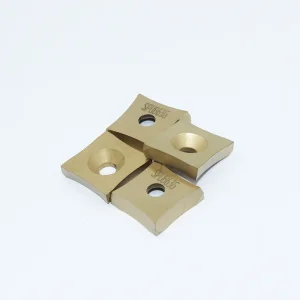
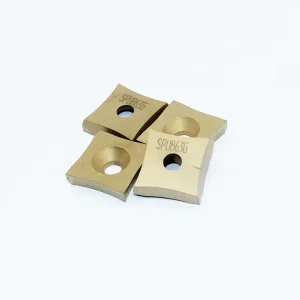
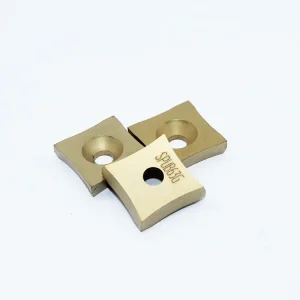
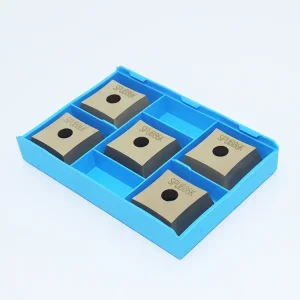
| High-Speed Tube Scarfing & Rolling (Global Steel Mills) | Extreme thermal shock, continuous red-hardness, shear impact | P30–P40 / TiC Coated | High rupture toughness, optimized clearance geometries (SPUB series) |
| Downhole Energy & Directional Drilling (Middle East, USA) | Abrasive silica slurry, erosive high-velocity cavitation, magnetic silence | Ni-Bonded Non-Magnetic | Magnetic Permeability μ < 1.05, Hardness 88–90 HRA, Nickel matrix |
| Lumber, MDF & Aggregate Processing (Southeast Asia, Brazil) | Severe granular quartz abrasion, low impact, chemical wood tannin | YG8 / YG11 Coarse Grain | Coarse grain 3.5 μm, Hardness 87.5–89.0 HRA, Heavy erosion resistance |
Application Engineering
Localized Tooling & Wear Application Scenarios
Specific engineering workflows where custom-dimensioned carbide plates and inserts optimize tooling life.
Silicon Steel Lamination Die Components
In electric motor rotor and transformer core manufacturing, stamping silicon steel sheets causes severe edge dulling. Precision ground YG15/YG20 carbide plates used as die punches and inserts deliver millions of punch cycles between sharpenings without generating burrs.
EDM Thick Block Tooling Fabrication
Stock plate blocks such as 100×100×60 mm serve as baseline blanks for wire EDM processing into complex extrusion dies, powder compacting cavities, and medical instrument forming jaws, maintaining dimensional stability throughout roughing and finishing passes.
Continuous Heavy Tube Bead Scarfing
ERW welded tube lines rely on high-toughness carbide inserts (such as SPUB63 and SPUB86 series) mounted on ID and OD scarfing rings to peel incandescent weld beads under high feed rates, requiring thermal crack resistance and precise edge prep.
Extended Industrial Catalog
Wholesale Carbide Plate Stock & Wear Solutions (Part II)
Comprehensive cemented tungsten carbide solutions including brazing-grade tips, chuck jaw gripper plates, and heavy alloy profiles for industrial manufacturing.



Procurement & Technical FAQ
Frequently Asked Questions for Wholesale Carbide Sourcing
Addressing engineering specifications, quality verification protocols, and ordering workflows for commercial buyers.
How does Zhongfu ensure internal porosity control across heavy carbide blocks?
We sinter 100% of our production runs using modern Sinter-HIP overpressure furnaces operating up to 100 bar with pure argon. This eliminates microscopic shrinkage voids throughout thick cross-sections (up to 100 mm thick), achieving ISO 4505 porosity ratings of A00-A02 and preventing cracking during wire EDM.
What is the standard lead time for customized carbide plate dimensions?
Standard semi-finished blank stock (such as 100×100×60 mm blocks or standard 200×200 mm flat plates) ships within 5–7 business days. Fully customized press tooling profiles requiring custom pressing dies typically dispatch within 15–20 working days, including sintering, stress-relief annealing, and metallurgical inspection.
Can you provide stress-relieved plates specifically suited for Wire EDM processing?
Yes. Plates and thick blocks intended for intricate wire electrical discharge machining undergo specialized sub-critical thermal cycles post-sintering. This process relieves residual cooling tensions, preventing internal stress release that could cause distortion or blade binding during cut-off.
Which cobalt and nickel binder grades do you recommend for abrasive versus corrosive wear?
For sliding abrasion and mechanical shearing without corrosion, low cobalt grades like YG6 or YG8 (6–8% Co) provide high hardness (89.5–91.5 HRA). For stamping dies subjected to high impact, YG15 or YG20 (15–20% Co) is recommended. For corrosive or magnetic environments, we provide nickel-bonded (Ni) formulations with magnetic permeability μ < 1.05.
What surface finishes and tolerances can be achieved on ground carbide plates?
As-sintered blanks maintain tolerances of ±0.5 mm to ±1.0 mm depending on planar scale. With precision diamond surface grinding, we achieve planar thickness tolerances down to ±0.005 mm, flatness within 0.003 mm, and mirror surface finishes down to Ra 0.05–0.1 μm upon request.
How are international wholesale orders packaged to protect fragile carbide plates?
Carbide is dense yet brittle upon impact. Finished plates and inserts receive an anti-corrosion oil coating, are wrapped in sealed protective film, cushioned with high-density EVA shock-absorbing foam, and packed into reinforced wooden crates with secure banding to prevent transit damage.