
Precision Engineered Carbide Parts Showcase (Phase I)
Explore our high-demand wear components, precision scarfing inserts, chuck jaw torque grippers, and railway track maintenance wear parts manufactured via 100% virgin powder metallurgy and high-pressure sinter-densification.








What Is Carbide? Industrial Definition, Chemical Physics & Phase Thermodynamics
In industrial manufacturing and metallurgy, the generic term "carbide" refers almost universally to cemented tungsten carbide (WC-Co)—an advanced metal-matrix composite (cermet) engineered to withstand catastrophic wear, intense mechanical friction, high-temperature creep, and structural deformation.
Stoichiometry & Hard Phase
The ceramic hard phase consists of stoichiometric tungsten carbide (WC) grains synthesized through the high-temperature carbidization of sub-micron tungsten powder with carbon black at 1400°C–2000°C. Tungsten carbide exhibits a hexagonal close-packed (hcp) crystal lattice with an exceptional Mohs hardness of 9.0–9.5 and a Vickers hardness ($HV$) reaching 1400 to 2200 $kg/mm^2$, ranking second only to superhard diamond and cubic boron nitride (cBN).
Ductile Binder Matrix Phase
Because pure tungsten carbide is inherently brittle, it is bonded with a transition metal binder—most predominantly metallic cobalt (Co) or specialized nickel (Ni) systems. During liquid-phase sintering at 1350°C–1450°C, the molten binder wets the faceted WC crystals, filling intergranular voids and producing a cohesive composite that unites the hardness and thermal stability of ceramics with the fracture toughness ($K_{1C}$) of ductile structural alloys.
Purity vs. Reclaim Scrap Risk
A foundational principle of industrial grade carbide is the absolute exclusion of recycled zinc-distillation scrap powders in critical parts. At Jiangxi Zhongfu, our manufacturing utilizes 100% virgin ammonium paratungstate (APT) derivatives, ensuring zero contaminated $\eta$-phase ($Co_3W_3C$) brittle double-carbide formations, uniform carbon potential, and maximized transverse rupture strength (TRS).
China’s Manufacturing Ecosystem: Supply Chain Resilience & Upstream Synergy
Why do leading global automotive manufacturers, Tier-1 aerospace tooling integrators, and multinational drilling companies partner with Chinese carbide factories? The strategic advantage extends far beyond basic labor unit costs into full-spectrum geologic, metallurgical, and technological integration.
Upstream Reserve Dominance
China commands over 80% of global tungsten reserves, with Jiangxi Province recognized internationally as the heart of wolframite and scheelite deposits. Operating directly within Nanchang, Jiangxi, Zhongfu eliminates multi-month raw material procurement delays, shielding international OEM customers from sudden export bottlenecks and volatile London Metal Exchange (LME) tungsten paratungstate pricing shifts.
Vertical In-House Manufacturing
Unlike assembling middlemen or pure sintering shops, our 5,000+ m² facility executes the full manufacturing route: precise wet ball-milling with organic paraffin wax binders, automated spray drying tower atomization, bi-directional CNC hydraulic pressing, high-pressure Sinter-HIP densification, and micron-level diamond wheel profile grinding under continuous automated inspection.
Lower Total Cost of Ownership (TCO)
Industrial purchasing managers realize that initial tooling purchase price is negligible compared to machine downtime, line re-tooling labor, and workpiece scrap rates. Zhongfu’s tight control over pore class ($A00, B00$) and grain consistency doubles tool changeover intervals on steel tube scarfing mills, CNC lathes, and high-impact railway ballast tamping assemblies.
Cemented Carbide Grade Selection Guide & Mechanical Matrix
Selecting the correct cemented carbide grade requires balancing hardness (abrasive wear resistance) against cobalt binder content (transverse rupture strength and shock resistance). Use our empirical benchmark matrix to match target working environments with the ideal metallurgical formulation.
| Carbide Grade | ISO Standard | Binder (Co / Ni %) | Density (g/cm³) | Hardness (HRA) | TRS (MPa) | Recommended Mechanical Applications |
|---|---|---|---|---|---|---|
| YG3X | ISO K01–K05 | 3.0% Co | 15.2 – 15.3 | 92.5 – 93.0 | ≥ 1450 | Finishing chilled cast iron, non-ferrous fine boring, wire-drawing mandrels. |
| YG6 | ISO K10–K20 | 6.0% Co | 14.8 – 15.0 | 90.5 – 91.5 | ≥ 1900 | Wear plates, hydraulic valve seats, precision guide bushes, finishing inserts. |
| YG8 | ISO K20–K30 | 8.0% Co | 14.6 – 14.8 | 89.5 – 90.5 | ≥ 2200 | Brazed lathe tips, chuck jaw torque grippers, rock drill chisel bits, scarfing tools. |
| YG11 | ISO K30–K40 | 11.0% Co | 14.3 – 14.5 | 88.0 – 89.0 | ≥ 2500 | Railway ballast tamping tines, percussion drill buttons, heavy blanking dies. |
| YG15 | ISO G30 | 15.0% Co | 13.9 – 14.1 | 87.0 – 88.0 | ≥ 2800 | Heavy cold-heading dies, metal stamping punches, wire drawing nibs, impact blocks. |
| YG20 | ISO G50 | 20.0% Co | 13.4 – 13.6 | 85.5 – 86.5 | ≥ 3100 | High-impact forging molds, severe stamping punches, thick EDM plate blocks. |
| ZF-NM10 | Non-Magnetic | 10.0% Ni Base | 14.5 – 14.7 | 88.5 – 89.5 | ≥ 2100 | MWD/LWD oilfield directional tools, magnetic sensor dies, anti-corrosive seals. |
Critical Operational Environments: Where Zhongfu Carbide Outperforms
Standard steels and conventional surface-hardened alloys buckle under complex tribological stresses. Zhongfu engineers formulate customized carbide wear components tailored specifically to our global clients' real-world mechanical stress profiles.
Railway Infrastructure Maintenance
Track tamping machines subject ballast tamping tines to violent cyclic impact (35 Hz vibration) while forcing abrasive granite ballast under high compressive hydraulic loads. Standard forged tines dull and erode rapidly. Zhongfu’s tungsten carbide tamping tine wear plates—brazed with high-toughness YG11/YG15 composites—extend tine field lifespans past 150–200 operational track kilometers, drastically cutting rail corridor downtime.
Steel Pipe & Tube Scarfing (ERW Mills)
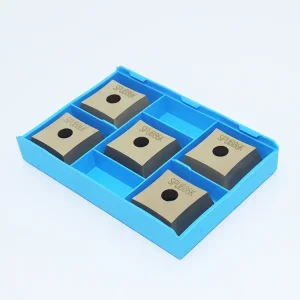
Removing the incandescent weld bead flash on high-frequency electric resistance welded (ERW) steel tubing demands continuous cutting under red-hot conditions (800°C–1000°C). Our CVD-coated SPUB63, SPUB86, and SNMX series scarfing inserts maintain edge sharpness without thermal thermal-fatigue cracking, producing mirror-smooth pipe seams across millions of linear production feet.
Downhole Energy Exploration & MWD Tools
Directional drilling assemblies (MWD/LWD) navigate high-pressure, highly abrasive drilling mud containing aggressive chlorides and entrained quartz sand. Ferromagnetic cobalt binders cause sensor interference in magnetic steering units. Zhongfu supplies precision nickel-bonded non-magnetic carbide flow restrictors, mud nozzles, and rotor-stator sets that exhibit zero magnetic deviation and extreme erosion resistance.
Metallurgical Roadmap: 2025–2035 Technology Trajectory
The cemented carbide sector is undergoing rapid evolution driven by nano-crystalline materials, alternative binder systems, and advanced additive manufacturing. Zhongfu’s internal R&D team is pioneering four key technological frontiers:
01. Nano-Grain Sub-Micron Synthesis
By controlling WC grain growth using trace additions of vanadium carbide (VC) and chromium carbide ($Cr_3C_2$) inhibitors, our R&D lab produces ultra-fine rods ($d_{WC} < 0.4 \mu m$). This increases micro-hardness above 93.5 HRA without sacrificing impact toughness, providing the foundation for micro-drills used in high-density PCB boards and aerospace composite routing.
02. High-Entropy Alloy (HEA) Binders
To address the limitations of cobalt binders in corrosive chemical processing and elevated temperatures, our metallurgical research integrates Fe-Co-Ni-Cr-Mn high-entropy alloys. These multi-component solid solutions dramatically reduce cobalt migration, resist aggressive acid attack, and increase high-temperature creep strength up to 900°C.
03. Additive Manufacturing & Conformal Dies
Complex internal coolant passageways in cutting tool bodies and stamping dies cannot be produced by traditional subtractive methods. Zhongfu is developing binder-jet 3D printing protocols followed by post-sintering Sinter-HIP processing to fabricate intricate near-net-shape carbide components with densities exceeding 99.8%.
International Standards, Quality Auditing & Seamless Logistics
Importing industrial components demands complete confidence in metallurgical traceability, dimensional repeatability, and international trade compliance. Jiangxi Zhongfu operates a rigorous, multi-tiered export assurance framework:
ISO 9001:2015 & Metallography
Every single batch undergoes metallographic inspection to verify grain size uniformity, cobalt distribution, and absence of micro-voids ($A00, B00$). We provide detailed physical inspection certificates with every shipment, verifying coercive force ($H_c$), magnetic saturation ($4\pi\sigma$), density, and Rockwell hardness (HRA).
Conflict Minerals & ESG Assurance
Zhongfu strictly adheres to international Responsible Minerals Initiative (RMI) protocols, verifying that all tungsten ores are ethically sourced through transparent, conflict-free mineral supply chains. Our production facilities implement closed-loop eco-friendly air filtration and comprehensive solvent recovery processes.
DDP Door-to-Door Global Logistics
Serving customers across the USA, Canada, Mexico, Germany, Australia, and 20+ other nations, we manage complete export packaging: precision VCI anti-corrosion barrier wrapping, custom high-density protective foam, and reinforced overseas export crates with air and ocean DDP (Delivered Duty Paid) shipping options.
Precision Engineered Carbide Parts Showcase (Phase II)
Explore additional core offerings including heavy alloy plates, lathe scarfing inserts, chain saw inserts, mining drill buttons, and factory-direct customized cemented carbide blanks engineered to OEM engineering drawings.






Frequently Asked Questions: Cemented Carbide Sourcing & Engineering
Direct answers from our senior metallurgical team regarding chemical purity, sintering technologies, custom CAD fabrication tolerances, and global supply guarantees.
What differentiates virgin WC powder from recycled carbide in industrial wear applications?
Why is Sinter-HIP processing superior to traditional high-vacuum sintering?
Can Zhongfu manufacture non-standard parts directly from 2D/3D CAD engineering drawings?
When should an engineer specify a nickel binder instead of a traditional cobalt binder?
What causes edge chipping on brazed carbide tips, and how can it be eliminated?
What international delivery lead times and customs documentation do you support?
Consult with a Zhongfu Carbide Metallurgical Specialist
Submit your 2D/3D drawings, target performance specifications, or sample components. Our engineering department delivers comprehensive manufacturability feedback, grade recommendations, and transparent factory-direct pricing within 8 hours.