
High-Performance Wear Components: Primary Tier Selection
Explore standard and tailor-engineered cemented tungsten carbide inserts, pin plug gauges, railway tamping tines, and kinematic power components engineered for harsh operating environments.






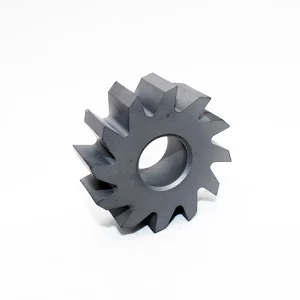

The Evolution of Industrial Wear Components: From Metallurgy to Nanomechanics
A systematic analysis of severe abrasive, erosive, and impact tribo-systems across primary heavy industry, mining, and high-precision manufacturing.
Mitigating Multi-Modal Wear in Extreme Heavy Industry
In modern aggregate extraction, tube scarfing mills, deep-hole directional drilling, and downhole flow control, wear components are subjected to destructive thermodynamic regimes. Tribological wear rarely operates in a single isolated mode. Rather, high-stress abrasion (two-body scratching and three-body gouging) frequently co-exists with cyclic shock impact, thermal fatigue cracking, and severe chemical corrosion.
Traditional structural alloys, heat-treated martensitic steels, and low-grade weld overlays fail prematurely because of binder depletion, surface spalling, and sub-surface fracture propagation. The transition toward high-density cemented tungsten carbide (WC-Co/Ni) and non-magnetic metal matrix wear parts provides an engineering breakthrough. By embedding high-hardness tungsten carbide micro-crystals (up to 2200 HV) within a ductile metallic binder phase, components withstand punishing compressive loads while preventing brittle micro-chipping.
Core Engineering Fact: Substituting high-chrome iron with Sinter-HIP tungsten carbide wearing tips in high-frequency ballast tamping machines increases component longevity from under 80 tamping hours to over 350 continuous operational hours.
The Microstructural Frontier: Grain Sizing and Binder Engineering
Optimizing a wear component requires meticulous chemical phase tuning. The classical trade-off between hardness (wear resistance) and fracture toughness (impact deflection) is systematically governed by tungsten carbide average grain size and binder concentration:
Ultrafine & Sub-Micron Formulations (0.2 – 0.8 µm): Tailored for intense friction, high-pressure scraping, wire drawing dies, and precision internal tube scarfing tools (such as the SPUB and SQ series). These matrices exhibit exceptional edge retention, preventing boundary cavitation and micro-grooving under fine abrasive powders.
Coarse & Extra-Coarse Grains (2.5 – 6.0 µm): Engineered specifically for heavy impact tools, railway ballast tamping tines, road milling picks, and scrap shredding hammers. The expanded mean free path in the binder phase deflects micro-crack propagation, eliminating catastrophic shattering during sudden foreign-object collision.
China Factory 4.0: Supply Chain Resilience, Upstream Dominance & Precision HIP
Why Tier-1 international OEMs, engineering contractors, and procurement directors rely on Chinese advanced powder metallurgy ecosystems for high-spec wear parts.
Upstream Mineral & Raw Powder Supremacy
China holds over 80% of global tungsten reserves, mining capacity, and chemical conversion facilities (Ammonium Paratungstate - APT). As vertically integrated domestic manufacturers:
- Direct procurement of 100% virgin grade tungsten carbide powder.
- Complete insulation from cross-border raw material embargoes and tariff volatility.
- Strict elimination of contaminated scrap or reprocessed secondary scrap powders in critical wear grades.
- Consistent micro-purity with tight limits on trace sulfur, phosphorus, and iron inclusions.
Sinter-HIP (Pressure Sintering) Mastery
Traditional vacuum sintering leaves residual sub-surface micro-voids that trigger fatigue spalling under high stress. Modern Chinese facilities operate cutting-edge Overpressure Sinter-HIP autoclaves:
- Simultaneous thermal consolidation at 1450°C and 60–100 bar inert argon pressure.
- Near-zero metallurgical porosity (ISO 4505 classification A00, B00, C00).
- Transverse rupture strength (TRS) elevated by 25% to 35% compared with conventional sintering.
- Elimination of structural pinholes essential for mirror-polished plug gauges and pins.
Autonomous CNC & Sub-Micron Precision
From complex helical worm gear cutting to multi-axis profile grinding of scarfing inserts, China's Factory 4.0 infrastructure integrates closed-loop precision automation:
- High-speed AgieCharmilles wire EDM machines and Studer CNC cylindrical grinders.
- Diameter tolerances strictly maintained to ISO h6 and h5 limits on solid carbide ground rods.
- Zeiss Coordinate Measuring Machines (CMM) and laser optical profilers on every production batch.
- Direct digital CAD/CAM drawing conversion with rapid prototyping lead times under 7 business days.
Calculating Total Cost of Ownership (TCO): The True Economics of Wear Parts
Why procurement teams evaluating unit purchase price instead of Mean Time Between Failures (MTBF) risk catastrophic production losses.
The Fallacy of Low-Cost Unit Pricing in High-Wear Applications
In high-tonnage industrial settings—such as continuous steel tube welding and pipe scarfing mills—the direct procurement price of a carbide insert represents less than 3% of total operating expenditure. The real financial driver is unplanned line stoppage.
When an inferior carbide scarfing tool chips due to cobalt pooling or incomplete sintering, the consequences multiply instantly:
- Immediate line shutdown requiring 45–90 minutes of re-tooling downtime.
- Dozens of meters of unsalvageable steel tube scrap created during thermal runout.
- Subsequent weld-seam re-grinding and non-destructive inspection labor costs.
- Potential secondary damage to expensive hydraulic tool holders and pneumatic actuators.
Procuring certified, Sinter-HIP wear components engineered with virgin powders ensures uniform hardness distribution (±0.3 HRA), giving maintenance supervisors repeatable, scheduled change-out cycles without unexpected breakdowns.
Comprehensive Metallurgical Quality Assurance Protocol
A premier Chinese manufacturer establishes reliability through rigorous multi-stage laboratory validation before any export batch is released:
Step 1: Powder Particle Characterization: Fisher Sub-Sieve Sizer (FSSS) verification and carbon-oxygen phase balancing.
Step 2: Magnetic Saturation (Cobalt Magnetism) & Coercive Force (Hc): Precise non-destructive assessment of the binder phase distribution and grain dissolution.
Step 3: Metallographic Microstructure & Porosity: High-magnification optical microscope examination adhering to ASTM B276 and ISO 4505 standards.
Step 4: Density & Rockwell A (HRA) Hardness Testing: Archimedes immersion density testing (ISO 3369) and diamond indent micro-hardness mapping.
| Carbide Grade | Cobalt / Binder Content (%) | Density (g/cm³) | Hardness (HRA) | Transverse Rupture (MPa) | Recommended Industrial Wear Application |
|---|---|---|---|---|---|
| YG6 / K10 | 6.0% Co | 14.90 – 15.00 | 90.5 – 91.5 | > 2100 | Fine wire drawing, metal strip slitting, high-wear precision plug gauges. |
| YG8 / K20 | 8.0% Co | 14.65 – 14.80 | 89.5 – 90.5 | > 2500 | Tube scarfing inserts (SPUB series), shear blades, rock drilling tips. |
| YG11C / K30 | 11.0% Co (Coarse) | 14.30 – 14.50 | 87.0 – 88.5 | > 2800 | Railway ballast tamping tines, mining percussion bits, impact crushers. |
| YG15 / K40 | 15.0% Co | 13.95 – 14.15 | 86.5 – 87.5 | > 3100 | Heavy cold stamping dies, punch matrices, high-shock forming tooling. |
| Non-Magnetic (Ni) | 8.0% – 12.0% Ni | 14.40 – 14.70 | 88.0 – 90.0 | > 2300 | MWD/LWD oilfield tools, jewelry forming pins, magnetic field sensor seals. |
Mission-Critical Operational Scenarios & Failure Mode Elimination
Demonstrated engineering reliability across primary steelmaking, heavy rail maintenance, non-magnetic exploration, and rotary mechanical drives.
Continuous Steel Tube Scarfing
Deployment: ID/OD weld seam bead removal on high-frequency longitudinally welded steel pipelines (API casing, automotive tubing).
Operating Load: Extreme red hardness demands up to 800°C under severe mechanical friction and corrosive cooling emulsions.
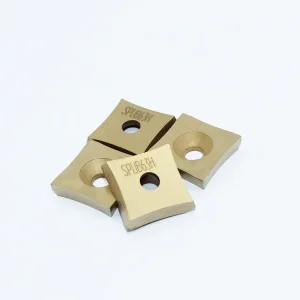
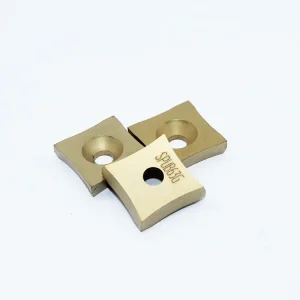
Engineered Solution: Specialized circular and chamfered inserts (SPUB63, SQ8615, SPUB86) utilizing fine-grain WC-Co substrates with high-temperature resistance to plastic deformation.
Railway Track Maintenance & Tamping
Deployment: Ballast packing and track alignment units operating dynamic vibration tamping cycles at 35 Hz.
Operating Load: Violent impact against crushed basalt, granite, and dolomite stone ballast, inducing severe gouging abrasion.
Engineered Solution: Tungsten carbide tamping tine wear plates brazed with high-strength silver-copper alloys onto forged steel shanks, absorbing high-magnitude shock waves without tip detachment.
Non-Magnetic Precision Tooling & Energy
Deployment: Directional Measurement While Drilling (MWD/LWD) collars, sensor probe pins, and jewelry stamping pins.
Operating Load: Severe corrosive fluids co-existing with high electromagnetic sensor arrays requiring near-zero magnetic susceptibility (µ < 1.005).
Engineered Solution: Non-magnetic nickel-chromium bonded tungsten carbide rod blanks ground to mirror finishes, fully neutral to high-frequency electromagnetic interference.
Kinematic Rotary Power Transmission
Deployment: Worm drives, spiral bevel gears, and precision pinion couplings in heavy commercial trucks and variable-speed reduction gearboxes.
Operating Load: High contact stresses (Hertzian pressure), high sliding speeds, and thermal friction causing tooth pitting and micro-scuffing.
Engineered Solution: High-integrity ductile cast iron and specialized alloy steel heat-treated gearing, case-hardened to achieve superior surface fatigue resistance and low-noise kinematic mesh.
High-Performance Wear Components: Advanced Series Selection
Complete your procurement requirements with wear-resistant tungsten carbide strips, woodworking blades, heavy industrial gear sets, and tube scarfing inserts.






Frequently Asked Questions: Industrial Wear Metallurgy & OEM Sourcing
Critical metallurgical answers for international procurement managers, tooling design engineers, and supply chain auditors.