
Primary Sintered & Coated Carbide Insert Selection
Direct factory supply of heavy-duty scarifier and tube scarfing inserts configured for high thermal loads, severe mechanical impact, and extreme abrasion resistance.







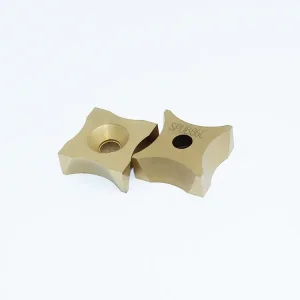
Evolution of Carbide Scarifier Inserts in High-Wear Dynamic Environments
Bridging metallurgical material science with extreme mechanical demands across high-frequency ERW welded pipe lines, heavy-duty asphalt cold planers, and surface scarification.
The Dynamic Challenge of High-Speed Removal
In continuous manufacturing lines—such as high-frequency Electric Resistance Welded (ERW) steel tube production—scarifying and scarfing inserts are subjected to extreme metallurgical realities: flash-trim temperatures exceeding 850°C to 1100°C combined with intense micro-shock vibrations. Conventional tool steels and substandard recycled cemented carbides fail rapidly via thermal cracking, cobalt leaching, and premature edge chipping.
HIP-Sintering Elimination of Micro-Voids
By leveraging Hot Isostatic Pressing (Sinter-HIP) at 1450°C and 100 bar argon gas pressure, our factory reduces residual structural micro-porosity to class A00, B00 standards under ASTM B276. This eliminates the initiation sites of mechanical micro-fractures, boosting transverse rupture strength (TRS) to upwards of 2800–3200 MPa, directly prolonging cutting cycle windows by up to 340%.
Advanced CVD/PVD Hard Coatings
Modern scarifier inserts demand complex barrier coatings. Multi-layer chemical vapor deposition (CVD) incorporating Ti(C,N) and nanostructured alpha-Al2O3 creates an inert barrier that resists tribo-oxidation and crater formation at cutting interface velocities exceeding 120 m/min, shielding the underlying tungsten carbide substrate from severe thermal diffusion wear.
Mitigating Downtime: Total Cost of Ownership (TCO) Analysis
How global procurement directors and technical plant managers evaluate cemented carbide tooling beyond unit price to maximize operational line efficiency.
The Hidden Cost of Sub-Standard Inserts
For large-scale continuous steel mill operations, cold scarifying projects, and heavy civil construction, direct tooling costs account for less than 3.5% of the total operational expense. The overwhelming driver of financial loss is catastrophic tooling failure:
- Unscheduled Line Stoppages: Replacing a chipped ERW pipe scarifying insert (such as SPUB63 or SNMX series) halts an automated mill line, costing between $1,200 and $4,500 per hour in idle capacity.
- Surface Imperfections & Scrapped Output: Burr remnants, gouges, or non-uniform seam removal cause rejection of entire pipe bundles during ultrasonic (UT) and hydrostatic compliance checks.
- Premature Toolholder Rupture: Catastrophic insert fracture under high mechanical torque leads to deformation and costly damage of specialized hydraulic toolholder assemblies.
Formulation-Driven Longevity & Tool Life Stability
As a vertically integrated Chinese manufacturing facility, Zhongfu Cemented Carbide enforces strict virgin powder metallurgy standards (zero recycled scrap WC) combined with grain size optimization tailored to precise mechanical shear loads:
- Ultra-Clean Virgin Raw Material: Ensures completely uniform cobalt distribution, preventing cobalt pooling that triggers brittle crack propagation.
- Repeatable Batch Traceability: Strict metallurgical spectroscopy ensures batch-to-batch variation remains below ±0.2 HRA in hardness and ±0.05 g/cm³ in density.
- Extended Edge Retention: Precision diamond wheel grinding delivers cutting edge hone tolerances within ±0.01 mm, drastically stabilizing tool engagement force.
| Evaluation Parameter | Generic / Low-Cost Sintered Carbide | Zhongfu Precision HIP-Sintered Carbide | Operational Impact & ROI |
|---|---|---|---|
| Raw Material Source | Recycled scrap powder / mixed secondary sludge | 100% Virgin ammonium paratungstate (APT) powder | Zero brittle macro-inclusions; maximum fatigue threshold |
| Internal Sintering Density | Standard vacuum sintering (occasional micro-pores) | Overpressure Sinter-HIP (1450°C @ 10 MPa Argon) | Eliminates micro-cracks under high impact load |
| Edge Wear Predictability | Erratic chipping; abrupt failures within 2–6 hours | Linear, predictable flank wear across 16–24 hours | Enables scheduled preventative tool rotations |
| Scarfing Seam Finish | Inconsistent Ra (>6.3 μm); occasional tear grooves | Consistent mirror/smooth Ra (<1.6 μm); zero flash gouging | 100% pass rate in API 5L and ASTM downstream inspections |
Engineered Cemented Carbide Formulations for Scarifier Tooling
A technical guide to matching tungsten carbide binder percentages, grain boundary structures, and hardness ratings to specialized heavy-wear scenarios.
Low-Cobalt High-Hardness (YG6 / YG6X)
Containing 6% Co with fine/sub-micron WC grain distribution (0.8–1.2 μm). Hardness reaches 91.0–92.5 HRA. Highly recommended for continuous OD scarfing and light metal finishing where abrasive sliding wear dominates and shock impact is damp-buffered.
Balanced Impact-Wear (YG8 / P30–P40)
Featuring 8%–10% ductile binder with balanced grain structure. Delivering 89.0–90.5 HRA paired with high transverse rupture strength (>2800 MPa). The international industry gold standard for general welded pipe scarfing, heavy road planing bits, and vibrating scarifier cutters.
High-Toughness Heavy-Impact (YG15 / YG20)
Formulated with 15%–20% binder content for severe, interrupted cutting loads, heavy-gauge structural tube weld seams, and cold heading stamping dies. Delivers exceptional mechanical elasticity, stopping macro-cleavage crack branching under shock loads.
Macro Industrial Applications: Where Precision Meets Heavy Abrasion
Custom-engineered carbide geometries deployed across demanding steel tube rolling, road milling, and dynamic tooling systems globally.
1. High-Frequency ERW Steel Pipe Scarfing
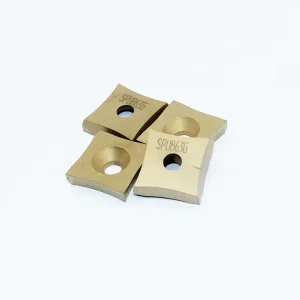
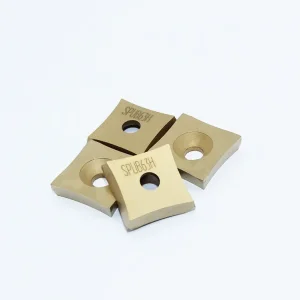
Removal of external (OD) and internal (ID) molten weld beads immediately after high-frequency induction induction welding. Our flagship SPUB63, SPUB86, and SNMX geometries feature computer-modeled concave radials that contour strictly to pipe radii from 1/2" up to 24", delivering defect-free weld flush profiles without damaging parent tube metal.
2. Cold Asphalt Planing & Concrete Scarifying
Equipping rotary drum scarifier machines with ultra-tough tungsten carbide tipped flail cutters, beam cutters, and milling picks. Engineered to pulverize road asphalt coatings, etch non-slip civil bridge decks, and plane concrete slabs without micro-fracturing under high-frequency rotational impact.
3. Heavy Machinery Tooling & Cold Forming
Supplying high-strength carbide cold heading dies, wire drawing dies, and precision nickel-binder non-magnetic wear parts. Designed to sustain localized hydrostatic compression exceeding 4,000 MPa in high-speed industrial bolt and fastener forming presses.
Rigorous Inspection Protocol & Global Export Compliance
Guaranteeing microstructural perfection, chemical traceability, and regulatory compliance from our Nanchang manufacturing center to worldwide job sites.
Full Metallographic Scrutiny
Every production heat undergoes automated metallographic analysis to confirm uniform grain size distribution, ensuring complete absence of harmful eta-phase (decarburization) and free graphite inclusions.
Sub-Micron Profile Grinding
Multi-axis CNC profile grinders and Swiss-made Agathon diamond wheel edge preparation guarantee cutting edge radius (honing) consistency within a stringent ±0.005 mm tolerance envelope.
Coating Adhesion Testing
Calibrated micro-scratch testing (ASTM C1624) verifies coating bond adhesion strength up to critical load HF1 standards, eliminating catastrophic delamination under severe dynamic thermal loads.
Global Logistics & Packaging
Direct export experience across 20+ countries including the USA, Germany, Canada, and Australia. Vacuum-sealed, shockproof anti-corrosion packaging ensures immediate factory-floor readiness.
Engineering the Future of Severe Abrasion Tooling
Continuous investment in cutting-edge powder metallurgy, alternative binder systems, and AI-optimized cutting edge geometries.
High-Entropy Alloy (HEA) Binder Systems
Replacing standard Co-matrices with multi-element Fe-Ni-Co-Cr binders to boost corrosion resistance by 300% and eliminate hot-acid weld seam erosion during continuous pipe scarifying.
Nano-Composite Diamond & DLC Hybrid Coatings
Synthesizing plasma-assisted CVD diamond films onto tailored tungsten carbide substrates, providing microhardness exceeding 8000 HV for non-ferrous, composite, and SiC abrasive planing.
Smart Sensor Integrated Toolholders
Integrating wireless micro-piezoelectric sensors within heavy scarifier insert clamping blocks for real-time acoustic emission feedback and automated wear-life prediction.
Engineering Questions Answered: Scarifier & Scarfing Inserts
Direct, data-driven answers to frequent technical queries posed by production engineers and international purchasing agents.
What distinguishes SPUB63 and SPUB86 series inserts in ERW pipe scarfing operations?
Why is HIP (Hot Isostatic Pressing) sintering critical for road scarifier cutters and weld deburring inserts?
How do CVD vs. PVD wear coatings compare on high-speed carbide scarfing inserts?
Can Zhongfu manufacture custom profile scarifier inserts from customer 2D/3D CAD drawings?
What are the root causes of premature chipping along the scarfing edge, and how can they be corrected?
- Excessive Edge Sharpness without Micro-Honing: A sharp, unhoned cutting edge (dead sharp) crumbles upon initial contact with hot weld spatter. Applying a 0.02–0.05 mm radius chamfer/hone stabilizes the cutting edge.
- Incorrect Grade Toughness: Using an overly hard grade (e.g., YG6) where high vibration is present. Shifting to an impact-resistant grade (such as YG8 or customized P40) provides the requisite ductility.
- Inadequate Clamping Rigidity: Worn toolholder seat pockets or inadequate pneumatic/hydraulic hold-down force allows micro-movement, generating fatigue-induced chatter cracks.
Heavy-Duty Scarfing, Peeling & Machine Wear Components
Complete your supply chain requirements with our precision toolholder inserts, heavy peeling blades, and customized HIP-sintered wear plate blanks.






Need Custom Scarifier Inserts Engineered to Your Exact Blueprints?
Our metallurgists and senior tooling engineers review every CAD drawing and operating condition within 8 hours. Send us your required pipe outer diameter, feed speed, or material hardness for optimized grade suggestions.