
Featured Industrial Carbide Inserts & Precision Wear Components
Direct factory floor supply: indexable chamfering inserts, centerless ground blanks, and wear-resistant carbide grades calibrated for high-chatter deburring and rotary countersinking setups.

Wholesale Wholesale SPUB63 tungsten indexable carbide brazing inserts woodworking tools Manufacturers, Supplier
Request Factory Quote
China Tungsten cemented carbide cutting inserts for CNC machine tool bar peeling SPUB86I Suppliers, Factories
Request Factory Quote
China SPUB63B wholesale lathe round tungsten carbide turning inserts Supplier, Factory
Request Factory Quote
Wholesale Best price woodturning tungsten carbide turning tip inserts and cutter railway Manufacturer, Suppliers
Request Factory Quote
China CNC Carbide Turning Tool Internal Tungsten Steel Cutting Insert Scraping Blade for Steel Workpiece Manufacturers, Factory
Request Factory Quote
Wholesale Industrial Tungsten Alloy Rod Tungsten Material For Stainless Steel Machining Wear‑Resistant Solid Tungsten Bar Supplier, Suppliers
Request Factory Quote
Wholesale Cemented carbide metal insert_cutting_tool SPUB86B/86C/86D/86E/86F/86G/86H/86K/86M Manufacturers, Factory
Request Factory Quote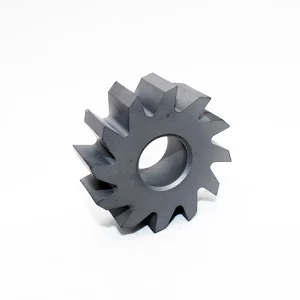
Buy Wholesale custom nonstandard metal worm gears bevel gears pinion gears Suppliers, Factories
Request Factory QuoteEngineering Metallurgy: Selecting the Ideal Grade for Countersinking
Countersinking demands a rigorous compromise between edge wear resistance (hardness) and impact damping (toughness) to prevent chipping during severe interrupted cuts and harmonic resonance.
Sub-Micron WC Particle Matrix
Standard High-Speed Steel (HSS) countersinks soften and deform rapidly above 450°C. Our factory applies 0.4µm to 0.8µm ultrafine Tungsten Carbide powder. This fine dispersion increases grain-boundary density, enabling tool cutting lips to retain structural integrity at elevated cutting speeds and temperatures up to 950°C without micro-fracturing.
60-Bar Sinter-HIP Consolidation
Conventional vacuum sintering leaves micro-voids (A04/B02 level porosity) that act as stress concentrators during cyclic thrust loads. Our facilities utilize overpressure Sinter-HIP furnaces with pure argon gas under 60-bar isostatic pressure, forcing molten binder phases into residual micropores to achieve an absolute relative density of >99.95%.
Optimized Binder Phase Doping
Cobalt content is engineered from 6% (for extreme abrasive wear in non-ferrous, composites, and cast iron) to 10–12% (with trace Vanadium Carbide (VC) and Chromium Carbide (Cr3C2) grain growth inhibitors) to increase fracture toughness for stainless steel, Inconel, and titanium machining.
| Carbide Grade | Grain Size (µm) | Co Binder (%) | Density (g/cm³) | Hardness (HRA) | TRS (MPa) | Ideal Application Spectrum |
|---|---|---|---|---|---|---|
| ZF-Micro06 (ISO K10-K20) | 0.5 µm | 6.0% | 14.95 | 92.8 | 3,500 | CFRP, Carbon Fiber, Cast Iron, High-Silicon Aluminum |
| ZF-Flex08 (ISO P20-M20) | 0.8 µm | 8.0% | 14.75 | 91.5 | 3,800 | General Tool Steels, 4140, 316L Stainless, Alloy Steels |
| ZF-Tuff12 (ISO M30-S20) | 1.0 µm | 12.0% | 14.25 | 89.6 | 4,200 | Titanium Grade 5, Inconel 718, Severe Interrupted Heavy Cuts |
| ZF-NiPure (Non-Magnetic) | 0.7 µm | 8.5% (Ni Binder) | 14.65 | 90.2 | 3,200 | Medical Instruments, MWD Downhole Sensor Assemblies, Electronic Enclosures |
Countersink Flute Architecture & Dynamic Chatter Elimination
Countersinking is inherently vulnerable to resonant vibration due to expanding radial contact length. Our specialized flute architectures decouple regenerative chatter for mirror-grade seatings.
Single-Flute Chatterless
Designed with an asymmetric cutting edge and wide continuous throat. Single-flute geometry distributes shearing stresses smoothly, preventing the polygonal hole profiles common in thin sheet metal and handheld pneumatic drilling.
3-Flute Self-Centering
The industry standard for CNC automated production lines. Ground on 5-axis Rollomatic/Walter grinding centers with unequal flute spacing (e.g., 118°-122°-120°) to break resonant harmonic chatter and provide rapid chip evacuation.
Zero-Flute (Cross-Hole)
Incorporates a precision micro-honed diagonal pilot hole penetrating the conical carbide head. Chips curl inward through the hole without marring exterior workpiece surfaces, creating true micro-finishes (Ra < 0.4µm).
Multi-Flute (6+ Flutes)
Engineered exclusively for hardened die steels (>50 HRC) and precision finishing passes. Light feed rates generate mirror-finish aerospace rivet countersinks while avoiding grabbing or tool binding in deep cavities.
Chamfer Angle Standards Manufactured In-House:
Our facility produces solid carbide and tipped countersinks ground to standard international angles: 60° (metric screw centering and deburring), 82° (ANSI/ASME flat head countersunk fasteners), 90° (ISO metric countersunk screws and DIN 74-A/B forms), 100° (aerospace structural fastener systems, NAS / MS standards), and 120° (riveting and specialized hydraulic port preparations).
Why Source From Jiangxi Zhongfu: China’s Upstream Advantage
Located in Nanchang, Jiangxi Province—the ground-zero hub of global tungsten ore refining—Zhongfu delivers uncompromised purity, cost resilience, and closed-loop process control.
Direct Mine-to-Tool Vertical Integration
China accounts for over 80% of global tungsten reserves, with Jiangxi Province holding the richest deposits. By eliminating four layers of international ore-broker intermediaries, we guarantee 100% virgin Ammonium Paratungstate (APT) feedstock without recycled scrap contamination, offering total price stability across volatile market cycles.
Modern Production Floor Scale
Our 5,000 m² plant operates continuous ball-milling arrays, automated multi-cavity TPA presses, high-capacity vacuum sinter-HIP furnaces, and automated Swiss-made CNC flute grinders. This allows high-mix, low-volume (HMLV) custom batches or million-unit OEM bulk contracts without subcontracting bottlenecks.
Rapid 8-Hour Engineering Turnaround
Global engineering procurement cannot afford multi-day communication lapses. Our dedicated bilingual metallurgists and toolpath designers evaluate incoming 2D/3D CAD drawings (STEP, IGES, DXF), returning detailed DFM (Design for Manufacturability) reports, grade recommendations, and binding quotes within 8 hours.
Localization Support, Regulatory Compliance & OEM Standards
Enterprise procurement requires strict audit readiness. Zhongfu’s production aligns with international manufacturing, trade compliance, and environmental protocols.
Export Compliance & Traceability
Fully certified to ISO 9001:2015 quality systems. Every shipping crate carries a verifiable Certificate of Analysis (CoA) documenting raw material lot tracing, Vickers hardness (HV30), density measurement, and saturation magnetism (magnetic moment) testing to confirm cobalt phase stability.
RoHS, REACH & Conflict-Free Sourcing
All cemented tungsten carbide formulations comply strictly with EU RoHS Directive 2011/65/EU and REACH Regulation (EC 1907/2006). We adhere to the Conflict-Free Smelter Initiative (CFSI), guaranteeing all raw ore originates from socially responsible, conflict-free mines.
Private Labeling & Flexible Logistics
We support tier-one tool distributors across North America, Europe, and Asia-Pacific with high-precision laser marking (custom logos, EDP numbers, flute angles), anti-corrosion VCI oil packaging, custom plastic storage tubes, and bonded warehousing or DDP shipping terms.
Mission-Critical Field Scenarios: Delivering Extended Tool Life
Where conventional cutting bits fail from rapid abrasive dulling, thermal cracking, or chatter delamination, our custom carbide countersinks excel.
Aerospace: CFRP & Titanium Fasteners
Drilling and countersinking stacked carbon-fiber-reinforced polymer (CFRP) and Ti-6Al-4V airframe skins creates aggressive abrasive wear and delamination hazards. Our sub-micron CVD diamond-coated and specialized geometry countersinks prevent fiber breakout and hold fastener depth tolerances within ±0.01mm.
Automotive Powertrain & Chassis
In high-volume cast iron engine blocks, ductile iron control arms, and high-strength boron steel body frames, automated CNC cycle times demand countersinks that run without unexpected chipping. Our TiAlN/AlCrN PVD-coated tools reliably achieve over 5,000 hole cycles per regrind.
Precision Tool & Die Making
Machining fastener pockets and ejector pin chamfers directly into pre-hardened H13, D2, and Stavax steels (48–56 HRC). Zhongfu’s rigid, zero-runout solid carbide countersinks eliminate the need for secondary EDM or burnishing procedures, slashing die manufacturing turnaround times.
Carbide Tooling Evolution: Micro-Geometries & PVD Coatings
Next-generation chamfering efficiency is driven by atomic-level surface engineering and automated micro-edge preparation.
HiPIMS AlTiN / AlCrN Coatings
High-Power Impulse Magnetron Sputtering (HiPIMS) produces extremely dense, droplet-free nanolayer coatings. These offer thermal barrier protection up to 1,100°C and a micro-hardness exceeding 3,300 HV for dry machining.
Robotic Drag Finishing Edge Prep
Raw ground cutting edges possess microscopic grinding burrs and jagged notches. We pass green and sintered blanks through robotic wet drag-finishing to create a controlled 5µm–12µm edge hone (K-factor), preventing initial edge micro-chipping.
Internal Coolant Through-Channels
For deep countersinking and high-temp superalloy processing, solid carbide shanks feature helical through-coolant ports directing high-pressure coolant (70+ Bar) straight to the cutting interface, purging chips and preventing heat build-up.
Indexable Modular Countersink Heads
To lower overall cost-per-hole on heavy diameters (>25mm), our factory engineers replaceable carbide tip geometries and indexable insert holders, reducing solid tungsten consumption while maintaining rigid clamping stiffness.
Explore Related Tungsten Carbide Products, Rods & Industrial Wear Blanks
Source directly from our factory floor. All components are sintered with 100% virgin powder and can be customized to your precise blueprint requirements.

Buy Premium Bright Surface Tungsten Heavy Alloy Sheets & Pure Tungsten Plates for Industrial Applications Manufacturer, Factories
Request Factory Quote
China SPUB86C P40 uncoated blank cemented tools carbide inserts Suppliers, Factory
Request Factory Quote
Wholesale China best price straight toothed steel small pinion gears Manufacturers, Supplier
Request Factory Quote
China Wholesale customized high precision hard alloy tungsten carbide cutting tool wear parts Suppliers, Factory
Request Factory Quote
China Tungsten Carbide Round Rod H6 Ground Ø1-40mm Solid Carbide Blanks Manufacturer, Supplier
Request Factory Quote
China Wholesale custom tungsten carbide module gear milling shaper cutters Manufacturers, Suppliers
Request Factory Quote
China Tungsten carbide tamping tines for railway construction equipment Suppliers, Factory
Request Factory Quote
China Wholesale SPUB-63 series carbide wood insert milling carbide insert Supplier, Suppliers
Request Factory QuoteProcurement & Technical Questions Answered by Machining Engineers
Everything enterprise buyers, tooling distributors, and CNC programmers need to know when sourcing tungsten carbide countersinks from our factory.
What are the key advantages of solid carbide countersinks over HSS-Co?
How do you solve tool chatter and polygonal (triangular) countersink holes?
Can Zhongfu manufacture custom countersinks directly from 2D/3D CAD drawings?
What parameters do you recommend for cutting stainless steel (304/316)?
What quality testing is performed on each production lot before export?
What is your typical production lead time for sample and production orders?
Partner Directly with a World-Class Tungsten Carbide Tooling Factory
Eliminate supply-chain intermediaries, enhance part surface finish, and reduce total tooling costs. Submit your countersink drawings, required grades, and annual batch volumes for an immediate engineering assessment.