

China 2020 wholesale square tungsten large chip blank carbide insert Suppliers, Factories
Explore Blank Specifications
Engineered for high thermal transfer, high shear strength, and structural endurance across extreme abrasive workflows.





Strategic shift from localized batch workshops to integrated metallurgical sintering and automated brazing manufacturing facilities.
Global procurement teams across North America and Europe no longer source cemented carbide solely on per-unit purchasing pricing. A failure in a single brazed joint on a tunnel boring disk, agricultural cultivator point, or downhole drill pick triggers thousands of dollars in line stoppage. Zhongfu Carbide operates as a direct-from-foundry manufacturing partner, balancing premium silver-copper-nickel sandwich brazing shims with grain-optimized tungsten carbide matrixes to minimize field maintenance cycles.
The differential coefficient of thermal expansion (CTE) between steel substrates (approx. 11-13 × 10⁻⁶/K) and tungsten carbide (approx. 4.5-5.5 × 10⁻⁶/K) presents critical residual stress. Sophisticated buyers require factory-floor induction or vacuum furnace brazing controls capable of maintaining joint shear strengths above 220 MPa, preventing interfacial delamination under violent radial impacts.
Engineering departments increasingly disinvest from intermediate sub-tier suppliers. Sourcing directly from an integrated powder-to-braze facility consolidates metallurgical traceability, eliminates compound import-export tariffs, and guarantees that WC grain structure, Cobalt pooling, and surface oxidation treatments are harmonized within a single quality-controlled infrastructure.
Bespoke metallurgical solutions mitigating aggressive impact, abrasive scouring, and chemical attrition across heavy industry.
Railway track tamping picks experience dynamic cyclic loading under constant gravel aggregate abrasion. Our proprietary brazed tips integrate micro-grain YG8/YG11C cemented inserts with ductile tri-metal interlayers (Ag-Cu-Ag), absorbing harmonic vibrational shocks without micro-cracking the carbide core or peeling the joint under 35 Hz impact frequencies.
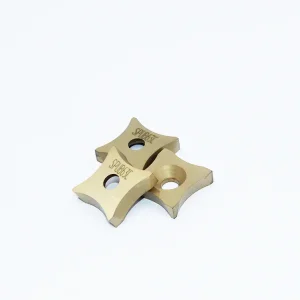
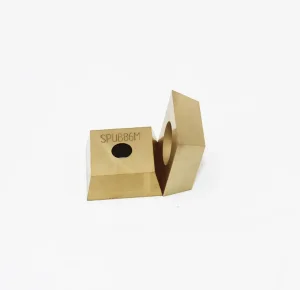
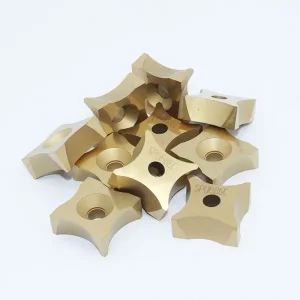
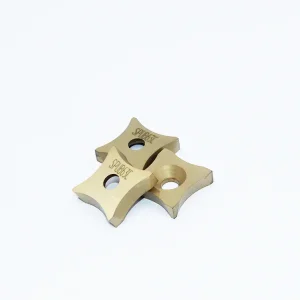
For welded tube and casing manufacturers, pipe scarfing inserts such as SPUB-63, SPUB86C, and SNMX lines must clear molten longitudinal bead flash at velocities exceeding 60 m/min. Vacuum brazed carbide configurations ensure zero localized oxidation, resisting thermal shock de-brazing under continuous coolant spraying and red-hot metallurgical swarf friction.
In downhole rotary drilling and rock-boring tools, tungsten carbide button inserts and chisel cutters rely on high-frequency induction brazing with high-temperature copper-zinc or manganese-based filler metals. Zhongfu’s furnace profiling guarantees complete capillary penetration without residual flux inclusions, boosting pick longevity in sandstone and granite formations.
Inside our 5,000 m² factory: Bridging atomic microstructure to high-stress industrial operations.
100% virgin Tungsten Carbide powder, customized from ultra-fine 0.25 µm to coarse 5.0 µm grain structures, blended with Cobalt and Nickel binders under alcohol-slurry ball milling for 48 hours to secure complete homogenization.
Components undergo 10 MPa (100 bar) hot isostatic pressing (Sinter-HIP) at 1,450°C. Sintering under argon pressure closes all sub-micron internal micro-voids, elevating transverse rupture strength (TRS) to upwards of 2,800–3,800 MPa.
Surface degreasing, ultrasonic flux activation, and automated continuous-feed induction heating ensure identical thermal gradient curves across steel-carbide assemblies, precluding microscopic thermal checking cracks.
Comprehensive metallurgical properties to streamline engineer-to-engineer grade allocation.
| Carbide Grade | Cobalt / Binder (%) | Density (g/cm³) | Hardness (HRA) | TRS (MPa) | Brazing Behavior & Thermal Sensitivity | Primary Industrial Use-Case |
|---|---|---|---|---|---|---|
| YG6 (ISO K10-K20) | 6.0% Co | 14.95 | 90.5 | 2,100 | Requires slow pre-heating; sensitive to high localized heat flux | Finishing cast iron, wear plates, ceramic dies, EDM blanks |
| YG8 (ISO K20-K30) | 8.0% Co | 14.70 | 89.5 | 2,400 | Excellent wetting with Ag/Cu alloys; robust shear toughness | Lathe welding blades, water well rock tips, mining picks |
| YG11C (Coarse Grain) | 11.0% Co | 14.40 | 87.0 | 2,700 | High thermal shock threshold; highly forgiving during brazing | Railway track tamping picks, heavy foundation casing shoes |
| YG15 (ISO K40) | 15.0% Co | 14.00 | 87.0 | 3,000 | Substantial thermal contraction tolerance; low cracking risk | Stamping dies, cold heading punches, structural wear rings |
| YG20 (Heavy Impact) | 20.0% Co | 13.50 | 85.5 | 3,400 | Matches steel expansion curves closer than low-cobalt grades | Severe impact forming tools, thick industrial shearing plates |
| Ni-Bonded (Non-Magnetic) | 8.0–12.0% Ni | 14.65 | 88.5 | 2,200 | Requires specific non-corrosive silver active fluxes | MWD/LWD downhole logging tools, magnet die matrices |
Ensuring end-to-end reliability for tier-1 original equipment manufacturers across 20+ countries.
Every production heat undergoes non-destructive magnetic saturation testing, coercive force screening, and metallographic microscope cross-sectioning. Material test certificates (MTC) confirm grain porosity ratings meeting ASTM B276 standards (A02, B00, C00), ensuring zero void concentrations along brazing planes.
Zhongfu provides seasoned documentation pipelines across US, EU, and Australasian customs gates. Products are coated with neutral anti-corrosion vapor phase inhibitors, encased in impact-absorbing polymer compartments, and crated in export-grade ISPM-15 heat-treated timber to safeguard h6 ground tolerances during transoceanic shipping.
Equipped with internal CNC electrical discharge machining (EDM), laser profile scanners, and precision surface grinders, we process bespoke engineering drawings within 8 hours. Prototype batches of complex brazed wear parts can be manufactured, verified via coordinate measuring machines (CMM), and dispatched within 12 to 18 days.
Complete precision portfolio engineered for tube drawing, heavy turning, and non-magnetic downhole instrumentation.





Addressing core metallurgical, manufacturability, and supply chain questions from OEM procurement professionals.
Because steel expands nearly twice as much as tungsten carbide under temperature, direct brazing without buffering creates enormous interfacial tensile residual stress during cooling. We employ tri-metal brazing foil shims (Silver-Copper-Silver / Ag-Cu-Ag). The ductile central copper core flows plastically under solidus temperatures, absorbing sheer stress and preventing catastrophic carbide cracking.
Induction brazing is ideal for targeted joints (such as railway tamping pick teeth or scarfing tips), applying localized electromagnetic heating to the seam within 15–30 seconds to preserve the steel shank's heat-treated hardness. Vacuum furnace brazing is selected for large wear plates and complex multi-component matrices, providing a completely fluxless, oxygen-free environment with zero porosity and immaculate joint cosmetics.
Standard cemented carbide utilizes a ferromagnetic Cobalt binder. In measurement-while-drilling (MWD/LWD) sub-assemblies and magnetic stamping die assemblies, cobalt induces electromagnetic distortions. Zhongfu manufactures specialized nickel-bonded carbide grades that retain complete non-magnetic properties (permeability μ < 1.005) alongside superior corrosion resistance against downhole sour crude and brines.
Yes. Custom tooling parts and blanks represent our core production. Send STP, IGS, or DXF files with designated tolerance brackets and operational environment requirements. Our metallurgy and CAD engineers will assess form tool geometry, compensate for volumetric sintering shrinkage factors, recommend optimal binder ratios, and reply with DFM feedback within 8 hours.