
High-Performance Scarfing, Mining, and Machining Inserts
Explore production-grade carbide geometries manufactured under 100-bar HIP conditions, featuring advanced CVD/PVD coatings for aggressive operational environments.

SPUB86F TiN Coated Tube Scarfing Insert

CVD Coated Non-Standard CNC Carbide Jaw Insert

SPUB-63C Mining Carbide Drill Insert
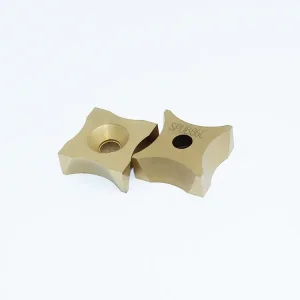
SPUB86C P40 CVD Coating Scarfing Insert

SPUB-63 Series Wood Milling Carbide Insert
Carbide Turning Tip Inserts for Railway Cutters

Tamping Tine Carbide Wear Parts

Carbide Plate 100×100×60 mm EDM Block
Macro Industry Solutions: Beyond Standard Powder Pressing
Industrial performance in severe mechanical friction hinges upon microscopic material control. Modern manufacturing requires a comprehensive transition from commodity-grade tools to formulation-tailored tungsten carbide.
Submicron Grain Microstructure
By modulating tungsten carbide grain sizes between 0.4 µm (ultrafine) and 4.5 µm (coarse aggregate), our factories achieve a tailored balance between Vickers hardness (HV30 1400–1950) and fracture toughness (K1C 9–14 MPa·m½), mitigating edge spalling under heavy chip loads.
Sinter-HIP Densification Dynamics
Standard vacuum sintering leaves micro-porosity (A02-B02 levels) that invites micro-crack propagation under impact. Our manufacturing cycle utilizes Hot Isostatic Pressing (Sinter-HIP) at 1450°C and 10 MPa argon pressure to achieve near-theoretical density (99.98%).
Binder Matrix Optimization
Beyond traditional Cobalt (Co) binders, our factories formulate specialized Nickel (Ni) and Chromium Carbide (Cr3C2) matrix alloys. These non-magnetic and corrosion-resistant grades withstand acidic, saline, and downhole drilling fluid environments without binder leaching.
The Global Landscape for Tungsten & Tool Manufacturing
A rigorous evaluation of global tungsten resources, OEM direct sourcing advantages, and strategies to minimize Total Cost of Ownership (TCO) in industrial procurement.
Raw Material Geopolitics & Upstream Control
Over 80% of the world's primary tungsten (scheelite and wolframite) reserves and ammonium paratungstate (APT) conversion facilities are concentrated in Jiangxi and Hunan, China. Sourcing directly from verified manufacturers in Nanchang eliminates 3 to 4 intermediary trading layers, ensuring direct batch provenance, chemical purity control, and steady supply chain availability free from commodity spot-market speculation.
Total Cost of Ownership (TCO) Calculation
In high-speed tube scarfing or continuous railway tamping, tooling cost accounts for less than 3% of total operational expenditure, while unplanned machine downtime represents over 65%. Procuring premium cemented carbide parts directly from specialized factories lowers tool failure rates, extends replacement intervals by up to 280%, and yields massive net cost savings per metric ton of processed metal.
| ISO / National Grade | Cobalt Binder (% wt) | Density (g/cm³) | Hardness (HRA) | Transverse Rupture (TRS) | Primary Industrial Application Vector |
|---|---|---|---|---|---|
| YG6 (ISO K10-K20) | 6.0% | 14.90 - 15.05 | 90.5 | 2400 MPa | Chilled cast iron, non-ferrous finish turning, light-load drawing dies. |
| YG8 (ISO K20-K30) | 8.0% | 14.65 - 14.80 | 89.5 | 2800 MPa | Brazed drill tips, rock core extraction, rough lathe parting tools. |
| P40 Carbide | 9.5% + TiC/TaC | 13.80 - 14.20 | 88.5 | 2650 MPa | ERW pipe scarfing, heavy intermittent steel milling, rail deburring. |
| YG15 (ISO K40) | 15.0% | 13.90 - 14.15 | 87.0 | 3200 MPa | Heavy cold-heading dies, metal stamping punches, high shock tooling. |
| YG20 (Impact Grade) | 20.0% | 13.40 - 13.60 | 85.5 | 3600 MPa | Fastener cold forging, railway tamping tine bodies, thick EDM blocks. |
| Ni-Bonded (Non-Mag) | 8.5% - 12% Ni | 14.40 - 14.75 | 88.0 - 90.0 | 2700 MPa | Oilfield MWD/LWD tools, corrosive slurry pumps, magnetic molding dies. |
High-Stress Application Scenarios Across Global Sectors
How customized tungsten carbide assemblies are engineered to perform across four demanding industrial manufacturing fields.
High-Frequency ERW Pipe Scarfing
During continuous induction welding of carbon and alloy steel tubing, internal and external bead trimmers face incandescent temperatures (>950°C) and violent vibration. Our SPUB86 and SPUB63 series scarfing inserts, coated with TiAlN/Al2O3 via CVD, ensure uniform flash removal with zero edge fracture.
Railway Track Maintenance
Ballast tamping tines must penetrate hard basalt and granite ballast under high-frequency hydraulic vibration. Vacuum brazed tungsten carbide wearing tips featuring YG20 high-cobalt impact resistance prevent tine deformation, ensuring track geometric precision across thousands of ballast kilometers.
Deep Wire EDM Stamping Dies
Precision progressive stamping dies for EV motor laminations and battery tabs require massive carbide plate blocks (such as 100×100×60 mm). HIP-sintered blanks eliminate interior pore defects, preventing micro-explosions, residual stress cracking, or thermal warping during Wire EDM slicing.
Heavy Milling & Non-Standard Jaws
High-torque CNC lathe chucking systems require non-standard jaw inserts featuring cross-serrated carbide profiles. These inserts prevent surface slip on hard-turned alloy forgings while distributing dynamic clamping loads evenly to avoid brittle fracture.
Engineering Compliance, Testing & Localized OEM Support
International industrial procurement demands full traceability, documented metallurgical integrity, and rapid engineering design collaboration.
Strict EN 10204 3.1 Metallurgical Certification
Every delivery batch includes verified laboratory certificates detailing specific gravity, coercive force (Hc), magnetic saturation (4πσ), Rockwell hardness (HRA), and transverse rupture strength (TRS). Batch-level optical micrographs verify the complete absence of deleterious Eta (η) phase brittle carbide crystals.
Global Environmental & Sourcing Standards
All carbide powders and sintering procedures conform to EU REACH regulations (EC 1907/2006) and RoHS compliance directives. We maintain strict Responsible Minerals Initiative (RMI) supply-chain tracking, ensuring conflict-free mineral sourcing throughout all upstream wolfram extraction and processing lines.
Fast Drawing-to-Sample Engineering Protocol
Our application engineering team provides technical feasibility and CAD/CAM review within 8 hours. Prototype tooling, custom scarfing profiles, or EDM preforms are sintered, diamond-profile ground, and air-freighted to North America, Europe, and Asia within 12 to 18 business days.
Technology Roadmap: The Future of High-Entropy Hardmetals
Anticipating the next decade of advanced manufacturing with next-generation coatings, multi-element binders, and digital quality monitoring.
High-Entropy Alloy (HEA) Binder Systems
To reduce dependence on standard Cobalt and overcome elevated-temperature softening above 700°C, our metallurgical development team is commercializing Fe-Co-Ni-Cr-Mn high-entropy binders. These formulations exhibit higher red hardness and exceptional corrosion resistance in severe wet-cutting conditions.
AlCrSiN Multi-Nanolayer PVD Architecture
Next-generation physical vapor deposition allows cyclic deposition of alternating AlCrN and Si3N4 nanolayers (periodicity <5 nm). This structure provides exceptional oxidation thresholds up to 1100°C and a nano-hardness exceeding 36 GPa, doubling the service life of external pipe scarfing inserts.
Direct 3D Binder Jetting for Complex Geometry
Additive manufacturing of cemented carbide via industrial binder-jetting allows production of conformal cooling internal channels and weight-optimized hollow drill bodies previously impossible with conventional hydraulic pressing dies.
Frequently Asked Technical & Sourcing Questions
Comprehensive answers to critical questions asked by procurement managers, tooling engineers, and machine shop directors.
How does Hot Isostatic Pressing (Sinter-HIP) prevent premature tool chipping compared to standard vacuum sintering?
What parameters dictate the selection between YG6, YG8, and YG20 grades for wear parts?
How do CVD and PVD coatings protect tungsten carbide scarfing inserts at elevated temperatures?
What measures eliminate wire breakage and micro-cracking when EDM wire-cutting thick carbide blocks?
Why is non-magnetic, nickel-bonded cemented carbide required for MWD/LWD downhole drilling components?
Specialized Wear Strips, Scarfing Rings, and Precision Lathe Blades
Complete product range featuring standard ISO and customized designs for pipe production, railway tamping maintenance, and industrial tooling fabrication.

SPUB86 Series B/C/D/E/F/G/H/K/M Inserts
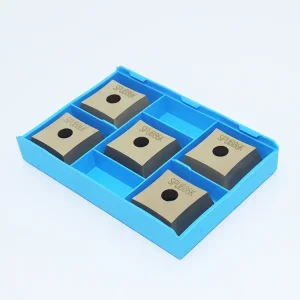
SPUB86K CVD Coating Lathe Cutting Insert

Cemented Wolfram Bars & Wear Strips

SPUB63B Round Lathe Turning Inserts

New Shape Railway Tamping Tine Tools
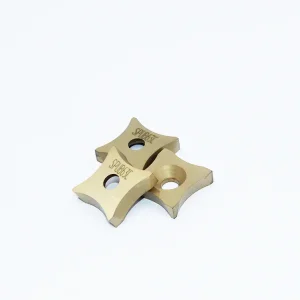
SPUB-63 External Scarfing Inserts for Tubes

Sintered Stone & Wood Diamond Cutting Tools
