High-Performance Cemented Carbide Tooling Catalog
Explore high-demand production inserts, rotary tooling, and precision-ground carbide blanks engineered for high-feed metallurgical execution and continuous line uptime.


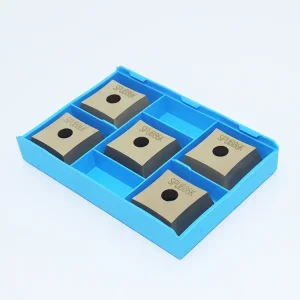


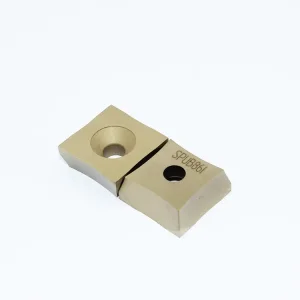

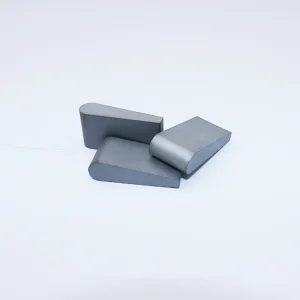
SPUB63F: The Critical Vector in Modern Welded Tube Manufacturing
In high-frequency longitudinal welded pipe production (ERW/HFW), the outer weld bead removal process—known as external scarfing—is a rigorous test of tooling metallurgy. Understanding the operational stress profile of the SPUB63F geometry reveals its technical advantages.
Thermal Fatigue Resistance
Continuous steel tube welding lines run at linear speeds exceeding 60 to 120 meters per minute. The weld bead reaches temperatures between 800°C and 1150°C during scarfing. SPUB63F inserts feature elevated cobalt-binder cohesion and cubic carbide additions (TaC/NbC) to prevent micro-cracking caused by extreme cyclic thermal exposure and cooling emulsions.
Severe Interrupted Cuts
Tube wall thickness variations, seam mismatch, and high-frequency weld flash spatter cause violent intermittent impact loads on cutting edges. Zhongfu's proprietary vacuum Sinter-HIP process eliminates internal voids, boosting Transverse Rupture Strength (TRS) above 2,600 MPa to prevent catastrophic edge fractures.
Optimized Surface Planarity
Scarfed tube surfaces must transition smoothly to base metal without gouging or secondary flash steps, meeting API 5L, ASTM A53, and EN 10217 specifications. SPUB63F inserts feature precision CNC edge radii and balanced clearance chamfers that produce clean, burr-free surfaces ready for ultrasonic non-destructive testing.
Engineering Grade Specifications & Coating Systems
Standard off-the-shelf indexable inserts frequently fail in continuous tube scarfing due to cobalt leaching and plastic edge deformation. Zhongfu tailors WC-Co powder formulations with multi-layered CVD coatings built specifically for high-temperature alloy shearing.
| Substrate / Coating Grade | Composition Matrix | Density (g/cm³) | Hardness (HRA) | TRS (MPa) | Recommended Tube Material Profile |
|---|---|---|---|---|---|
| ZF-SC10 (CVD Al₂O₃/TiCN) | WC + 6.8% Co + TaC/NbC | 14.85 | 91.8 | 2,450 | Low-carbon structural pipe, ASTM A500, ERW conduit (high-speed runs). |
| ZF-SC25 (Heavy Impact CVD) | WC + 8.5% Co + Micro-grain | 14.50 | 90.2 | 2,850 | API 5L X42-X70, heavy-wall casing, high-manganese structural tubing. |
| ZF-SC35 (Toughness Master) | WC + 10.2% Co + Grain Stabilizers | 14.25 | 88.6 | 3,100 | Interrupted flash-butt welding, high tensile alloy tubing, heavy scrapers. |
| ZF-NM08 (Non-Magnetic Ni) | WC + 8.0% Nickel Binder | 14.65 | 89.5 | 2,300 | High-purity stainless tubes (304/316L), corrosion-prone acid environments. |
Multi-Layer CVD Thermal Barrier Protection
Our SPUB63F scarfing inserts utilize an 8–14 μm CVD coating system. A nano-columnar TiCN inner layer bonds securely to the carbide substrate to prevent shear delamination. An intermediate alpha-Al₂O₃ layer provides an oxygen-diffusion and chemical barrier up to 1100°C, while a polished TiN outer layer reduces friction, prevents chip welding, and provides clear visual wear indication.
Total Cost of Ownership (TCO) Economics
Procurement teams often compare initial price rather than scrap rates and line stoppage costs. A line shutdown caused by insert chipping costs hundreds of dollars per minute in lost output. Zhongfu's vacuum-sintered SPUB63F inserts increase pass-line tonnage between index changes by 35% to 55%, lowering tooling cost per ton of finished welded pipe.
Localized Applications & Case Study Validations
Tube mills across Europe, North America, and Southeast Asia face distinct processing challenges. Here is how customized SPUB63F inserts perform in three typical production environments.
API 5L Line Pipe (North America)
Challenge: Heavy external bead removal on X65 grade steel tubing (12.7 mm wall thickness) at 45 m/min. Standard commercial SPUB63 inserts cracked at the cutting edges every 2.5 hours.
Solution: Zhongfu supplied grade ZF-SC25 inserts with a 0.04 mm honed edge and 12 μm CVD Al₂O₃ coating.
Result: Tool life increased to 7.2 hours per cutting edge, eliminating emergency mill shutdowns.
Automotive Hydroforming Tubes (EU)
Challenge: Strict surface roughness limits (Ra < 1.6 μm) on cold-rolled high-strength structural tubing. Chipped inserts left surface scratches that triggered hydroforming splits.
Solution: Custom-ground SPUB63F geometry with a specialized wiper flat and nano-grain ZF-SC10 substrate.
Result: Maintained consistent Ra 0.8–1.1 μm finishes across 18,000 meters per corner, cutting hydroforming rejection rates to zero.
Stainless Exhaust Systems (Asia)
Challenge: Built-up edge (BUE) and work hardening when scarfing AISI 409/441 ferritic stainless tube weld seams, causing rapid tool pullout.
Solution: Mirror-polished rake surfaces combined with our non-magnetic nickel-cobalt balance grade (ZF-NM08).
Result: Reduced metal adhesion, lowered cutting friction by 40%, and stabilized scarfing chip ribbons.
Need Custom Drawings or Toolholder Geometry Matches?
Our engineering team can evaluate your current toolholder profiles, tube wall thicknesses, and weld line speeds to recommend optimized carbide grades and edge preps within 8 hours.
Traceability, Global Logistics & Regulatory Compliance
Jiangxi Zhongfu implements rigorous quality controls at every step of manufacturing, from incoming tungsten ore refining to the final export packaging of precision carbide inserts.
100% Virgin Tungsten
We source virgin ammonium paratungstate (APT) from Jiangxi's primary mineral supply chain, avoiding scrap-metal contaminants that cause micro-porosity and unpredictable tool fractures.
Pressure Sinter-HIP
Every SPUB63F blank undergoes 60-bar isostatic pressure sintering at 1450°C. This closes microscopic internal pores, yielding pore-free carbide that meets ISO 4505 metallographic standards.
Full EN 10204 3.1 Trace
Shipments include complete Material Test Reports (MTR) documenting batch density, magnetic saturation (Cobalt-magnetization), coercive force (Hc), and micro-Vickers hardness ratings.
Global Export Support
We provide full export documentation (Certificate of Origin, Form E, EUR.1, customs HS-code harmonization) and ship globally via air-courier and sea freight with shockproof protective packaging.
Engineering Roadmap: The Next Era of Tube Scarfing
As pipe mills deploy higher-strength steel grades and automate production lines, scarfing insert metallurgy continues to evolve. Here is what we are building into our production pipelines.
Gradient Binder Micro-Layering
We are developing powder compaction techniques that create an enriched cobalt phase (10–12% Co) in the core for high shock absorption, paired with a cobalt-lean surface layer (< 4% Co) for maximum abrasion resistance, eliminating the traditional trade-off between toughness and wear life.
Sensorized Tool Wear Monitoring
Collaborating with tube mill equipment builders, Zhongfu is testing toolholders equipped with wireless piezoelectric sensors that track cutting forces, high-frequency vibration, and temperature spikes in real time to alert operators before catastrophic tool failure occurs.
Closed-Loop Carbide Reclamation
Our hydrometallurgical recycling initiative enables industrial customers to return spent SPUB63F inserts. We chemically reclaim virgin-purity tungsten and cobalt powders with up to 70% lower energy consumption compared to primary ore processing.
SPUB63F Manufacturing & Procurement FAQ
Direct technical answers to common questions about carbide grades, order minimums, tolerances, and tool performance.
What is the difference between SPUB63 and SPUB63F inserts?
The "F" designation denotes an engineered edge-prep chamfer and micro-honed radius along the cutting perimeter. This edge conditioning distributes high shear stresses during continuous pipe scarfing, reducing micro-chipping caused by unconditioned, sharp as-ground edges.
Can you supply custom corner radii and clearance angles?
Yes. Custom tooling is our core specialty. We grind outer radii, chamfers, rake profiles, and locating hole bevels to match proprietary OEM scarfing toolholders, including systems from PRÜFTECHNIK, T&H Lemont, and Thermatool lines.
Which coating performs best on API 5L line pipe steels?
Our multi-layer CVD system featuring columnar TiCN and an alpha-Al₂O₃ thermal barrier layer (grade ZF-SC25) delivers dependable tool life. The alumina layer shields the tungsten carbide substrate against crater wear at interface temperatures above 950°C.
What is the typical production lead time and MOQ?
Standard SPUB63F blanks in popular grades are kept in stock with a minimum order quantity (MOQ) of 50 pieces. Custom dimensions, proprietary chipbreakers, or tailored grades ship within 15–20 business days from drawing sign-off.
Should tube scarfing be performed wet or dry?
While coolant helps control tube exit temperatures, erratic emulsion spray directly on the cutting edge can induce thermal cracking. We recommend applying steady emulsion behind the insert or switching to our thermal-shock resistant ZF-SC25 grade for uncooled lines.
How do you verify metallurgical density and edge integrity?
Every production batch is tested via Archimedes immersion density measurement, magnetic saturation, coercive force tests, and 500x optical metallographic microscopy. Insert cutting edges are inspected with 3D optical coordinate measurement machines (CMM).
Specialized Wear Parts, Gears & Railway Construction Tooling
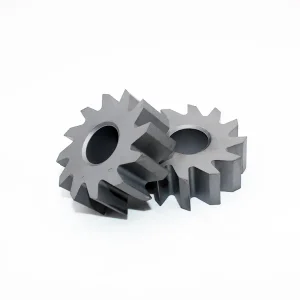
Beyond tube scarfing inserts, our Nanchang production facility manufactures high-impact railway components, custom-machined mechanical transmission assemblies, and wear-resistant carbide blanks.