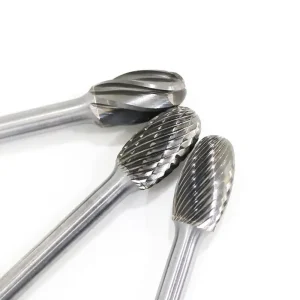
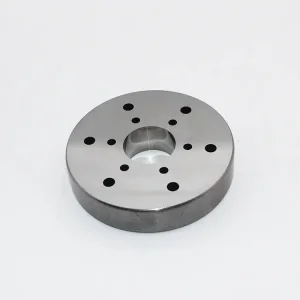
High-Performance Radius Cutter Mill & Wear Solutions
Direct manufacturing floor delivery of ultra-fine grain tungsten carbide wear components, tube scarfing profile inserts, and extreme-load cutting solutions engineered to micron-level runout tolerances.




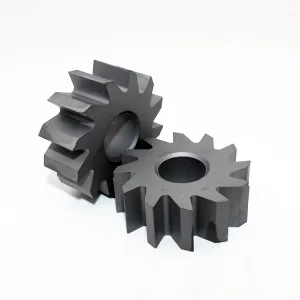

Engineering Precision: Macro Solvers for 5-Axis Profiling & Extreme Heavy Machining
How corner radius end mills, profile scarfing cutters, and engineered carbide substrates mitigate thermal fatigue, damp high-frequency chatter, and reduce per-part tooling costs in structural aero-structures, energy pipeline production, and automotive tooling.
Stress Dissipation via Toroid Geometries
Unlike standard square end mills where edge chipping initiates rapidly at sharp 90-degree corners under heavy engagement, radius cutter mills (bull-nose geometry) redistribute chip thinning shear strain over a smooth radial arc. This lowers localized edge heating and drastically reduces micro-spalling during trochoidal milling of hardened alloys.
Continuous ERW Tube Weld Seam Conditioning
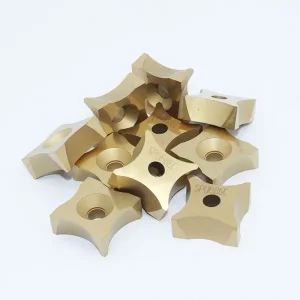
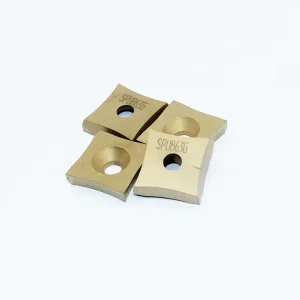
In high-frequency longitudinal pipe welding (ERW), removing excess outside diameter flash requires radius tube scarfing inserts (e.g., SPUB63, SPUB86). Manufactured with concave precision radii matching the outer pipeline curvature, our P40/P45 grade scarfing tips withstand dynamic shock at speeds over 120 m/min without catastrophic fracturing.
Non-Magnetic Downhole & Sensor Tooling
Standard cobalt matrix tools create electromagnetic interference in directional drilling (MWD/LWD) and precision electronic manufacturing. Zhongfu replaces cobalt with a proprietary nickel-chromium binder system, delivering zero-magnetic field interference, extreme chemical anti-corrosion, and wear resistance up to HRA 91.5.
Material Characteristics: Solid Cemented Carbide Formulations
Rigorous metallurgical formulation determines tool survivability. Below is our engineering classification index for solid radius blanks, profile turning inserts, and heavy-duty milling blocks.
| Grade Designation | Binder (Co/Ni %) | Grain Size (µm) | Hardness (HRA) | TRS (MPa) | Optimized Radius Cutter Application |
|---|---|---|---|---|---|
| ZF-Nano02 (Ultra-Fine) | 8.0% Co | 0.2 – 0.4 µm | 93.5 – 94.0 | 4,200 | High-speed profile radius finishing on hardened steel (>55 HRC), mold ribs, aerospace titanium 5-axis sculpting. |
| ZF-YG6X (Micro-Submicron) | 6.0% Co | 0.6 – 0.8 µm | 91.5 – 92.2 | 3,200 | High-abrasion solid carbide end mill fluting, non-ferrous aluminum radius profiling, graphite electrodes. |
| ZF-P40/P45 (Tough Matrix) | 10.5% Co + TiC/TaNbC | 1.5 – 2.2 µm | 89.0 – 90.0 | 2,900 | Heavy-impact tube scarfing inserts (SPUB63/SPUB86), scale deburring, roughing mills for interrupted cuts. |
| ZF-NM10 (Non-Magnetic) | 10.0% Ni Matrix | 0.8 – 1.2 µm | 88.5 – 89.5 | 2,800 | Sensing pin gauges, magnetic media die blocks, non-inductive wear plates, downhole drill tool stabilization. |
| ZF-YG15/YG20 (High Shock) | 15.0 – 20.0% Co | 2.0 – 3.5 µm | 85.5 – 87.5 | 3,600 | Crushing roll carbide studs, railway ballast tamping tine tips, heavy cold heading dies, extreme rock profiling. |
Enterprise Reliability: Traceability, Certifications & Regional On-Site Backing
Procuring industrial carbide from Jiangxi Zhongfu guarantees supply-chain transparency, material certifications complying with European and North American industrial directives, and rapid customs readiness.
100% Virgin Powder Traceability
Every batch of carbide originates from certified primary ammonium paratungstate (APT) refineries in Jiangxi. We implement an uncompromising zero-recycled-scrap policy for all cutting tool blanks, ensuring predictable grain structures and zero micro-void fracture points.
Comprehensive Sinter-HIP Protocol
Internal porosity is the root cause of early carbide corner fracture. Our production line operates automated vacuum Sinter-HIP furnaces running at 100 bar isostatic argon pressure at 1450°C, compressing microporosities down to ASTM A00-B00 inspection standards.
Turnkey Export Documentation & Support
Serving direct buyers in the United States, Germany, Mexico, Canada, and Australia with complete EN 10204 3.1 chemical inspection sheets, optical metallographic reports, certificate of origin (COO), and localized logistics support through dedicated DAP/DDP freight corridors.
Precision Applications Across High-Demanding Industrial Verticals
From turbine impellers to massive steel processing lines, here is where our engineered carbide radius milling tools and wear parts maintain uptime and deliver measurable competitive advantage.
Aerospace Turbine Blisks
Multi-flute solid carbide corner radius end mills sculpting high-nickel Inconel 718 and Ti-6Al-4V aerodynamic profiles without vibration chatter or dimensional deflection.
Die & Stamping Mold Making
Deep pocket rib milling using toroid radius cutters, producing clean fillet transitions, uniform Ra 0.2 surface finish, and bypassing downstream manual EDM polishing steps.
Continuous Steel Pipe Scarfing
Mounting SPUB63 and SPUB86 radiused peeling plates on continuous welding lines, stripping molten and hardened outer-diameter weld beads on X70 and X80 oil-grade steel casing.
Infrastructure & Railway Track
Heavy-cobalt YG20 carbide inserts and tip profiles mounted on ballast tamping tines and track levelers, resisting extreme cyclic concussion and abrasive granite gravel degradation.
Engineering Roadmap: Pioneering High-Performance Carbide Metallurgy
Anticipating next-generation manufacturing needs, Zhongfu invests significantly into binderless carbides, advanced PVD nano-composite layerings, and automated multi-axis grinding automation.
Ultra-Fine Submicron Grading & Optimized Sinter-HIP
Complete scale deployment of 0.25 µm grain size carbide rods with integrated coolant channels, allowing high-pressure cooling straight to the corner radius edge during severe dry cut titanium operations.
AlTiSiN & Diamond-Coated Radius Solutions
Direct implementation of HiPIMS (High Power Impulse Magnetron Sputtering) coatings yielding smooth, droplet-free AlTiSiN matrices that maintain hot-hardness up to 1150°C for extreme high-feed milling.
Gradient Carbide Substrates & Binderless Tooling
Pioneering functionally graded material (FGM) technology where the external cutting radius delivers diamond-adjacent hardness (HRA 95) transitioning smoothly to an impact-resistant core (15% Co matrix).
Frequently Asked Technical & Commercial Questions
Find direct, authoritative answers to help toolmakers, plant managers, and procurement leads make informed supplier selections.
What are the key technical advantages of corner radius mills over square end mills?
Can Zhongfu fabricate custom radius cutter blanks or profile inserts directly from CAD drawings?
How does non-magnetic tungsten carbide perform compared to standard WC-Co tooling?
What quality control protocols protect your carbide blanks against subsurface cracks and porosity?
What are your minimum order quantities (MOQ) and production lead times for export contracts?
Heavy-Duty Profile Inserts, Wear Tooling & Components
Browse our expanded portfolio of heavy-duty pipe scarfing cutters, railway maintenance tips, precision cast-iron gearing parts, and downhole mining inserts engineered for punishing wear conditions.