
Precision Tooling & Thermal Resistant Carbide Products
Engineered for high-friction, thermo-mechanical fatigue, and severe continuous wear operations across global machining sectors.

China Wholesale custom tungsten carbide module gear milling shaper cutters Manufacturers, Suppliers
Inquire / Specification
China SPUB86F TiN coating tungsten carbide tube scarfing insert Manufacturers, Suppliers
Inquire / Specification
Buy Square Tungsten insert carbide manufacturer threading carbide blank inserts Manufacturer, Manufacturers
Inquire / Specification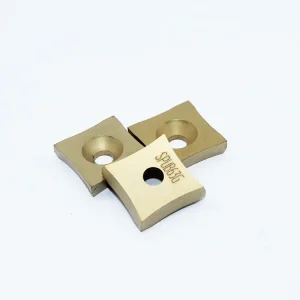
Wholesale Wear resistant SPUB 63G customize imported carbide threading inserts Factory, Factories
Inquire / Specification
China New shape cemented carbide tips for railway track tamping pick center tooth Manufacturers, Factory
Inquire / Specification
Wholesale China best price custom tungsten carbide steel cutters concrete scarifier blade Supplier, Factory
Inquire / Specification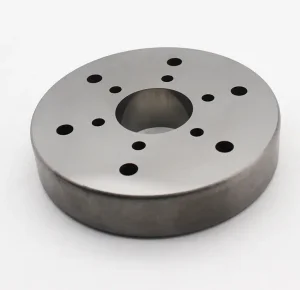
Buy Customized tungsten cemented carbide wear parts for roll crushing Manufacturer, Manufacturers
Inquire / Specification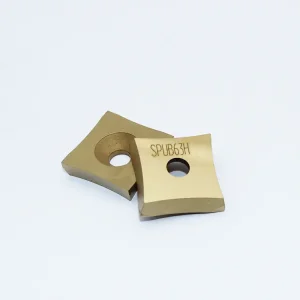
Buy Wholesale SPUB63H square tungsten carbide cemented cutting turning lathe tools Manufacturers, Factories
Inquire / SpecificationThermodynamic Profile & Melting Point Thresholds of Advanced Carbides
Decoupling theoretical refractoriness from operational liquid-phase sintering dynamics in modern industrial components.
Stoichiometric WC (2,870°C)
Pure stoichiometric Tungsten Monocarbide (WC) exhibits one of the highest melting points known to materials science at ~2,870°C (5,198°F). In isolation, it serves as the ultimate refractory grain, providing structural hardness above 2200 HV.
- Crystal Structure: Hexagonal Primitive
- Thermal Expansion: 5.2 × 10⁻⁶ / K
- Thermal Conductivity: 110 W/(m·K)
The Pseudo-Binary Sintering Window
Cemented carbides integrate ductile metallic binders (Cobalt, Nickel, Chromium). During Liquid Phase Sintering (LPS), the eutectic temperature drops to 1,280°C–1,350°C. Controlling liquid-solid mass transfer dictates porosity elimination and boundary integrity.
- Cobalt Eutectic: ~1,320°C (WC-Co)
- Nickel-Cr Eutectic: ~1,280°C - 1,360°C
- Sinter-HIP Overpressure: Up to 100 bar Ar
Eta Phase (η) & Carbon Deficit
Operating near thermal limits risks solid-state phase migration. Carbon deficiency triggers brittle complex carbides (Co₃W₃C or Co₆W₆C), drastically eroding fracture toughness. Precision-atmosphere control prevents decarburization at high service heats.
- Phase Equilibrium: Fixed Carbon Window ±0.05%
- Fracture Impact: Up to 40% reduction if η-phase exists
- Magnetic Saturation Check: 4πσ control standard
Thermal & Mechanical Property Matrix Across Industrial Carbide Formulations
| Composition / Grade | Binder Content (wt%) | Theoretical Melting / Solidus (°C) | Max Continuous Temp (°C) | Hardness (HRA / HV) | Key Engineering Suitability |
|---|---|---|---|---|---|
| Pure Monocarbide (WC) | 0% (Binderless) | 2,870°C | 950°C (Inert atm) | 93.5 HRA / 2400 HV | Optical mold inserts, ultra-abrasive waterjet nozzles |
| Micro-Grain WC-6Co (YG6X) | 6% Co | 1,320°C (Eutectic solidus) | 650°C (Air) | 92.5 HRA / 1750 HV | High-speed semi-finishing of chilled alloy cast irons |
| Standard Medium WC-8Co (YG8) | 8% Co | 1,335°C (Eutectic solidus) | 600°C (Air) | 89.5 HRA / 1500 HV | Rock drill inserts, railway tamping picks, heavy shearing |
| Tough Heavy WC-15Co (YG15) | 15% Co | 1,350°C (Eutectic solidus) | 500°C (Air) | 87.0 HRA / 1250 HV | Cold heading dies, metal stamping punches, high shock tooling |
| Corrosion-Resistant WC-Ni-Cr | 8-10% Ni-Cr | 1,360°C (Eutectic solidus) | 850°C (Corrosive air) | 90.0 HRA / 1550 HV | Downhole MWD/LWD drilling components, hot roll scarfing |
High-Heat Stress Environments in Global Heavy Industry
Where thermal equilibrium, resistance to plastic deformation, and extreme melting point characteristics prevent catastrophic downtime.
North American Steel Mills: Tube & Billet Scarfing
During continuous weld-seam scarfing and billet de-scaling in Ohio and Ontario mills, inserts face red-hot steel strip exceeding 900°C. Cemented carbide grades with sub-micron WC grains maintain hot-hardness, avoiding thermal edge spalling where tool steel instantly softens.
- Core Products: SPUB63, SPUB86, SNMX inserts
- Key Metric: Resistance to thermal-shock cracking
Australian & Chilean Open-Pit Mining
Downhole percussion hammer bits and roll crushing teeth encounter friction-induced localized micro-flash temperatures upwards of 750°C in high-quartz ore grinding. Cobalt migration is curbed by using strictly balanced HIP-processed YG8 to YG11C formulations.
- Core Products: Parabolic & Ballistic Chisel Tips
- Key Metric: High impact combined with micro-abrasion resistance
European High-Precision Automotive Gear Shaving
High-efficiency power-skiving and gear-milling operations across German automotive hubs generate extreme shear-zone thermal spikes. Our custom solid carbide gear hobs resist crater wear and plastic deformation under sustained 600m/min dry machining speeds.
- Core Products: Custom module gear shaper cutters
- Key Metric: Profile retention within DIN Class 4 limits
Transcontinental Railway Ballast Maintenance
Track maintenance units operating tamping machinery subject tine tips to violent cyclical dynamic impacts against granite ballast. The high hot-compressive strength of custom brazed cemented carbide prevents blunt wear and tip detachment.
- Core Products: Railway track tamping pick tips
- Key Metric: Transverse rupture strength (TRS > 2600 MPa)
China Factory Direct: Upstream Integration & Supply Chain Resilience
Why sourcing from the tungsten epicenter of Nanchang, Jiangxi secures procurement predictability, margin advantages, and metallurgical control.
100% Virgin Raw Material Supply
Located in Jiangxi Province—the undisputed world capital of tungsten reserves—our production draws directly from ammonium paratungstate (APT) refineries. We strictly forbid recycled scrap or black powder mixtures, guaranteeing ultra-low trace impurities (Fe, S, P < 50 ppm).
Pressure Sintering (Sinter-HIP) Infrastructure
Every structural blank and profile insert undergoes simultaneous vacuum heating and 100-bar high-pressure Argon isostatic pressing at 1,450°C. This collapses interior micro-voids, increasing density to near 100% theoretical limits (14.8-15.0 g/cm³ for YG6) and doubling wear life.
Integrated CNC In-House Die & Grinding Shop
From precision automated multi-cavity dry pressing to 5-axis Agathon grinding, centerless h6 finishing, and Walter CNC profile centers, we produce custom geometries from CAD prints within 12 working days without third-party reliance.
R&D Technology Roadmap: The Next Era of Refractory Composites
Bridging traditional powder metallurgy with next-generation extreme-heat surface technologies.
Nano-Grain WC Optimization
Transitioning grain size distributions from sub-micron (0.8 µm) to true nano-scale (0.2 µm - 0.4 µm) with VC/Cr₃C₂ grain-growth inhibitors. This elevates hardness beyond 94 HRA without sacrificing boundary toughness at elevated friction heats.
High-Entropy Alloy (HEA) Binders
Replacing traditional mono-cobalt matrices with FeCoNiCrAl multi-component alloys. HEA binders suppress the eutectic liquidus depression, raising continuous operational service temperature thresholds from 650°C to over 900°C in open atmospheric wear.
HiPIMS Multi-Layered Coatings
High-Power Impulse Magnetron Sputtering (HiPIMS) deposition of AlTiN / AlCrN nanostructured lattices. These films provide a chemical oxidation barrier, allowing carbide cutting edges to withstand transient machining shears approaching 1,100°C.
Compliance, Quality Verification & International Trade Assurance
Eliminating supply chain uncertainties for OEM parts procurement across the Americas, Europe, and Asia-Pacific.
Full Metallurgical Traceability
Every dispatch batch is certified with an official 3.1 Material Test Report detailing density, HRA hardness, coercivity (Hc), magnetic saturation (4πσ), and Porosity Ratings adhering to ISO 4505 standards.
ESG & Conflict-Free Material Sourcing
Our raw materials comply strictly with RMAP (Responsible Minerals Assurance Process) guidelines. We verify non-conflict origins of all tungsten, cobalt, and nickel ores, protecting international buyers from reputational and legal vulnerabilities.
Global DDP Delivery & Buffer Warehousing
We provide full Delivered Duty Paid (DDP) logistics handling customs clearance, tariffs, and inland port transits across 20+ countries, supported by custom stockholding agreements for high-volume repeat contracts.
Frequently Asked Questions on Carbide Melting Points & Sourcing
Essential technical clarifications for lead design engineers, metallurgical buyers, and plant managers.
What is the true melting point of carbide vs. cemented tungsten carbide?
Pure tungsten monocarbide (WC) has a melting point of approximately 2,870°C. However, industrial carbide products are "cemented" using metallic binders (usually Cobalt or Nickel). Thus, the effective melting threshold (solidus) of the composite is dictated by the Co-WC pseudo-binary eutectic point, typically occurring between 1,280°C and 1,350°C during liquid-phase sintering.
How does operating temperature affect cemented carbide tool hardness?
At ambient temperatures, WC-Co demonstrates 89-93 HRA. As continuous operating temperatures cross 500°C–600°C, the cobalt binder softens, leading to "hot hardness" degradation. Above 800°C in atmospheric air, severe oxidation of WC occurs (forming volatile WO₃). Using fine-grain structures, higher WC ratios, and PVD/CVD coatings prevents plastic thermal deformation under continuous dynamic loads.
Can you manufacture custom wear parts directly from technical CAD drawings?
Yes. Over 75% of our factory output comprises custom-engineered OEM parts. We accept Step, IGES, DXF, and PDF drawings. Our metallurgical engineers assess draft angles, sintering shrinkage factors (normally 18-22%), and grinding allowances to achieve tight tolerances down to ±0.002 mm (such as h6 cylindrical tolerances).
Why is Sinter-HIP processing vital for high-temperature wear components?
Standard vacuum sintering often leaves residual microscopic pores (A04/B02 class). Under cyclical high-temperature friction, these micro-voids become focal points for crack propagation. Sinter-HIP applies 60 to 100 bar of argon pressure at the liquidus point, forcing the molten binder into all voids, eliminating internal porosity, and radically boosting rupture strength.
Precision Structural & Machining Carbide Components
HIP-sintered blanks, high-precision rods, specialized drawing dies, and precision turning inserts manufactured to exact CAD tolerances.
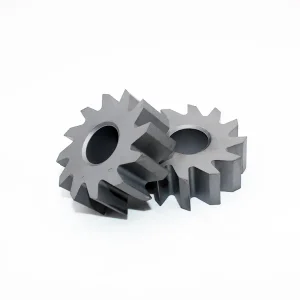
Buy Custom made transmission reverse idle gear starter gear spur gear set Manufacturer, Factory
Inquire / Specification
China OEM Customizable HIP Processed Square Tungsten Carbide Plate, Polished Flat Blank for Industrial Cutting Tools Manufacturer, Factories
Inquire / Specification
China High-quality tungsten carbide rods for precision drilling and milling Manufacturer, Factories
Inquire / Specification
Buy Customized Tungsten Carbide Cold Heading molds/punch dies/wire drawing dies Manufacturers, Suppliers
Inquire / Specification
China Best price YG8 tungsten carbide gripper inserts for chuck jaw Suppliers, Factories
Inquire / Specification
Wholesale SPUB63B wholesale ISO TiN tungsten carbide scarfing insert Supplier, Factory
Inquire / Specification
China Best price CVD coating tungsten carbide non standard carbide jaw insert cnc Manufacturer, Factory
Inquire / Specification