
High-Performance Carbide Welding & Tooling Inserts
Explore our foundational range of sintered tungsten carbide inserts, scarfers, and heavy-duty wear blanks engineered for continuous industrial manufacturing lines.






Macro Dynamics of Carbide Welding Inserts in Modern Manufacturing
A comprehensive review of hardfacing interfaces, thermal coefficient mitigation, and mechanical bonding integrity under high-shear industrial operations.
Thermal Expansion Mismatch Control
Cemented tungsten carbide features a coefficient of thermal expansion (CTE) of 4.5–6.0 × 10⁻⁶/K, roughly half that of carbon and alloy tool steels (11.5–12.5 × 10⁻⁶/K). High-reliability welding and brazing inserts require specialized sandwich-braze interlayer alloys (e.g., Cu-Ag-Cu foil) or customized cobalt/nickel-binder grading to suppress residual thermal tensile stress during cooling cycles, preventing premature micro-fracturing along the metallurgical boundary.
Global Shift to Sinter-HIP Consolidation
The global hardmetal landscape has pivoted entirely away from conventional hydrogen atmospheric sintering toward Overpressure Sinter-HIP technology (100 bar argon gas atmosphere at 1,420–1,460°C). Sinter-HIP processing eliminates internal sub-surface microporosities down to ISO 4505 Class A02/B00 ratings, yielding exceptional transverse rupture strength (TRS exceeding 2,800 MPa) vital for heavy-load brazed tips, scarfing cutters, and tamping tines.
Nano-Crystalline Chemical Vapor Deposition
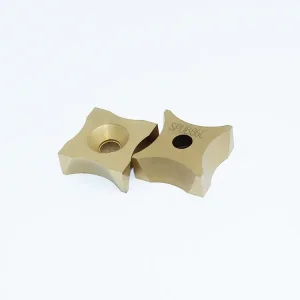
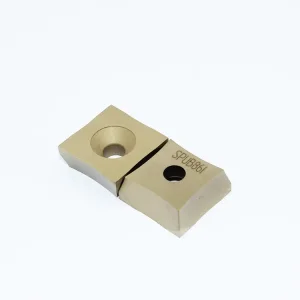
Modern tube scarfing inserts (e.g., SPUB, SNMX, and SDUW series) utilize thick multi-layer CVD coatings (Ti(C,N) + α-Al2O3 + TiN) up to 12–18 μm. This nanostructured thermal barrier enables continuous flash weld removal at temperatures exceeding 900°C on high-strength API 5L steel lines without catastrophic chemical dissolution, edge softening, or mechanical adhesive notch failure.
Engineering Grade Formulations for Weld-On & Brazed Applications
Review mechanical properties, binder volume distributions, and metallographic thresholds across our primary sintered carbide formulations.
| Alloy Classification | Cobalt / Binder (wt%) | Grain Size (μm) | Hardness (HRA) | Density (g/cm³) | Transverse Rupture (TRS MPa) | Primary Industrial Use-Case |
|---|---|---|---|---|---|---|
| ZF-P20 / YG6X | 6.0% Co | 0.8 – 1.2 (Fine) | 91.5 – 92.5 | 14.90 – 15.05 | 2,200 – 2,400 | Precision lathe brazed tips, finishing chilled cast iron, non-ferrous turning. |
| ZF-P40 / YW2 | 8.5% (Co+TaC/TiC) | 1.2 – 1.8 (Medium) | 89.5 – 90.8 | 12.80 – 13.10 | 2,600 – 2,850 | Heavy-duty tube scarfing (SPUB/SNMX), interrupted structural weld bead scraping. |
| ZF-K30 / YG8C | 8.0% Co | 2.2 – 3.0 (Coarse) | 88.0 – 89.2 | 14.70 – 14.85 | 2,700 – 2,900 | Percussive mining picks, foundation drilling weld-on lugs, water well bits. |
| ZF-M30 / Surgical | 6.0 – 9.0% Co/Ni | 1.0 – 1.5 (Uniform) | 89.0 – 91.0 | 14.65 – 14.95 | 2,500 – 2,750 | Precision needle holder jaw pyramids, medical forceps brazed plates. |
| ZF-G40 / YG15 | 15.0% Co | 1.8 – 2.5 (Medium) | 86.5 – 87.8 | 13.90 – 14.15 | 3,100 – 3,300 | Heavy impact stamping dies, blanking punches, railway tamping tine base joints. |
| ZF-NM10 / Non-Mag | 10.0% Ni-Cr-Mo | 1.4 – 2.0 (Corrosion) | 88.5 – 90.0 | 14.45 – 14.65 | 2,400 – 2,650 | MWD/LWD oilfield logging tools, non-magnetic valve trim, chemical wear tiles. |
Strict Porosity Elimination
Every structural carbide blank undergoes continuous pressure sintering where internal voids are collapsed under 10 MPa of hot isostatic argon pressure. Microstructural verification guarantees strict adherence to ASTM B276 standards.
Substrate Pre-Treatment for Brazing
To eliminate surface oxides and promote uniform capillary wetting of Ag-Cu-Zn and pure copper brazing fillers, all weld inserts receive precision chemical de-oxidation or micro-grit blasting along the bonding seat interface.
Zero-Recycled Virgin Tungsten
We formulate carbide powders exclusively from 99.95% pure virgin ammonium paratungstate (APT). This eliminates traces of harmful tramp elements (Fe, Ca, S) that cause thermal cracking during high-temperature oxy-acetylene or induction welding.
Integrated Manufacturing Ecosystem: Jiangxi Raw Material to Precision Tool
Leveraging deep territorial reserves, vertical powder metallurgy integration, and rapid automated pressing to lower total acquisition costs for global enterprise buyers.
Mine-to-Blank Integration
Located directly within Jiangxi Province—the world's most concentrated tungsten refining corridor—our factory guarantees continuous upstream raw material security, insulating enterprise supply agreements from global spot-market volatility.
DORST CNC Powder Pressing
Utilizing multi-axis multi-level automatic CNC powder compacting presses enables near-net-shape tolerances (±0.05 mm) on intricate scarfing chip-breakers and serrated needle holder grips, minimizing post-sinter diamond grinding costs.
8-Hour Technical Iteration
Our in-house powder metallurgy and tooling engineering team evaluates customer CAD models, working loads, and abrasive mediums within 8 hours, delivering optimized cobalt binder recommendations and customized mold tooling setups.
Agile Batch Scalability
Whether producing standardized SPUB scarfing runs of 100,000 units or custom-dimensioned heavy wear plates in pilot runs of 50 pieces, our cellular Sinter-HIP lines provide agile lead times without compromising metallographic purity.
Mission-Critical Operating Scenarios for Brazed & Welded Carbide
Real-world engineering environments demanding the highest levels of shear strength, high-temperature thermal barrier protection, and abrasive erosion mitigation.
ERW Steel Pipe Scarfing (ID/OD Beads)
Continuous Electric Resistance Welded (ERW) line pipe production generates red-hot, hardened weld flash along inner and outer pipe seams. Precision carbide scarfing rings and inserts (SPUB63, SNMX19, SQ86) operate at 800–1000°C under high mechanical vibrations. Multi-layered Al2O3 CVD coatings resist continuous crater wear and crater washout, ensuring clean flush seam profiles without seizing.
Railway Ballast Tamping Tines
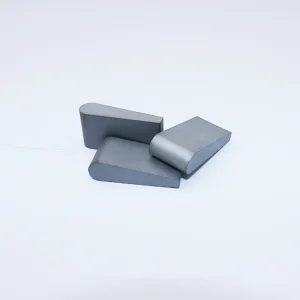
Tamping equipment subjects tine tips to violent cyclical percussive impacts and severe crushed granite stone abrasion. Our braze-on tungsten carbide tamping tine inserts utilize engineered coarse-grained YG11C/YG15 substrates. High fracture toughness absorbs multiple dynamic shock loads per minute, preventing catastrophic fracture and extending rail maintenance intervals 4× over hardened steel forgings.
Medical Surgical Needle Holders
Micro-fine precision carbide gripping jaw inserts (SPUB63M30 series) are vacuum silver-brazed onto stainless steel surgical forceps. Precision pyramid teeth (0.2 mm to 0.5 mm pitch) formed via precision EDM or micro-compaction demand complete absence of free carbon or eta-phase sub-carbides, providing tactile needle retention and total corrosion resistance under high-temperature autoclave sterilization cycles.
Enterprise Procurement Criteria: Total Cost of Ownership (TCO)
Evaluating vendor capability beyond piece-price: metallographic phase stability, capillary brazing wettability, and lifecycle wear longevity.
Eta-Phase (η) Elimination
Carbon deficiency in the WC-Co binary system creates brittle ternary carbides (Co3W3C or Co6W6C), known as η-phase. These brittle micro-constituents cause premature cleavage fractures under moderate mechanical impact. Zhongfu maintains automated stoichiometric carbon control within a narrow ±0.05% carbon window during raw ball-milling to ensure optimum toughness.
Brazing Shear Resistance Verification
Weld inserts only deliver performance if the brazed metallurgical joint holds. Our quality inspection protocol conducts standardized push-off shear testing. Joints brazed with our specialized surface pre-treatments consistently exceed 200 MPa shear resistance, ensuring zero risk of insert detachment under heavy cyclic rock drilling or scarifying loads.
Microstructural Uniformity
Using digital field emission scanning electron microscopy (FE-SEM) and magnetic saturation (Cobalt-magnetic balance) checks, our metallurgy department ensures uniform distribution of grain-growth inhibitors (VC, Cr3C2), eliminating localized coarse-grain pooling that acts as an initiation locus for catastrophic fatigue failure.
Frequently Asked Questions: Carbide Welding Inserts & Sourcing
Detailed technical responses addressing joint design, brazing metallurgy, substrate selection, and international procurement workflows.
What is the recommended brazing alloy and joint clearance for carbide welding inserts?
For high-stress steel cutting tools and wear components, a silver-based brazing filler alloy conforming to AWS BAg-22 (49% Ag, Cu, Zn, Ni, Mn) or BAg-24 is recommended, paired with active fluoride fluxes. The optimal joint clearance at brazing temperature (680–760°C) is 0.05 mm to 0.12 mm. This ensures optimum capillary flow and full wet-out without creating excessive filler thickness, which lowers shear resistance.
How does Zhongfu Carbide manage thermal crack mitigation during high-heat welding?
We supply inserts with optimized grain growth inhibitors and tailored cobalt content (e.g., YG8 to YG11C). The higher thermal conductivity of coarser-grained WC grades (up to 100 W/m·K) accelerates heat dissipation away from the localized brazing puddle. Additionally, we provide tripartite "sandwich" shim foils (Cu-Ag-Cu) for large weld-on inserts to absorb the differential shrinkage stresses between carbide and steel substrates.
When should buyers choose CVD coating over PVD coating for tube scarfing inserts?
Chemical Vapor Deposition (CVD) is selected for severe continuous tube scarfing applications (SPUB86, SDUW) where cutting temperatures routinely surpass 850°C. CVD coatings allow thicker deposition (12–20 μm) of protective α-Al2O3 ceramic layers that resist high-temperature oxidation and diffusion wear. PVD coatings (3–5 μm TiAlN) are reserved for interrupted cutting or thin-wall ERW tubes where razor-sharp cutting edges and high compressive residual stresses are vital.
Can you manufacture non-magnetic carbide welding inserts for MWD/LWD drilling components?
Yes. By replacing standard ferromagnetic cobalt binders with specialized austenitic nickel-chromium-molybdenum formulations, we produce non-magnetic cemented carbide parts possessing a magnetic permeability (μ) of less than 1.005. These are brazed or welded onto directional drilling collars, downhole measurement tools, and precision electronic manufacturing fixtures without inducing electromagnetic interference.
What documentation and inspection certificates accompany export shipments?
Every industrial consignment is accompanied by a comprehensive EN 10204 Type 3.1 Mill Test Certificate detailing chemical composition (WC, Co, TaC, TiC), physical properties (specific gravity/density, Rockwell HRA hardness, coercivity, magnetic saturation), and microstructural porosity ratings according to ISO 4505 standards, accompanied by dimensional CMM inspection reports.
What is the typical production lead time for customized carbide tooling blanks?
Standard catalog blanks and scarfing inserts are maintained in safety inventory for immediate export dispatch within 48 to 72 hours. For customized CAD drawings requiring new powder compaction tooling or EDM profile forming, mold fabrication and pilot sample sintering are completed in 10 to 14 days, with full production batch delivery scaling within 3 to 4 weeks.
Engineered Tungsten Carbide Turning, Peeling & Tamping Solutions
Complete your tooling supply chain with our precision ground turning inserts, railway ballast tamping blanks, and heavy-duty rotary cutters.






Request Grade Formulations & Custom Drawing Analysis
Send your CAD drawings, dimensional specifications, or target operational parameters. Our metallurgical engineering team provides comprehensive manufacturability feedback, powder grade matching, and factory-direct volume pricing within 8 hours.