
Primary Sintered Non-Magnetic Carbide Assemblies
Engineered for Scandinavian clean-tech environments requiring complete magnetic neutrality and micron-grade geometric fidelity.

Non-Magnetic Carbide Scarifier Cutter & Through-Hole Wear Parts (Denmark Spec)
Formulated with specialized non-ferromagnetic binder matrix to eliminate magnetic flux distortion in offshore concrete renovation and pipeline scarifying.
Explore Product Details →
High-Precision Hard Alloy Tungsten Carbide Wear Parts for Danish CNC Machining
Sub-micron grain WC tailored for extreme abrasive conditions without magnetic interference in precision robotics and automation cells.
Explore Product Details →
Custom Non-Magnetic Cemented Carbide Bushings & Sliding Wear Sleeves
100% austenitic binder composition offering near-zero eddy current resistance, ideal for precision acoustic transducers and flow meters.
Explore Product Details →
Ultra-Fine Non-Magnetic Carbide Locating Pins & Micro Plungers
Designed for medical diagnostic equipment, watchmaking, and high-frequency sensor tooling where stray magnetic fields are prohibited.
Explore Product Details →Denmark's High-Tech Industrial Landscape & Non-Magnetic Carbide Demands
A rigorous metallurgical overview of how non-magnetic hard metals empower Danish innovation across maritime wind, acoustics, and life science sectors.
The industrial architecture of Denmark is globally recognized for high-complexity, precision-driven manufacturing. From the wind turbine nacelles developed off the Jutland peninsula to the biotech research corridor of Medicon Valley spanning Greater Copenhagen, Danish equipment manufacturers demand components that survive severe friction, chemical corrosion, and intense electromagnetic fields without signal corruption.
Electro-Acoustic Instrumentation
Denmark's legacy in acoustic measurement (e.g., Brüel & Kjær) and hearing aid technologies requires micro-tooling, calibration pins, and wear guides that demonstrate absolute zero stray magnetic interference to safeguard miniature balance armatures.
Offshore Wind & Subsea Systems
Operating in the North Sea and Baltic waters presents dual stressors: marine chloride corrosion and severe abrasive wear. Non-magnetic carbide shafts, seal faces, and ROV wear shoes prevent electrolytic galvanic pitting while remaining invisible to subsea magnetic compasses.
Intelligent Metering & Fluid Handling
Pioneering Danish smart energy meter manufacturers (such as Kamstrup and Danfoss ecosystems) utilize ultra-hard, non-magnetic carbide shafts for ultrasonic and electromagnetic induction flow sensors to eliminate rotational drag and sensor distortion.
Metallurgical Roadmap: Engineering Non-Ferromagnetic Hardmetal
Achieving relative magnetic permeability μr < 1.005 while maintaining Vickers hardness over HV 1550.
Standard cemented carbide exhibits strong ferromagnetism because cobalt transforms into a close-packed hexagonal (ε-Co) or face-centered cubic (α-Co) crystal structure during cooling, both of which align spontaneously with external magnetic fields. To suppress magnetic susceptibility completely, our metallurgical research team implements three fundamental process innovations:
1. Solid-Solution Austenitic Binder Alloying
We replace the pure cobalt phase with an engineered nickel-chromium-molybdenum (Ni-Cr-Mo) solid solution binder. By doping high-purity nickel with precisely calculated concentrations of chromium (Cr3C2) and molybdenum (Mo), the Curie point of the binder phase is depressed far below -50°C. This guarantees that the binder remains 100% austenitic (non-magnetic) even under deep subsea cryo-temperatures or cryogenic liquid processing.
2. Hot Isostatic Pressing (Sinter-HIP) at 10 MPa
Non-magnetic nickel binders typically exhibit lower wettability on tungsten carbide grains than cobalt. To counteract this, all parts are processed in advanced vacuum Sinter-HIP furnaces at 1420°C under 100 bar (10 MPa) of ultra-high-purity argon gas. This pressure collapse mechanism eliminates all internal micro-pores (achieving porosity standard A00, B00, C00 according to ISO 4505) and increases transverse rupture strength (TRS) to >2600 MPa.
3. Micro-Phase Grain Boundary Engineering
Free carbon (graphite precipitation) and eta-phase (η carbides such as Co3W3C or Ni2W4C) can cause localized magnetic anomalies. Our digitally controlled carbon-potential balance in the reduction and carburization stage maintains an exceptionally narrow two-phase WC + γ field, ensuring zero parasitic magnetic nucleation sites.
| Physical Property | Standard Cobalt Grade (YG8) | Zhongfu Non-Magnetic Grade (ZF-NM10) | Danish Marine/Med Spec Requirement |
|---|---|---|---|
| Relative Permeability (μr) | > 100.0 (Strongly Magnetic) | ≤ 1.002 ± 0.001 | < 1.005 (Zero Magnetic Leakage) |
| Hardness (HRA / HV30) | 89.5 HRA / 1450 HV | 90.5–91.5 HRA / 1580 HV | > 89.0 HRA (Wear Resistance) |
| Density (g/cm³) | 14.70 | 14.50 ± 0.10 | Near-theoretical density (>99.9%) |
| Transverse Rupture Strength | 2800 MPa | 2500–2700 MPa | > 2200 MPa (Shock Resistance) |
| Corrosion Rate in 10% H2SO4 | High (Co leaches rapidly) | Extremely Low (<0.05 g/m²·h) | Resistant to Salt Spray & Cleaners |
China Industry 4.0: Resilient, High-Volume Metallurgy for Denmark
Bridging Chinese mineral abundance and German-grade CNC finishing to deliver uninterrupted supply chains directly to Scandinavian ports.
Global procurement heads face a persistent dilemma: European local tool shops frequently quote extended lead times of 14–22 weeks for non-standard non-magnetic sintered parts, exacerbated by high energy surcharges. Jiangxi Zhongfu Cemented Carbide Co., Ltd. resolves this bottlenecks by anchoring operations in Nanchang, Jiangxi—the epicenter of global tungsten reserves—operating under ISO 9001 and ISO 14001 digital factory protocols.
Integrated Quality Assurance: From Powder Chemistry to Air Freight
Every non-magnetic carbide batch destined for Denmark undergoes 5 tiers of non-destructive and analytical verification: 1) Fluxgate Magnetometer Testing ensures zero residual magnetic dipole signature; 2) Zeiss Metallographic Microscopy verifies complete dissolution of nickel binders without localized clusters; 3) Ultrasonic Flaw Detection checks for internal density variations; 4) Mitutoyo CMM Optical Profilometry certifies sub-micron geometric tolerances; 5) RoHS & REACH Compliance Auditing confirms freedom from restricted hazardous materials.
Localized Support, CBAM Readiness & European Compliance
Ensuring complete peace of mind for Danish corporate supply chains under evolving EU environmental mandates.
Danish enterprises operate under some of the most progressive ESG (Environmental, Social, and Governance) and carbon accountability systems globally. Procurement departments cannot risk non-compliant supply chains. Our factory implements stringent compliance protocols tailored to Denmark’s legal frameworks:
EU CBAM & Carbon Footprint
Full support for the EU Carbon Border Adjustment Mechanism (CBAM). We provide verified embedded emissions data and energy sourcing documentation for smooth import declarations via Danish customs (Toldstyrelsen).
REACH & RoHS Validation
Our nickel-binder non-magnetic components are 100% compliant with EU REACH SVHC regulations and RoHS directives, certified by third-party SGS testing to protect food-grade and medical equipment makers.
Door-to-Door Nordic Logistics
Direct DDP air and sea shipping solutions to Copenhagen, Aarhus, Odense, and Aalborg. Express prototype shipments delivered to your toolroom within 5 to 7 business days.
Precision Non-Magnetic & Tooling Carbide Solutions
Explore our complete manufacturing line-up engineered for Scandinavian OEM integration and wear component upgrades.

Non-Magnetic Carbide Rods for Water Meter Shafts (Denmark Standard)
Ground to h6 tolerance, eliminating magnetic braking effects in high-accuracy flow calculation chambers.
View Specifications →
Nickel-Based Tungsten Carbide Rods for Danish Chemical Machinery
Exceptional resistance against nitric, sulfuric, and organic acid environments with zero magnetic retention.
View Specifications →
Sinter-HIP Nickel Non-Magnetic Carbide Precision Ground Mandrels
Engineered for high-speed balancing mandrels and non-inductive electric motor testing spindles.
View Specifications →
Solid Non-Magnetic Carbide Pin Plug Gauges & Inspection Rods
Zero magnetic attraction prevents debris adhesion and electrostatic dust collection during calibration.
View Specifications →
Heavy-Duty SPUB63B Lathe Round Tungsten Carbide Turning Inserts
Engineered for extreme chip removal in Danish steel mills, offshore piling, and heavy shaft roughing.
View Specifications →
Custom Tungsten Carbide Steel Cutters & Concrete Scarifier Blades
Impact-resistant YG15/YG20 tips brazed to heat-treated alloy discs for North Sea asphalt and bridge maintenance.
View Specifications →
CVD-Coated Non-Standard Tungsten Carbide CNC Clamping Jaw Inserts
Diamond-hard surface micro-profiles for automated robotic workholding chucks in Danish automotive lines.
View Specifications →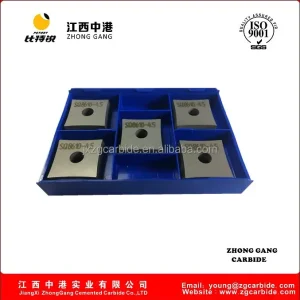
Precision SDUW Carbide OD Tube Scarfing Inserts for Welded Steel Pipes
Radius-profiled wear edges for continuous scarfing of high-frequency welded tubing in wind turbine towers.
View Specifications →Engineering Questions on Non-Magnetic Carbide
Direct answers for Danish design engineers and global procurement managers.
What is the absolute magnetic permeability (μr) of your non-magnetic grades?
Our standard non-magnetic grades (e.g., ZF-NM10 and ZF-NM15) maintain a relative magnetic permeability (μr) between 1.001 and 1.005. Under standard magnetic testing fields (such as a 100 Oe or 0.1 Tesla test coil), the material exhibits negligible magnetic dipoles, completely preventing eddy current heating and sensor perturbation in high-precision Danish instruments.
How does nickel-bonded non-magnetic carbide compare in wear life to cobalt grades?
Historically, early nickel binders yielded lower hardness than cobalt. However, through our nano-grain WC doping and 100-bar Sinter-HIP pressure densification, our non-magnetic alloys achieve hardness levels of 90.5–92.0 HRA (comparable to fine-grain YG6/YG8). In acidic, wet, or marine chloride environments common in Denmark, our non-magnetic nickel-based carbide actually outlasts standard cobalt carbide by 300% to 500% because cobalt binders leach rapidly in corrosive media.
Can you provide custom EDM and CNC ground shapes based on Danish STEP/DWG files?
Yes. Custom fabrication accounts for over 85% of our export volume. You can submit CAD files (.step, .dwg, .dxf) directly. Our in-house machining center utilizes slow-feeding wire EDM, profile grinders, and high-precision centerless grinders to achieve inner/outer diameter tolerances down to ±0.002 mm and surface finishes down to Ra 0.05 μm.
What is the typical shipping timeline from your Jiangxi factory to Denmark?
Standard prototype tooling takes 10 to 14 working days from drawing sign-off. Finished parts are dispatched via express air courier (DHL/FedEx/UPS) arriving in Copenhagen or Billund airport within 4 to 6 business days. For high-volume production orders (1,000+ kg), containerized sea shipments reach the Port of Aarhus within 28–32 days under full DDP / DAP shipping terms.
Ready to Elevate Your Danish Tooling Performance?
Send us your 2D drawings or 3D CAD files today. Our chief metallurgical engineers will deliver an optimized grade recommendation, magnetic flux verification protocol, and competitive factory-direct quote within 8 business hours.