High-Performance Indexable Inserts & Sintered Carbide Components
Precision-engineered sintered grades, standard ISO turning blanks, non-magnetic submicron rods, and tube scarfing inserts designed for high-stress cyclic loading and extended tooling longevity.






The Commercial Landscape of Global Tungsten Carbide Tooling
Cemented tungsten carbide (WC-Co, WC-Ni) remains the bedrock of modern manufacturing, driving productivity across machining centers, energy extraction, and chip fabrication worldwide.
Strategic Supply Dynamics
Tungsten carbide represents an indispensable strategic asset. Global demand is propelled by expanding aerospace structures, EV battery casing dies, high-silicon aluminum turning, and directional drilling assemblies. Sourcing strategies among Fortune 500 procurement leaders have evolved from short-term spot purchasing to integrated vendor partnerships that guarantee chemical purity and trace raw material origins.
Submicron Structural Evolution
The tooling market has largely shifted away from conventional coarse grades toward ultrafine (0.5–0.8 µm) and nano-crystalline (<0.2 µm) grain distributions. These microstructures enable higher transverse rupture strength (TRS > 4200 MPa) and superior edge retention under extreme thermal stress, preventing thermal micro-cracking during interrupted cutting conditions.
Geopolitical Supply Security
With over 80% of upstream ammonium paratungstate (APT) resources centralized in China, Tier-1 industrial buyers mitigate supply-chain disruptions by partnering directly with integrated Chinese smelters and sintering facilities. This vertical consolidation eliminates intermediate markups while ensuring direct control over batch lot chemistry and grain boundary stability.
Why Chinese Tungsten Carbide Factories Lead Global Supply Chains
China’s dominance in tungsten carbide production transcends raw material reserves. It is sustained by massive capital reinvestment into continuous automated processing, HIP overpressure metallurgy, and full vertical integration.
Mine-to-Spindle Integration
Chinese integrated facilities manage the entire production chain: APT refinement, ball milling, spray drying, automated CNC pressing, and Hot Isostatic Pressing (HIP) under one roof. This minimizes oxidation exposure and delivers total traceability for ASTM B276 microstructure qualification.
Advanced Sinter-HIP Furnaces
Modern Chinese manufacturers use computer-controlled 10 MPa overpressure Sinter-HIP furnaces. By applying combined vacuum dewaxing, high-temperature sintering, and isostatic argon gas pressurization, internal porosity is suppressed to A00-B00-C00 levels, eliminating catastrophic shear failure.
Sub-Micron CNC Finishing
Utilizing multi-axis precision grinding centers (Agathon, Wendt, Rollomatic) and diamond-wheel EDM wire cutting, Chinese OEM facilities deliver ground carbide rods with h6 diametrical runout tolerances (≤ 0.002 mm) and Ra ≤ 0.05 µm mirror polish finishes for medical and aerospace punch tooling.
Rapid Tooling Prototyping
Custom engineered shapes—including specialized tube scarfing rings, complex chuck gripper teeth, and stepped gun-drill inserts—progress from CAD model approval to sintered pilot run within 7 to 10 days, supported by domestic precision graphite EDM tooling infrastructure.
Key Technical Advantage: Cobalt Leaching & Gradient Surface Control
State-of-the-art Chinese sintering plants apply precise nitrogen partial-pressure adjustments during thermal cycles. This creates cobalt-enriched surface zones (≈ 15–25 µm thick) that increase fracture toughness at the cutting edge while preserving high core hardness, providing impact resistance without sacrificing crater wear resistance.
Specialized Industrial Use Cases for Tungsten Carbide Tools
From heavy continuous-casting steel mills to micro-electronics manufacturing, cemented carbide tooling provides the structural integrity required to operate under high temperatures and severe abrasion.
Heavy Steel Mill Tube Scarfing
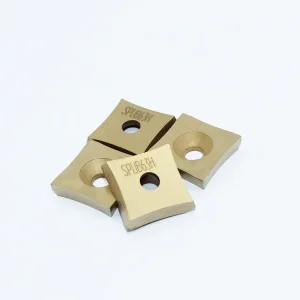
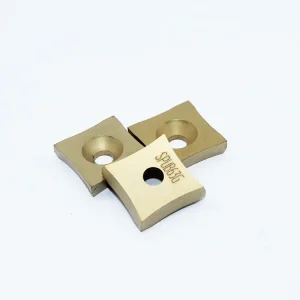
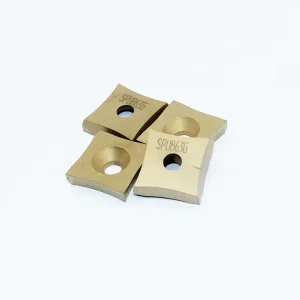
Welded tube mills require specialized scarfing inserts (e.g., SPUB63, SPUB86, SNMX series) to strip weld beads from internal and external diameters at temperatures exceeding 850°C. These applications rely on coarse-grain WC-Co grades with thick TiAlN/AlCrN multi-layer PVD coatings to resist thermal fatigue and thermal shock spalling.
Non-Magnetic Downhole Instrumentation
In directional oil and gas drilling (MWD/LWD tooling) and precision electromagnetic measurement systems, standard cobalt binders create magnetic interference. We manufacture nickel-bonded (WC-Ni) non-magnetic cemented carbide rods and wear sleeves that offer magnetic permeability μ ≤ 1.005 while maintaining strong corrosion resistance in sour gas (H2S) environments.
Precision Chuck Jaws & Gripper Inserts
Workholding devices in high-speed CNC turning require gripper inserts that hold workpieces securely without fracturing under sudden torque spikes. YG8-grade carbide gripper buttons feature pyramidal diamond serrations that penetrate outer scale on forged components while resisting edge chipping.
Industrial Tungsten Carbide Grade Selection Matrix
Matching binder content, WC grain size, and mechanical metrics to application-specific tribological and kinetic wear conditions.
| Carbide Grade | Binder Ratio (%) | Grain Size (µm) | Density (g/cm³) | Hardness (HRA) | TRS (MPa) | Recommended Industrial Applications |
|---|---|---|---|---|---|---|
| YG6X | 6.0% Cobalt | 0.8 – 1.0 (Submicron) | 14.95 | 92.5 – 93.0 | ≥ 2800 | Chilled cast iron finishing, non-ferrous turning, precision stamping dies |
| YG8 | 8.0% Cobalt | 1.4 – 2.0 (Medium) | 14.70 | 89.5 – 90.5 | ≥ 3200 | Chuck gripper inserts, heavy turning tools, woodworking blades, core drill tips |
| YG15 | 15.0% Cobalt | 1.8 – 2.4 (Medium-Coarse) | 14.05 | 86.5 – 87.5 | ≥ 3800 | Cold heading punches, blanking dies, high-impact forming, wear plates |
| YG20 | 20.0% Cobalt | 2.2 – 3.0 (Coarse) | 13.55 | 84.5 – 85.5 | ≥ 4200 | Fastener stamping tools, heavy stamping punches, high shock extrusion dies |
| WN8 (Ni) | 8.0% Nickel | 1.0 – 1.6 (Fine-Medium) | 14.80 | 89.0 – 90.0 | ≥ 2900 | Non-magnetic flowmeter shafts, MWD sensor housings, chemical pump seals |
| Ultra-Nano | 10.0% Co + Cr/V Inh. | 0.2 – 0.4 (Nano) | 14.40 | 93.5 – 94.2 | ≥ 4500 | Micro-drills for 5G PCBs, titanium alloy end mills, dental burs, graphite tooling |
Technological Trajectories in Cemented Carbide Engineering
Recent advances in powder processing, nanostructured grain inhibitors, and cathodic arc PVD coatings continue to expand the operational limits of carbide tooling.
Grain Growth Inhibitor Chemistry
Controlling grain boundaries during 1450°C liquid-phase sintering is essential for high-performance submicron grades. Doping with vanadium carbide (VC), chromium carbide (Cr3C2), and tantalum carbide (TaC) suppresses Ostwald ripening, preserving uniform sub-0.5 µm microstructures that prevent catastrophic micro-chipping during high-feed milling.
Circular Economy & Zinc Recycling
Modern factories are integrating zero-waste initiatives using thermo-chemical zinc recovery processes. By selectively dissolving cobalt binders from post-consumer carbide scrap, virgin-equivalent WC powder is reclaimed with minimal carbon footprint, yielding secondary tool blanks that match virgin powder in purity and density.
High-Entropy Binder Systems
To satisfy automotive requirements for machining nickel superalloys and compacted graphite iron (CGI), manufacturers are replacing standard cobalt binders with Co-Ni-Fe-Cr multi-component high-entropy matrices. These novel formulations boost hot hardness at 900°C by 40% while preventing binder phase migration during dry machining.
OEM Procurement Framework for Tungsten Carbide Tooling
A rigorous qualification methodology for overseas procurement heads, tooling engineers, and manufacturing supply-chain professionals.
Porosity Verification
Require certified ASTM B276 metallographic reports. High-reliability suppliers guarantee pore sizes smaller than 10 µm (A02 or better). Porosity levels above A04 cause premature structural fractures under cyclic mechanical shock.
Free Carbon & Eta Phase
Inspect magnetic saturation (4πσ) and coercive force (Hc). An imbalance in the carbon-to-tungsten ratio produces brittle eta-phase (Co3W3C) or graphite flake precipitation, reducing transverse rupture strength by up to 50%.
Coating Adhesion Testing
Verify coating adhesion ratings on PVD/CVD inserts via Rockwell HF1 indent testing (VDI 3198 standard). Qualified tooling blanks feature zero interfacial delamination around the impression perimeter, ensuring dependable performance at extreme chip loads.
Dimensional Runout Metrology
Validate that precision solid carbide round rods satisfy ISO h6 tolerances using non-contact dual-axis laser micrometers. Ensuring straightness within 0.005 mm per 300 mm length prevents dynamic tool chatter in high-speed shrink-fit chuck assemblies.
Frequently Asked Questions on Wholesale Carbide Tooling
Direct metallurgical and commercial insights addressing key engineering parameters, shipping standards, and custom OEM manufacturing workflows.
What is the standard lead time for custom sintered carbide dies and inserts?
Standard blank tooling geometries ship within 5 to 7 business days from our inventory. Custom-engineered designs requiring new powder compaction tooling, CNC pre-sinter machining, and final Sinter-HIP cycles typically deliver in 12 to 18 calendar days. Expedited air-freight sampling routes are available for priority qualification testing.
How does binder composition affect corrosion and magnetic properties?
Standard cobalt binders are ferromagnetic and vulnerable to acid attacks. For marine components, electromagnetic flowmeters, and oilfield downhole assemblies, we replace cobalt with a 6–10% nickel (Ni) or nickel-chromium (Ni-Cr) binder. This achieves magnetic permeability values under 1.005 while dramatically increasing pitting resistance in sour petrochemical environments.
Can you provide custom edge preps (honing, chamfering) on cutting inserts?
Yes. Edge preparation is critical for preventing early fracture on indexable inserts. We provide robotic nylon brush and abrasive slurry micro-honing, delivering controlled radii from 10 µm to 50 µm with tolerances within ±3 µm. We also offer precision T-land chamfers tailored for interrupted turning in hardened steels.
What quality documentation accompanies international batch shipments?
Every production run includes an EN 10204 Type 3.1 inspection certificate. This document details verified density, Rockwell HRA/HV30 hardness, coercive force (Hc), magnetic saturation (4πσ), transverse rupture strength (TRS), ASTM B276 porosity class ratings, and dimensional CMM scan reports.
Specialized Tooling, Billets, Blanks & Tube Scarfing Cutters
Precision-ground billets, tube scarfing inserts, chuck jaws, and indexable grooving inserts engineered for reliable tool life across automated manufacturing operations.