Featured Cemented Carbide Components & Semi-Finished Blanks
Sub-micron virgin powder formulations, pressure-assisted hot isostatic pressing (Sinter-HIP), and micro-grain mechanical tooling engineered for continuous industrial manufacturing.





Microstructural Engineering & Cemented Carbide Grade Classification
A comprehensive technical reference examining the correlation between WC grain boundary physics, metallic binder phase volume fractions, and industrial performance limits.
In modern industrial manufacturing, cemented tungsten carbide (WC-Co/Ni composite) functions as the backbone of high-stress material processing. Formulated through powder metallurgical consolidation, tungsten carbide combines the extreme intrinsic hardness and elastic modulus of ceramic tungsten mono-carbide (WC) grains with the ductility and fracture toughness imparted by a ferromagnetic cobalt (Co) or non-magnetic nickel (Ni) metallic matrix. As an established direct factory and manufacturing partner with over 24 years of continuous metallurgical refining in Jiangxi, China, our production lines bridge the fundamental materials science of Sinter-HIP processing with strict OEM commercial tolerances.
Understanding the operational behavior of industrial tungsten carbide grades requires assessing the mechanical tradeoff between abrasive wear resistance and mechanical shock fracture toughness. This balance is dictated by two foundational metallurgical variables: mean WC grain size (spanning ultra-fine 0.2–0.5 µm up to coarse 3.0–8.0 µm) and binder mass percentage (typically ranging between 3 wt% and 25 wt%). When binder content is restricted to 3–6%, the tungsten carbide skeleton exhibits near-continuous contact, driving Rockwell A hardness (HRA) to peaks of 91.5–93.5, which is essential for precision EDM plates, wire drawing dies, and ceramic slicing blades. Conversely, elevating cobalt volume to 12–20 wt% widens mean binder free path spacing, dramatically arresting microcrack propagation under severe mechanical impact and thermal fatigue—the prime requirement for cold heading dies, rotary rock drilling buttons, and railway track maintenance tamping tines.
Sub-Micron & Nano-Grain WC
Mean grain distribution below 0.6 µm with balanced vanadium/chromium grain growth inhibitors (VC/Cr3C2). Yields high-edge stability, mirror finishes on ground rods (h6 tolerance), and minimal micro-chipping during high-speed CNC finish milling.
Non-Magnetic Nickel Formulations
Formulated with high-purity austenitic nickel solid solution binders instead of cobalt. Yields relative magnetic permeability below 1.005 µr, high chemical resistance against galvanic corrosion, and stability in subsea oil & gas sensor pins.
Overpressure Sinter-HIP Furnace
Integrated 100-bar argon atmosphere consolidation at 1450°C. Sinter-HIP drives residual microporosity down to ISO A02-B00 standards, ensuring structural density across thick EDM tooling plates and heavy blank profiles.
Engineering Metallurgy Note: Phase Diagram & Eta (η) Phase Prevention
A critical challenge during commercial cemented carbide manufacturing is avoiding carbon deficiency, which produces brittle ternary carbide phase Fe3W3C or Co3W3C (known as the Eta phase, η), and carbon excess, which results in unbound free graphite clusters. Our computerized vacuum carbothermic reduction processes preserve a tightly monitored two-phase equilibrium (WC + γ), maximizing Transverse Rupture Strength (TRS > 3200 MPa).
| Grade Designation | Equivalent (ISO Standard) | Binder Mass (wt%) | Density (g/cm³) | Hardness (HRA) | TRS (MPa) | Primary Industrial Field |
|---|---|---|---|---|---|---|
| YG6 / K10 | ISO K10–K20 | 6.0% Co | 14.85–15.00 | 90.5–91.5 | ≥ 2200 | Chilled cast iron, non-ferrous turning, wear plates, drawing dies |
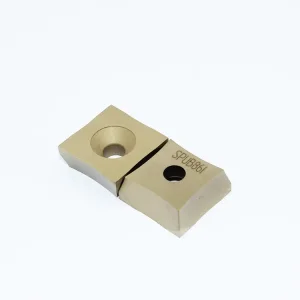
| YG8 / K30 | ISO K20–K30 | 8.0% Co | 14.60–14.80 | 89.5–90.5 | ≥ 2600 | Rotary drill bits, tube scarfing inserts (SPUB86, SDUW), concrete cutters |
| YG11C / P40 | ISO P30–P40 | 11.0% Co | 14.30–14.50 | 87.0–88.5 | ≥ 2900 | Percussive rock mining, tunneling shield cutters, heavy railway tamping tines |
| YG15 / G40 | ISO K40 | 15.0% Co | 13.95–14.15 | 87.0–88.0 | ≥ 3100 | Stamping punches, cold header dies, heavy metal stamping forming blocks |
| YG20 / G50 | Impact Tooling | 20.0% Co | 13.45–13.70 | 85.0–86.5 | ≥ 3300 | Heavy cold extrusion dies, fast-strike stamping, thick wire drawing |
| YW2 / M20 | ISO M20 | 8.0% Co+TaC | 12.80–13.20 | 90.0–91.0 | ≥ 2400 | Alloy steel roughing, stainless steel profile scarfing, interrupted milling |
| NM-10Ni (Non-Mag) | Non-Magnetic | 10.0% Ni | 14.40–14.60 | 88.5–89.5 | ≥ 2300 | Downhole LWD/MWD drill sensors, magnetic molding cores, jewelry pins |
The Strategic Advantage of China's Jiangxi Tungsten Mining & Processing Corridor
Direct upstream integration from Ammonium Paratungstate (APT) refinement to downstream micronized finished parts provides supply security, cost predictability, and technical agility.
In volatile global industrial markets, supply chain disruptions, geopolitical export caps, and fluctuating raw material costs can derail manufacturing schedules. More than 60% of the earth's natural wolframite and scheelite reserves are concentrated in Jiangxi and adjacent Southern China provinces. Jiangxi Zhongfu Cemented Carbide Co., Ltd. is located in Nanchang, at the center of this tungsten corridor. This physical proximity provides a structural advantage for our global procurement and OEM partners.
By establishing long-term off-take relationships with major primary smelters, we process 100% virgin-grade Ammonium Paratungstate (APT) without relying on untraced secondary scrap. This maintains low levels of trace contaminants such as Arsenic (As), Sulfur (S), and Phosphorus (P) (under 10 ppm), protecting against intergranular embrittlement during sintering. Direct access to primary tungsten powder, cobalt, and nickel allows our 5,000+ m² facility to bypass multiple layers of supply chain markups, keeping our factory pricing competitive for high-volume wholesale contracts.
100% Virgin Raw Materials
Direct reduction from primary APT eliminates the thermal-shock vulnerabilities associated with secondary scrap powder, ensuring consistent metallurgical performance across every batch.
Stable Production Delivery
An in-house inventory of tungsten oxide and elemental cobalt ensures stable pricing and continuous delivery schedules during global tungsten market supply swings.
ISO 14001 Closed-Loop
Our wet-milling alcohol recovery systems and HEPA micro-filtration meet international environmental standards, preventing production pauses during local environmental inspections.
Export Reach to 20+ Countries
Direct logistics lines to Shanghai and Shenzhen ensure sea-freight departures within 48 hours of packing, serving tool distributors across North America, the EU, and Southeast Asia.
Application Scenarios Across Heavy Manufacturing Environments
Examining how specific carbide grades are deployed within high-wear operating conditions worldwide.
Weld Bead Removal & Tube Scarfing
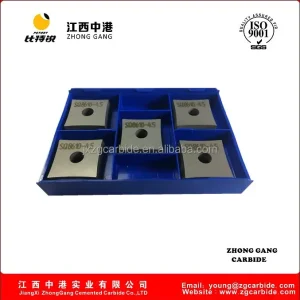
During continuous high-frequency longitudinal tube welding (ERW), flash weld beads must be planed at temperatures exceeding 800°C. Standard inserts soften rapidly, creating chip jams and dimensional drift. Our tungsten carbide tube scarfing inserts (SDUW, SPUB86, SNMX25) feature tailored TiAlN/AlTiN CVD multi-layer nanocoatings over an impact-grade YG8/YW2 matrix, sustaining continuous peeling of red-hot flash seams across carbon and stainless steel tubing.
Road Milling & Scarifier Cutters
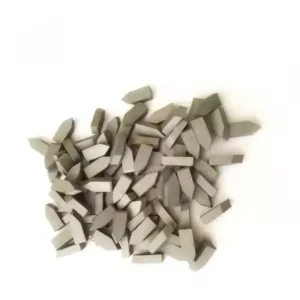
Asphalt profiling machines and concrete scarifiers encounter high-frequency, shock-loaded gouging abrasion. Tungsten carbide steel cutters equipped with brazed YG11C tips provide the necessary impact resilience. The coarse-grain microstructure slows micro-spalling under gravel impacts, extending tool service life on heavy highway maintenance runs.
Precision Non-Magnetic Micro Pins
In micro-instrumentation, automated jewelry assembly, and downhole directional drilling tools, standard cobalt-bonded carbide parts distort external electromagnetic signals. Our non-magnetic nickel-bonded carbide pins (magnetic permeability < 1.005 µr) provide high compressive strength and corrosion resistance without interfering with sensitive magnetic sensor packages.
Future Frontiers: Functionally Graded Carbides & Binderless Technologies
How our R&D laboratory is addressing the operational demands of next-generation manufacturing platforms.
Functionally Graded Cemented Carbides (FGCC)
Through controlled nitrogen atmosphere diffusion during high-pressure sintering, we produce cobalt gradient distributions within a single monolithic part. This creates a cobalt-enriched, impact-absorbing core paired with a wear-resistant, high-hardness surface layer for extreme metal-forming operations.
Binderless Nano-Carbide Matrices
By reducing metallic binders to under 0.5 wt% and utilizing Spark Plasma Sintering (SPS) kinetics, our laboratory produces pure WC components with hardness exceeding 2600 HV. These parts prevent binder-leaching corrosion across semiconductor polishing and aggressive optical glass hot-pressing applications.
Next-Generation CVD Diamond & HiPIMS
Integrating High-Power Impulse Magnetron Sputtering (HiPIMS) and multi-layer CVD diamond reactors directly onto pre-treated carbide substrates. The result is smooth, low-friction coatings with adhesion ratings beyond HF1, designed for dry machining carbon-fiber reinforced polymers (CFRP) and titanium aerospace alloys.
Full Traceability from Wet Ball-Milling to Final Metrology Inspection
Our testing framework guarantees that dimensional tolerances and metallurgical compositions match your exact engineering drawings.
Metallographic Microstructure
Polished cross-sections are evaluated under 1000x digital metallographic microscopes to verify uniform WC grain boundary distribution and verify that porosity meets ISO A02-B00 criteria.
Coercivity & Magnetic Saturation
Every batch undergoes non-destructive magnetic coercivity (Hc) and saturation (4πσ) verification to confirm correct carbon balance and eliminate free graphite and brittle eta phases.
RoHS, REACH & Conflict-Free
Materials comply fully with EU RoHS, REACH, and Dodd-Frank Conflict Minerals regulations (RMAP conformant), supported by transparent supply chain audits and material declarations.
Laser Metrology & CMM Check
Equipped with non-contact laser micrometer arrays and multi-axis Zeiss coordinate measuring machines to verify ground rod runout (h6), edge profiles, and flat plate parallelism.
Frequently Answered Questions for Overseas Buyers
Key technical and commercial considerations for purchasing direct from a Chinese tungsten carbide manufacturer.
Consistency is maintained by standardizing our raw material stream through long-term partnerships with primary APT smelters in Jiangxi, using automated ball-milling cycles with precise alcohol-to-powder ratios, and applying computer-monitored Sinter-HIP cycles. We log density, coercive force, magnetic saturation, and HRA hardness for every production run, cross-verifying them against customer-approved control samples.
Yes. Custom manufacturing accounts for roughly 70% of our production volume. When you supply 2D (DWG/PDF) or 3D (STEP/IGES) CAD models along with working condition details (e.g., cutting speeds, operational impact, cooling media, contact materials), our metallurgical team will recommend an optimal grade—such as YG6X, YG8, or YG15—or engineer a custom powder blend to balance hardness and fracture toughness.
Standard cemented carbide uses elemental cobalt as its binder phase. Because cobalt is ferromagnetic, parts will attract ferrous particles and interfere with magnetic fields. Non-magnetic carbide replaces cobalt with a nickel-chromium solid solution, producing an austenitic matrix with a relative magnetic permeability below 1.005 µr. This is essential for downhole MWD/LWD drilling electronics, magnetic sensor housings, and specialty jewelry pins.
For solid and coolant-hole round rods, our precision centerless grinding lines reliably maintain ISO h6 tolerance (+0 / -0.008 mm for Ø3–Ø18 mm) with surface roughness down to Ra 0.2 µm. For wire-cut and surface-ground carbide plates, we achieve flatness and parallelism within ±0.005 mm across working faces up to 300 mm.
For standard stock blanks (such as unground rods and basic plates), dispatch can occur within 48 to 72 hours. Custom molded blanks requiring newly built CNC tooling typically ship within 12 to 16 calendar days. High-volume repeat orders (multi-ton shipments of scarfing inserts, brazed tips, or ground bars) are usually fulfilled within 25 to 30 days, supported by scheduled sea or air-express delivery.
Industrial Indexable Inserts, Scarfing Tips & Gripper Assemblies
Engineered for high-shear steel mill scarfing lines, precision CNC turning operations, and aggressive aggregate milling.