Sintered Alloy Inventory
High-Precision Tungsten Carbide & Alloy Tooling
Direct-from-factory sintered blanks, micro-grain alloy cutting components, and high-strength metalworking solutions engineered under ISO-certified metallurgy lines.





Industrial Metallurgy Report
Global Commercial Status: The Industrial Strategic Value of Refractory Alloys
Modern heavy industry relies fundamentally on refractory alloys, cemented carbides, and tungsten-based metal matrix composites to withstand extreme mechanical friction, severe thermal loads, and highly corrosive wear profiles.
Refractory Metal Supply Chain Security
Tungsten (W), Cobalt (Co), and Nickel (Ni) remain irreplaceable across the global list of high-hardness alloys. With high density, extreme melting thresholds (over 3400°C for pure tungsten), and low thermal expansion coefficients, these materials drive downhole energy extraction, semiconductor manufacturing, and aerospace flight surfaces.
Sinter-HIP Metallurgical Integrity
Standard vacuum sintering often leaves microporosities that compromise tensile failure thresholds. High-tier industrial components leverage Hot Isostatic Pressing (Sinter-HIP) at 100+ bar pressure, eliminating internal micro-voids, increasing transverse rupture strength (TRS), and standardizing Rockwell hardness across multi-ton production lots.
Total Cost of Ownership (TCO) Optimization
Modern machine shops and mill operators are shifting from tracking raw consumable purchase cost to measuring downtime reduction. Cemented alloy inserts (e.g., SPUB/SNMX series) deliver extended edge life and consistent thermal conductivity, cutting spindle idle times, tooling setup variations, and emergency tool-failure outages.
Metallurgical Classification
Comprehensive List of Cemented Carbide & Hardmetal Alloys
Binder ratios, physical grain sizing, and structural properties for custom manufacturing and drawing-specific optimization.
| Alloy Grade Class | Binder Element (%) | Density (g/cm³) | Hardness (HRA / HV) | Transverse Rupture (MPa) | Target Industrial Use-Case |
|---|---|---|---|---|---|
| YG6 / ISO K10–K20 Wear Hard | Cobalt (Co) 6.0% | 14.8 – 15.0 | 90.5 HRA | ≥ 1900 | Precision cast iron machining, high-wear drawing dies, finishing inserts, non-ferrous alloy turning. |
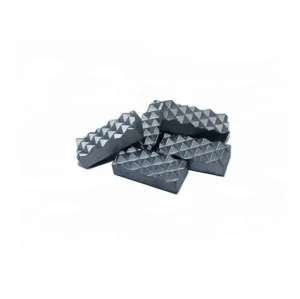
| YG8 / ISO K20–K30 General Workhorse | Cobalt (Co) 8.0% | 14.6 – 14.8 | 89.5 HRA | ≥ 2200 | Brazed cutting tips, rotary rock drill bits, torque chuck grippers, wood planning blades, pipe scarfing. |
| YG15 / ISO K40 Impact Proof | Cobalt (Co) 15.0% | 13.9 – 14.1 | 87.0 HRA | ≥ 2800 | Cold heading dies, progressive stamping punches, structural trimming tools, extreme impact forming dies. |
| YG20 / Heavy Shock High Ductility | Cobalt (Co) 20.0% | 13.4 – 13.6 | 85.5 HRA | ≥ 3100 | High-tonnage stamping, fastener forging dies, heavy wire drawing, thick-section EDM wear blocks. |
| Nickel-Bonded (Ni) Non-Magnetic | Nickel (Ni) 6–12% | 14.4 – 14.9 | 88.0 – 90.0 HRA | ≥ 1800 | MWD/LWD oilfield logging tools, jewelry extrusion, magnetic powder compaction molds, corrosive media. |
| Sub-Micron Ultra-Fine High Surface Finish | Cobalt (Co) 10–12% | 14.2 – 14.5 | 91.5 – 92.5 HRA | ≥ 3600 | Solid round rods for high-speed CNC end mills, PCB micro-drills, medical surgical tooling, titanium routing. |
Manufacturing Infrastructure
China Factory Efficiency & Upstream Tungsten Integration
Jiangxi Zhongfu operates directly within the primary global tungsten corridor in Nanchang, Jiangxi, combining raw mineral access with full metallurgical execution.
100% Virgin Raw Materials
Zero recycled black powder contamination. By sourcing pure Ammonium Paratungstate (APT) and metallurgical virgin tungsten powder, we maintain crystalline purity, eliminating structural inclusions that cause sudden tooling micro-fractures.
Full-Chain Powder Metallurgy
From ball milling, spray drying, and multi-axis hydraulic pressing to vacuum sinter-HIP and precision CNC profile grinding. In-house control ensures traceability from metallurgical grain batch to finished h6 ground tolerance.
Sub-8-Hour Engineering Turnaround
Our veteran application team reviews complex CAD drawings (.DWG, .DXF, .STEP), advises on optimal grain selection and draft angles, and calculates exact shrinkage parameters within an 8-hour communication window.
Complete Quality Assurance (QA)
Every production heat undergoes density measurement via Archimedes’ principle, coercive force (Hc) testing, saturation magnetization, and optical metallographic checks to verify void-free carbide microstructures.
Heavy Industry Deployment
Localized Application Scenarios & Working Conditions
How our specialized alloy compositions and precision-ground shapes operate across mission-critical field operations globally.
Tube & Pipe Scarfing Inserts
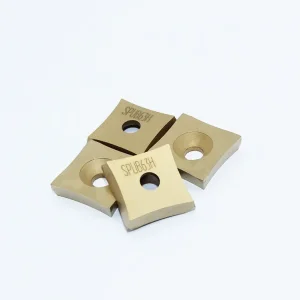
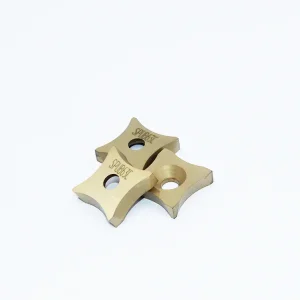
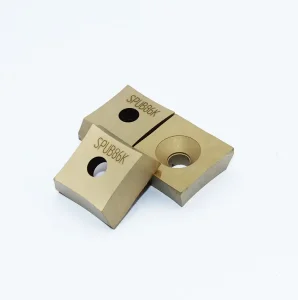
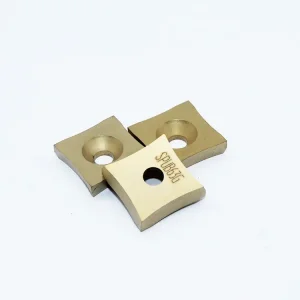
Deployed in automated ERW pipe mills. Heavy-duty alloy inserts (such as SPUB-63, SPUB86, SNMX19, SNMX25) operate under extreme thermal conditions, shaving hot weld flash and longitudinal bead remnants along high-strength API-grade steel lines with zero chipping.
Directional Drilling & Non-Magnetic MWD
Downhole directional tools demand zero electromagnetic interference with survey instrumentation. Our nickel-bonded non-magnetic tungsten carbide parts provide wear and erosion protection for sub-mud impellers, sleeves, and pulse telemetry housings without distorting azimuth sensors.
High-Precision EDM & Stamping Dies
YG15 and YG20 metallurgical flat plates, blocks (100×100×60 mm), and ground blanks provide uniform density free from grain boundary pooling. This ensures clean, burr-free cuts during wire Electrical Discharge Machining (EDM) for silicone steel laminations and micro-fastener stamping.
Market Trajectory
Industry Trends & International Procurement Priorities
Analyzing the metallurgical shifts and commercial demands guiding alloy factory selection through 2026 and beyond.
Grain Boundary Refinement
Demand is shifting toward sub-micron and nano-grain alloy structures (0.2–0.5 µm). Incorporating tantalum carbide (TaC) and vanadium carbide (VC) grain growth inhibitors preserves structural micro-hardness at high spindle friction without sacrificing flexural toughness.
Supply Chain Resiliency & Direct Sourcing
Procurement teams in North America, Europe, and Australasia are bypassing trading intermediaries. Direct agreements with primary sintering manufacturers ensure transparent metallurgy certificates, custom tolerances, and stable pricing unaffected by middle-tier distributor markups.
PVD & CVD Advanced Barrier Coatings
Uncoated cemented carbide blanks are increasingly paired with multi-layer AlTiN, TiAlSiN, and Diamond-Like Carbon (DLC) physical vapor depositions. These barrier coatings handle dry machining of hardened steels, inconel, and titanium alloys at elevated interface temperatures.
Engineering Helpdesk
Frequently Asked Questions: Alloys & Custom Sintering
Answers to common technical queries regarding metallurgical formulation, tolerances, and custom ordering protocols.
Can Zhongfu manufacture custom alloy components from customer drawings?
Yes. Custom sintered parts represent our primary manufacturing stream. We process 2D/3D engineering drawings (.DWG, .DXF, .STEP), analyze application loads, and optimize powder recipes (cobalt/nickel ratio and grain size) to balance wear resistance, thermal dissipation, and fracture toughness.
How does cobalt content influence cemented carbide performance?
Cobalt acts as the ductile binder phase holding tungsten carbide grains together. Lower cobalt content (e.g., YG6 with 6% Co) yields maximum hardness and abrasive wear life, while higher cobalt (e.g., YG15 or YG20 with 15–20% Co) increases impact resistance for heavy stamping and forging dies.
Why select a nickel binder over cobalt for non-magnetic components?
Cobalt is ferromagnetic, generating magnetic interference that disrupts sensitive instrumentation. A nickel binder matrix ensures the carbide remains non-magnetic (µ < 1.005), making it suitable for MWD downhole logging tools, semiconductor handling, and corrosive chemical environments.
What grinding tolerances are achievable on solid carbide rods and blanks?
Our centerless and CNC optical profile grinding systems achieve h6 dimensional tolerances on solid carbide rods (e.g., ±0.004 mm on Ø6 to Ø10 mm rods), with surface roughness down to Ra 0.05 µm for high-speed milling and drilling tool fabrication.
What is the standard turnaround time for technical inquiries and custom quotes?
Our engineering team reviews drawings and delivers manufacturability feedback, grade recommendations, and volume-tiered quotes within 8 hours across standard international business timezones.
Which geographic export markets do you currently supply?
We export to industrial buyers across more than 20 countries, including the United States, Germany, Canada, Mexico, Australia, Japan, and Italy, supporting sea, air, and expedited international courier logistics.
Extended Alloy Catalog
Heavy-Duty Tooling, Peeling & Scarfing Inserts
Industrial-grade turning, tube scarfing, and bar-peeling inserts manufactured from sintered tungsten alloy blanks for high-throughput production lines.