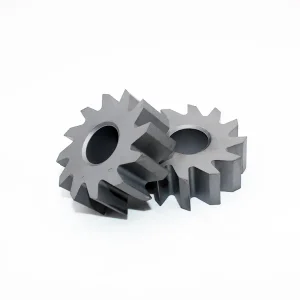
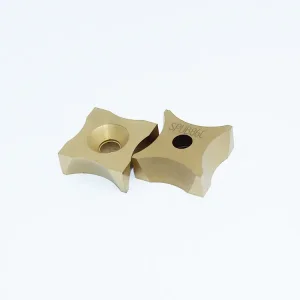
High-Precision Carbide Tooling & Inserts (Series I)
Direct supply from Jiangxi Zhongfu Cemented Carbide Co., Ltd. Standardized ISO blanks, profile threading tips, and wear tooling engineered from 100% virgin tungsten powders.





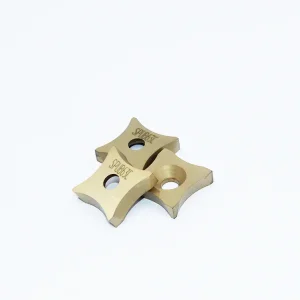

Macro Dynamics & The Evolution of Precision Thread Turning
How advanced metallurgy, digital twin simulation, and high-feed threading geometries are redefining productivity benchmarks across the precision tooling value chain.
Ultra-Fine Grain Microstructures
The modern manufacturing frontier has shifted toward sub-micron and nano-grain (0.2–0.5 μm) WC substrates. These offer superior edge toughness, resisting plastic deformation during high-speed threading of hard-to-machine alloys like Inconel 718 and Titanium Grade 5.
Next-Gen CVD / PVD Barrier Coatings
Application of nanolayered AlTiN, AlCrN, and CVD diamond coatings guarantees high oxidation stability up to 1100°C. Controlled residual compressive stress reduces micro-chipping along the crest profile during continuous high-stress thread passes.
Optimized Chip Control Topography
Computer-modeled 3D chipbreakers allow flawless chip curl and evacuation even under low-feed finishing passes, eliminating bird's nesting, workpiece re-cutting, and catastrophic insert failure during unmanned CNC operations.
Supply Chain Resilience & Metallurgical Superiority
How Jiangxi Zhongfu leverages upstream material integration in Nanchang, intelligent manufacturing, and rigorous quality loops to support procurement teams across 20+ countries.
Raw Material Security
Situated in Jiangxi, the global hub of tungsten reserves, Zhongfu eliminates supply chain volatility. Our directly controlled raw powder blending guarantees batch-to-batch chemical stability without reliance on recycled scrap materials.
Pressure Sinter-HIP
Equipped with computerized high-pressure sintering furnaces operating under 60–100 bar inert gas atmosphere, we eliminate residual internal micropores, delivering 100% metallurgical theoretical density and unmatched rupture strength.
Multi-Axis Precision CNC
Utilizing high-precision multi-axis periphery grinding suites, our inserts maintain profile tolerance limits within ±0.005 mm (class E and M standards), ensuring pitch accuracy across API, UN, Metric, and Whitworth forms.
Full Metallographic QC
Every shipment is cleared through metallographic microscopic analysis, eddy current defect detection, magnetic saturation testing, and coercivity screening, providing global buyers with total traceability.
Engineering Grade Matrix: Cemented Carbide Formulation
Selecting the optimal balance between cobalt/nickel binder ratio and carbide grain sizing for specific cutting dynamics, impact resistance, and chemical wear.
| Grade Category | Cobalt / Binder (%) | Density (g/cm³) | Hardness (HRA) | Transverse Rupture (TRS) | Typical Industrial Target Application |
|---|---|---|---|---|---|
| YG6 (ISO K10–K20) | 6.0% Co | 14.80 – 15.00 | 90.5 – 91.5 | > 2200 N/mm² | Chilled cast iron, non-ferrous metals, precision threading, finishing wear plates. |
| YG8 (ISO K20–K30) | 8.0% Co | 14.60 – 14.80 | 89.5 – 90.5 | > 2600 N/mm² | General lathe tooling, brazed tips, heavy thread roughing, geological rock drilling. |
| YG15 (ISO K40) | 15.0% Co | 13.90 – 14.10 | 87.0 – 88.0 | > 3100 N/mm² | Cold heading dies, stamping tools, heavy interrupted-cut machining, shear blades. |
| YG20 (High-Impact) | 20.0% Co | 13.40 – 13.60 | 85.0 – 86.5 | > 3400 N/mm² | Forging dies, high-shock forming punches, deep drawing punches, thick EDM blocks. |
| Non-Magnetic Ni-Binder | Ni-Based Matrix | 14.50 – 14.90 | 88.0 – 90.0 | > 2400 N/mm² | MWD / LWD downhole sensors, semiconductor tooling, chemical mechanical seals. |
Mission-Critical Global Industrial Deployments
Demonstrating robust tool life, vibration dampening, and profile integrity in challenging operational environments worldwide.
OCTG & Oilfield Connections
Machining API Buttress, Premium, and Extreme-Line rotary-shouldered threaded connections in L80, P110, and 13Cr casing/tubing. High resistance against notch wear ensures airtight fluid and gas sealing in downhole environments.
Aerospace & Defense Propulsion
Threading titanium airframe fasteners, nickel superalloy turbine driveshafts, and high-tensile landing gear assemblies. Our controlled cutting edge radius (ER treatment) maintains surface roughness down to Ra 0.4 μm.
Automotive Powertrain & EV
High-volume internal and external threading for crankshafts, steering ball screws, planetary transmission assemblies, and lightweight electric vehicle drive components with continuous multi-pass stability.
Frequently Asked Questions for B2B Procurement
Addressing engineering inquiries, tolerances, grade selection, and export supply chain protocols.
How do full-profile threading inserts compare to partial-profile versions?
Full-profile threading inserts machine both the thread flank and crest simultaneously in a single operation, ensuring complete burr-free crest formation and correct pitch-diameter relationships without requiring secondary finishing passes. Partial-profile inserts offer pitch versatility across various leads but require separate turning of the root and crest diameters.
What cutting parameters are recommended to prevent insert chipping?
Insert chipping is usually caused by excessive infeed on the final pass, tool centerline misalignment, or micro-vibrations. We advise a modified flank infeed (1–3° angle) instead of radial plunge infeed, an optimal peripheral cutting speed tailored to the substrate (e.g., 80–140 m/min for P20–P30 steel grades), and ensuring total tool overhang remains below a 3:1 length-to-diameter ratio.
Can Zhongfu manufacture custom profile threading inserts from proprietary CAD prints?
Yes. Custom tooling and specialized profile geometry development represent a major portion of our OEM business. By supplying 2D (.dwg/.dxf) or 3D step files along with target workpiece material hardness, our tooling engineering department reviews geometries, simulates tool clearance, and produces precision CNC ground prototypes within 10–14 business days.
Why is HIP sintering critical for cemented carbide wear life?
Hot Isostatic Pressing (HIP) sintering combines extreme thermal exposure with uniform high-pressure inert argon gas. This closes internal microscopic voids, prevents porosity-induced micro-fractures under high impact loads, elevates transverse rupture strength by 15–25%, and ensures consistent performance across high-volume production batches.
What quality documentation and testing reports are supplied with overseas shipments?
Every commercial consignment includes complete Certificate of Analysis (CoA) documentation containing optical micrograph inspections, Vickers/Rockwell hardness verification, density calculations, coercivity (Hc), magnetic saturation (4πσ), and dimensional inspection reports confirming compliance with agreed engineering drawings.
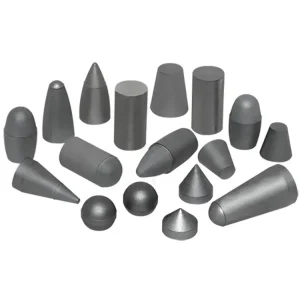
Precision Scarfing, Turning & Wear Solutions (Series II)
Explore heavy-duty scarfing inserts, diamond-edge turning tools, and custom cemented carbide geometries manufactured for severe industrial wear environments.