High-Performance Extrusion & Machining Tooling Catalog
Explore precision-ground cemented carbide bar peeling tools, tube scarfing inserts, and high-impact wear components built for demanding industrial metal extrusion processes.





Engineering Physics & Tribology of Heavy-Duty Extrusion Tooling
A rigorous examination of powder metallurgical densification, microstructural grain boundaries, and high-stress deformation kinetics in advanced extrusion assemblies.
The Rheology of Metal Flow & Extreme Die Wear Dynamics
In modern industrial extrusion operations—spanning hot direct extrusion of copper, precision aluminum architectural profiles, cold backward extrusion of automotive transmission gears, and continuous welded tube deburring—the tooling core is subjected to destructive physical regimes. Tooling faces severe cyclic thermo-mechanical shocks, extreme compressive pressures exceeding 2,500 MPa, and intensive interfacial tribological shear. When standard high-speed steels (HSS) or basic tool steels (like H13 or D2) reach their mechanical plastic deformation limits at elevated temperatures, tungsten cemented carbide extrusion tooling solutions stand as the definitive metallurgical barrier against premature failure.
Jiangxi Zhongfu Cemented Carbide Co., Ltd. addresses these tribological challenges through formulation-driven powder synthesis. Utilizing only 100% virgin sub-micron tungsten carbide (WC) grain sizes combined with tightly calibrated cobalt (Co) and nickel (Ni) binding matrices, our extrusion tooling blanks, sizing dies, mandrels, and scarfing blades maintain extreme hardness (85.5 to 92.5 HRA) without compromising transverse rupture strength (TRS ≥ 2,800 N/mm²). This fundamental microstructure minimizes catastrophic adhesive galling, chemical interdiffusion, and mechanical edge spalling during heavy continuous extrusion cycles.
Sinter-HIP Densification: Eliminating Structural Micro-Defects
The life expectancy of an extrusion die or scarfing tip correlates inversely with internal porosity. Under conventional atmospheric vacuum sintering, micron-scale voids (A04/B02 porosity ratings) act as critical stress concentrators, catalyzing micro-crack initiation along the cobalt binder pathways. In contrast, Zhongfu executes all extrusion tooling sintering within ultra-modern Sinter-HIP furnaces operating at 1,420°C under high-purity argon pressures up to 6 MPa (60 bar).
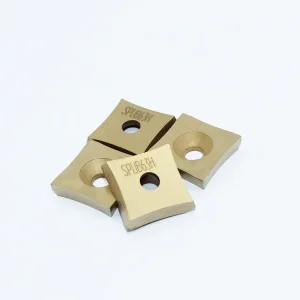
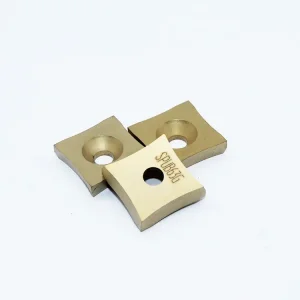
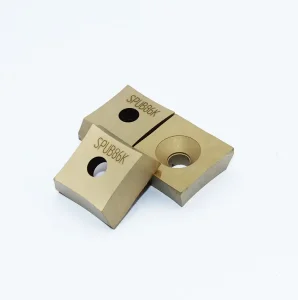
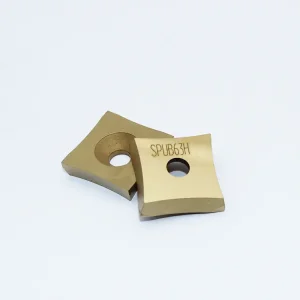
This thermodynamic overpressure eliminates micro-voids, elevating material theoretical density to 99.98% (A02/B00 rating). Consequently, tooling exhibits unprecedented resistance to subsurface fatigue propagation when repeatedly impacted by cold billet upsetting or fluctuating draw loads. When coupled with CVD multi-layered titanium carbonitride (TiCN) and aluminum oxide (Al&sub2;O&sub3;) nanocoatings, our wear-resistant SPUB86 and SPUB63 series scarfing inserts achieve 3.8-fold improvements in operational lifespan when peeling scale and flashing from welded line pipes.
Localized Application Scenarios & Tailored Engineering
Deploying specialized extrusion tooling assemblies across primary industrial clusters in North America, Europe, East Asia, and the Global South.
Continuous ERW Pipe Scarfing & Deburring
Applied extensively across North American and European line-pipe manufacturers. Our SPUB86 and SNMX heavy-duty scarfing inserts remove interior and exterior longitudinal weld beads at line speeds up to 120 m/min. Custom CVD-coated P40 and K20-K30 tungsten substrates deliver high thermal shock resilience against residual welding arcs, preventing edge chipping and minimizing pipe ovality defects.
Automotive Precision Cold Backward Extrusion
Tailored for German, Mexican, and Japanese tier-one automotive plants producing transmission pinions, CV joints, and EV motor shafts. Utilizing high-cobalt impact grades (YG15 and YG20), our cold heading punches and extrusion dies resist bursting pressures up to 3,000 MPa, delivering precise dimensional repeatabilities within ±0.003 mm over production runs surpassing 250,000 strikes.
Non-Ferrous Wire, Rod & Tube Drawing Mandrels
Engineered for copper refrigeration tube and brass extrusion lines. Our ultra-fine grain sintered carbide drawing dies and floating mandrels maintain a Ra 0.05 μm mirror finish, suppressing metal pickup and micro-galling. The result is superior surface luster and strict wall thickness tolerances across millions of linear meters of drawn tubing.
Railway Track Infrastructure & Ballast Tooling
Formulated for high-impact track ballast maintenance in Australia, the US, and East Asia. Zhongfu brazed carbide tips for tamping tines and track levelers utilize coarse-grained WC combined with high-toughness binder architectures. They endure severe repetitive stone impacts and abrasion, outlasting conventional induction-hardened forged steel tines by more than 400%.
Severe Wear Roll Crushing & Pelletizing
Specialized for mineral processing, cement clinker grinding, and lithium-ion battery cathode material roll compaction. High-hardness carbide segments and studs provide exceptional compressive strength and tribological resistance under extreme high-pressure grinding roll (HPGR) operating conditions, ensuring uniform particle sizing.
Non-Magnetic Petrochemical & Sensor Enclosures
Engineered for downhole Measurement-While-Drilling (MWD/LWD) geophysical instruments and magnetic stamping dies. Utilizing a pure nickel (Ni) non-ferromagnetic binder matrix instead of cobalt, these components remain chemically inert in corrosive saline media while preserving absolute non-magnetic neutrality (μ&sub1; ≤ 1.005).
Chinese Manufacturing Velocity & Supply Chain Resilience
Unlocking measurable total-cost-of-ownership (TCO) advantages through geographic raw material proximity, vertical powder integration, and rapid OEM customization.
Vertical Integration at the Tungsten Source
Jiangxi Province represents the geographic epicenter of global tungsten reserves (scheelite and wolframite). Located directly in Nanchang, Jiangxi Zhongfu controls the entire manufacturing journey from primary ammonium paratungstate (APT) reduction and carburization to ball-milling, spray drying, and sintering. This proximity insulates our production pipeline from global geopolitical raw material shocks, pricing volatility, and international logistics bottlenecks.
By producing our own spray-dried ready-to-press (RTP) carbide granules, our metallurgists fine-tune carbon stoichiometry and crystal growth inhibitors (VC, Cr&sub3;C&sub2;) directly in-house. This degree of control yields unprecedented grain size uniformity across every batch of extrusion dies, mandrels, and scarfing blades delivered overseas.
Agile Prototyping & Rapid Scalability
Unlike Western tooling vendors constrained by high overheads and 12-to-16 week delivery lead times for specialized extrusion profiles, Zhongfu operates an agile manufacturing infrastructure. Our technical engineering division reviews custom 2D/3D component drawings and provides complete DFM (Design for Manufacturability) assessments with customized grade recommendations within 8 hours.
With an array of automatic hydraulic presses, cold isostatic pressing (CIP) vessels for oversized blocks, and high-speed multi-axis EDM wire cut systems, custom prototypes transition to full volume production within 15 to 20 business days. This agility shortens qualification timelines and mitigates downtime risks for multinational procurement departments.
Extrusion Tooling Technology Roadmap (2025–2035)
Strategic R&D pathways advancing nanostructured composite materials, multi-layer reactive coatings, and computational finite element flow mechanics.
Nano-Grain WC & Functional Gradient Binders
- Commercial rollout of 0.2 μm nano-grain cemented carbide rods and dies for micro-extrusion applications.
- Functional gradient sintering establishing tough, crack-arresting cobalt-rich cores combined with ultra-hard, wear-resistant cobalt-depleted die surfaces.
- Adoption of AlCrN and AlTiSiN advanced PVD physical vapor arc coatings for high-temperature aluminum profile tooling.
Conformal Cooling & Hybrid Additive Tooling
- Binder jet 3D printing of complex tungsten carbide preforms featuring internal optimized conformal cooling galleries.
- Laser directed energy deposition (DED) hardfacing of severe-wear lead zones on multi-ton extrusion rams.
- Substantially reduced thermal cycle times and enhanced extrusion ram velocities via computational internal fluid mechanics.
AI-Driven In-Die Sensing & CVD Diamond Surfaces
- Integration of embedded thin-film micro-thermocouple and acoustic emission piezoresistive wear sensors within carbide die lands.
- Growth of continuous polycrystalline CVD diamond (PCD) micron films on internal die orifices for zero-lubricant extrusion.
- Real-time autonomous closed-loop extrusion press feedback and predictive maintenance alerting prior to tooling failure.
Comprehensive Compliance & Micron-Level Quality Control
Ensuring cross-border industrial reliability through standardized metallographic inspection, ultrasonic non-destructive testing, and multi-axis CMM verification.
Metallographic Grain & Porosity Audits
Every sintered production batch undergoes metallurgical cross-sectioning and optical microscopic analysis at 1,500x magnification. Sintered blanks are certified to meet ASTM B276 porosity standards (A02, B00, C00) and ASTM B390 grain size standards, verifying complete absence of uncombined free carbon or brittle eta-phase (Co&sub3;W&sub3;C) complexes.
Zeiss 3D Coordinate Metrology (CMM)
Critical extrusion die orifices, bearing land lengths, draw angles, and insert locator pockets are inspected utilizing Zeiss CNC 3D coordinate measuring machines. With a linear measuring accuracy of 0.9 μm + L/350, our engineering team supplies complete dimensional inspection reports, including full GD&T verification, alongside every export shipment.
International Regulatory Compliance
Zhongfu maintains full ISO 9001:2015 Quality Management System and ISO 14001:2015 Environmental System accreditations. All tungsten cemented carbide formulations comply with EU RoHS and REACH environmental guidelines. Consignments are packed within vacuum-sealed moisture-barrier films and heavy export-grade wooden crating to guarantee zero transit oxidation.
Frequently Asked Questions on Extrusion Tooling Solutions
Authoritative technical guidance compiled by Zhongfu senior metallurgical engineers for tooling designers, manufacturing directors, and supply chain managers.
Cold heading punches and backward cold extrusion tools experience intense cyclical impact forces and significant tensile hoop stresses. These require medium-to-coarse grain carbide grades with elevated cobalt contents (15% to 20% Co, such as YG15 or YG20) to maximize transverse rupture strength (TRS ≥ 3,000 N/mm²) and prevent shock shattering. Conversely, hot extrusion dies and sizing inserts require maximum hot hardness, thermal conductivity, and resistance to plastic deformation under continuous thermal loads. For such applications, fine-to-medium grain compositions with low-to-medium cobalt (6% to 10% Co, such as YG6 or YG8) provide optimal thermal stability and wear resistance.
Standard atmospheric vacuum sintering frequently leaves minute residual micro-pores in the tungsten-cobalt matrix. In high-speed ERW tube scarfing, inserts encounter continuous severe mechanical chatter and thermal cycling from red-hot weld beads. Micro-voids serve as focal points for thermal micro-cracking and chipping along the cutting edge. Sinter-HIP processing applies high isostatic pressure (up to 60 bar) of pure argon at the sintering phase, completely collapsing and consolidating voids. This raises theoretical density to 99.98%, drastically enhancing the insert's edge toughness and delaying chipping or catastrophic breakage.
Cobalt is naturally ferromagnetic. When used in applications involving intense magnetic fields—such as magnetic core powder compaction dies, sensor component sizing sleeves, or downhole Measurement-While-Drilling (MWD) housings—cobalt-bonded carbide causes significant magnetic interference and picks up abrasive ferritic dust. By replacing cobalt with a specialized nickel-chromium (Ni-Cr) binder formulation, Zhongfu produces non-magnetic carbide components featuring relative magnetic permeability (μ&sub1;) below 1.005, while simultaneously enhancing electrochemical corrosion resistance in humid, acidic, or saline operating environments.
Yes. More than 70% of our production volume comprises custom-engineered OEM wear solutions. We accept CAD models in STEP, IGES, DXF, or DWG formats. Our technical engineering division performs full DFM reviews, evaluating draft angles, transition radiuses, and powder shrinkage factors (typically 18% to 22% during sintering). We advise on critical dimensional tolerances and surface finishes, executing precision multi-axis CNC profile grinding, Wire EDM, and diamond lap polishing down to ±0.002 mm.
Each export shipment is accompanied by a formal 3.1 Inspection Certificate (EN 10204) detailing chemical composition, exact density (g/cm³), hardness (HRA), and transverse rupture strength (TRS). In addition, customers receive full metallographic microstructural analysis reports verifying porosity class (ASTM B276), CMM dimensional inspection protocols, Certificate of Origin (CO), and formal RoHS/REACH environmental compliance declarations.
Precision Extrusion, Milling & Forming Carbide Solutions
Browse our extensive selection of CNC turning inserts, CVD-coated tube scarfing cutters, cold heading mold inserts, and heavy-duty milling tips.